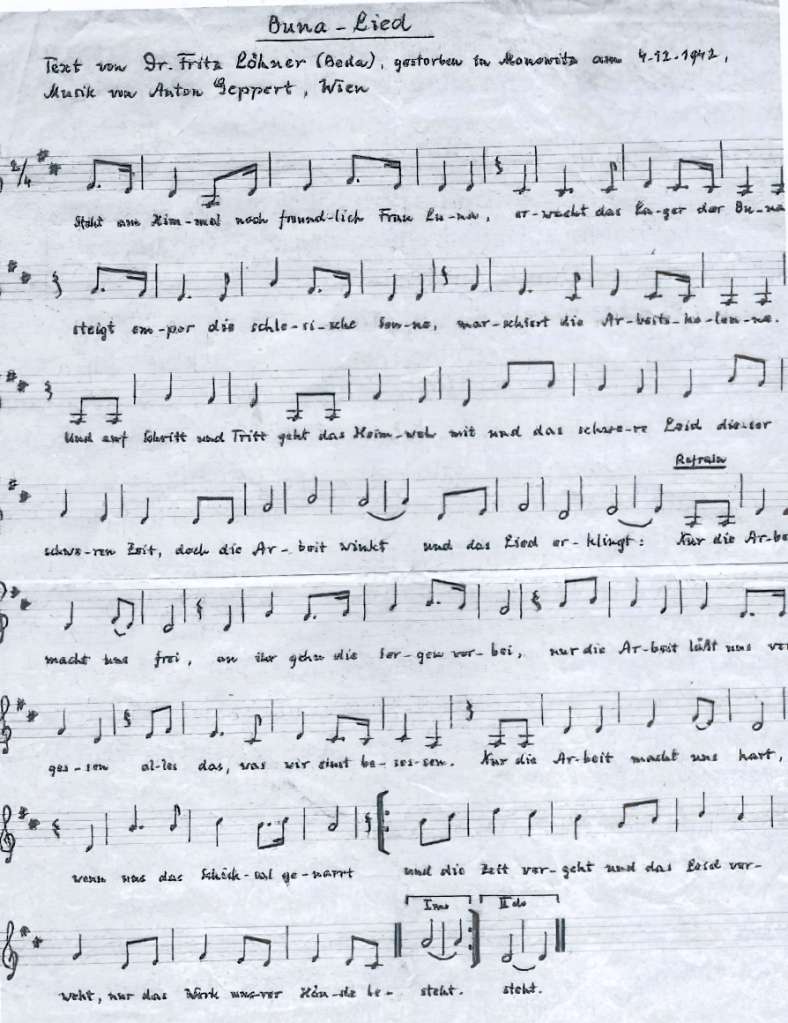
The Bunalied, or “Song of Buna,” stands as a harrowing testament to the resilience and creativity of individuals subjected to unimaginable suffering during the Holocaust. Composed in the Buna-Monowitz subcamp of Auschwitz in 1942, the song poignantly reflects the daily struggles of prisoners and their unyielding will to retain their humanity amidst inhuman conditions. This essay delves into the Bunalied‘s origins, themes, and legacy, shedding light on its role as both an artistic expression and a historical artifact.
Historical Context
The Buna-Monowitz Concentration Camp, part of the Auschwitz complex, was established to support the labor demands of IG Farben, a German chemical company. Prisoners were forced into grueling labor, constructing and operating facilities for the production of synthetic rubber and fuel. Conditions were brutal: malnutrition, disease, and the constant threat of violence characterized daily life. It was within this environment that the Bunalied was born.
The lyrics were penned by Fritz Löhner-Beda, an Austrian librettist and songwriter of Jewish descent. Born Friedrich Löwy in 1883, Löhner-Beda was already an accomplished artist before his arrest by the Gestapo in 1938. Alongside Anton Geppert, a fellow prisoner who composed the melody, Löhner-Beda created the Bunalied as a means of processing and resisting the dehumanization of camp life. Tragically, Löhner-Beda was murdered in Auschwitz on December 4, 1942, leaving behind this haunting piece of cultural memory.
Themes and Significance
The Bunalied is both a documentation of suffering and a subtle act of defiance. The lyrics speak of relentless labor, encapsulating the prisoners’ daily reality. The refrain, which ironically echoes the phrase “Arbeit macht frei” (“Work makes you free”), illustrates the bitter sarcasm embedded in the song. Far from the liberation promised by the Nazi propaganda slogan, work in the camps led only to exhaustion and death.
Despite its grim subject matter, the Bunalied served a purpose beyond despair. It was a way for prisoners to assert their individuality and humanity in the face of systematic dehumanization. By creating and singing this song, they reclaimed a measure of agency and solidarity, reminding themselves and others that they were more than tools of labor—they were individuals with voices, histories, and dreams.
Artistic and Historical Legacy
The Bunalied occupies a unique place in the history of Holocaust music. It is not merely a lament but a form of testimony, preserving the experiences of those who endured the horrors of Buna-Monowitz. The song’s raw and direct language ensures its accessibility, making it a powerful educational tool for future generations.
The survival of the Bunalied is itself a victory against the Nazis’ attempts to erase Jewish culture. Today, it is performed and studied as part of efforts to commemorate the Holocaust and honor its victims. Recordings and analyses of the Bunalied ensure that its message resonates, reminding the world of the resilience of the human spirit.
The Bunalied is more than a song; it is a poignant narrative of suffering, resistance, and resilience. Born in the crucible of Auschwitz, it captures the dual realities of despair and hope that defined the lives of its creators. As we remember the Holocaust, the Bunalied serves as a somber reminder of the atrocities committed and a tribute to the indomitable spirit of those who endured them. Its melody and lyrics continue to echo, compelling us to reflect on the past and strive for a future free from hatred and oppression.
Lyrics
Steht am Himmel noch freundlich Frau Luna,
erwacht das Lager der Buna,
steigt empor die schlesische Sonne,
marschiert die Arbeitskolonne.
und auf Schritt und Tritt geht das Heimweh mit
und das schwere Leid dieser schweren Zeit,
doch die Arbeit winkt
und das Lied erklingt:
  Nur die Arbeit macht uns frei,
  an ihr geh’n die Sorgen vorbei,
  nur die Arbeit lässt uns vergessen
  alles das, was wir einst besessen.
  Nur die Arbeit macht uns hart,
  wenn uns das Schicksal genarrt,
  und die Zeit vergeht und das Leid verweht,
  nur das Werk unsrer Hände besteht.
If Mrs Luna still stands friendly in the sky,
the camp of Buna awakes,
the Silesian sun rises high,
the work crew marches on.
And at every turn homesickness accompanies them
and the heavy song of this heavy time,
but work waves to us
and the song resounds:
  Through work our sorrows will pass,
  only work will let us forget
  everything that we once possessed.
  Only work will make us tough,
  when fate has had the best of us,
  And when time has passed and suffering blown over,
  only the work of our hands will remain.
A prisoner, Raymond van den Straaten reported on Löhner-Beda’s death at the Nuremberg trials against IG Farben:
“One day, two Buna prisoners, Dr. Raymond van den Straaten, and Dr. Fritz Löhner-Beda went to work when a group of visitors consisting of IG Farben bigwigs came along. One of the directors pointed to Dr. Löhner-Beda and said to his SS companion: ‘This Jewish pig could work faster.’ Another IG director then remarked: ‘If they can’t work anymore, they should die in the gas chamber.’ After the inspection was over, Dr. Löhner-Beda was taken from the work detail, beaten and kicked so much that he returned to his camp friend as a dying man and died in the IG factory in Auschwitz.”
Sources
https://holocaustmusic.ort.org/places/camps/camp-anthems/bunalied/
https://holocaustmusic.ort.org/places/camps/camp-anthems/
http://www.musiques-regenerees.fr/GhettosCamps/Camps/LeopoldiHermann_Beda-LohnerFritz/BunaLied.html
http://www.wollheim-memorial.de/de/fritz_loehnerbeda_18831942
https://en.wikipedia.org/wiki/Buna_Werke_Schkopau
Please support us so we can continue our important work.
Donations
Your readership is what makes my site a success, and I am truly passionate about providing you with valuable content. I have been doing this at no cost and will continue to do so. Your voluntary donation of $2 or more, if you are able, would be a significant contribution to the continuation of my work. However, I fully understand if you’re not in a position to do so. Your support, in any form, is greatly appreciated. Thank you. To donate, click on the credit/debit card icon of the card you will use. If you want to donate more than $2, just add a higher number in the box left from the PayPal link. Your generosity is greatly appreciated. Many thanks.
$2.00

 History of Sorts
Leave a comment