
Art is a powerful tool for narrating events, and in the context of the Holocaust, it tells a profoundly moving story. For many artists, it was a means of expressing the horrors they endured daily. Though their suffering often ended in death, their art remains a lasting testimony to their pain and resilience.
Pictured above:
Jacob Lipschitz (1903–1945)
Beaten (My Brother Gedalyahu), Kovno Ghetto, 1941–1944)
Jacob Lipschitz (1903, Kovno [Kaunas] – 1945, Kaufering Camp, Bavaria) was a talented artist and educator. After graduating from the Vilnius Academy of Arts, he taught printmaking while illustrating textbooks and participating in exhibitions.
In June 1941, he, his wife Lisa, and their daughter Pepa were interned in the Kovno ghetto. Assigned to a forced labor brigade, he worked in the ghetto workshops and painted in secret at night. He later joined Esther Lurie and other artists in documenting ghetto life. Fearing Nazi Aktions, the couple smuggled Pepa out, entrusting her to the Christian Zabielavičius family.
When the ghetto was liquidated in the summer of 1944, Lipschitz was deported to Dachau and later to forced labor in the Kaufering camp. Weakened by harsh conditions, he died in March 1945. After the war, Lisa and Pepa retrieved his hidden paintings from the ghetto graveyard, preserving his artistic testimony.

Bedřich Fritta (Friedrich Taussig) (1906–1944)
Rear Entrance, Theresienstadt Ghetto, 1941–1944
Bedřich Fritta (Friedrich Taussig) (1906, Višňová, Bohemia – 1944, Auschwitz-Birkenau) was a Prague-based graphic designer and cartoonist. In December 1941, as part of the second Jewish transport, he was deported to the Theresienstadt ghetto alongside engineers, artists, and physicians tasked with establishing the ghetto.
Appointed director of the painting section in the Technical Department, Fritta created graphic prints and propaganda material for the Germans while secretly documenting the brutal realities of ghetto life through his art. Some of these clandestine works were smuggled out, but the Nazis discovered others.
In July 1944, Fritta, his wife Johanna, and their three-year-old son Tommy (Tomáš) were imprisoned in the Small Fortress within the ghetto. Three months later, he was deported to Auschwitz, where he died of exhaustion. Johanna succumbed to typhus in the ghetto, leaving Tommy as the sole survivor. After the war, he was adopted by Fritta’s friend and fellow artist Leo Haas. Around 200 of Fritta’s buried artworks were later recovered, preserving his powerful testimony.
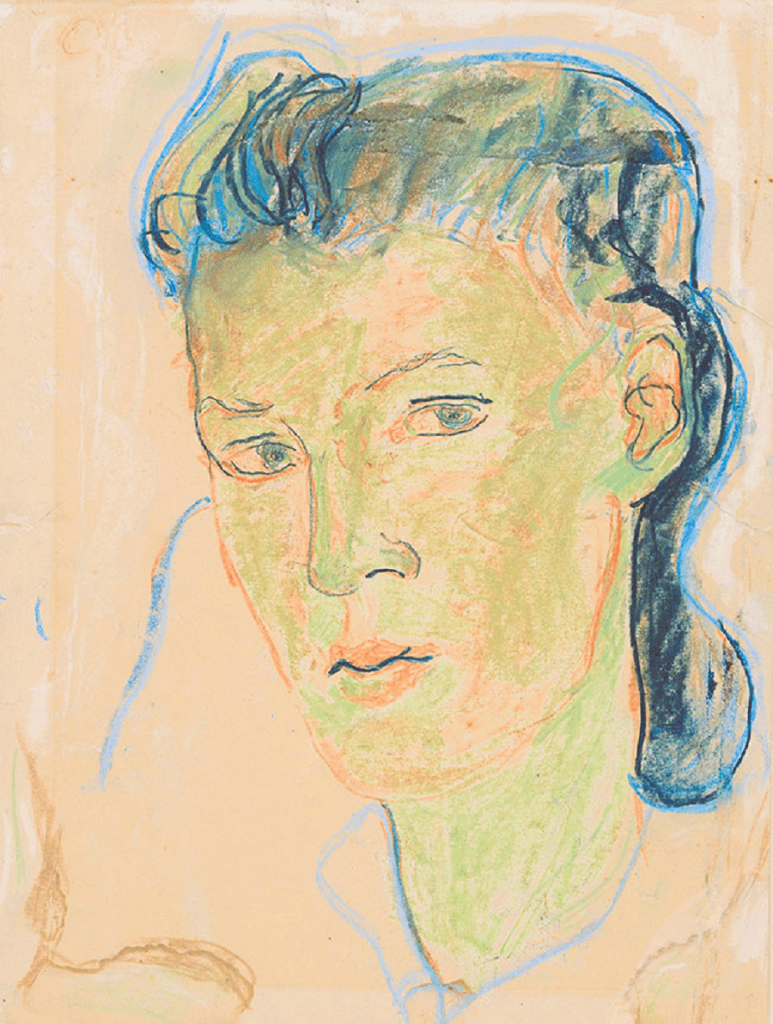
Charlotte Salomon (1917–1943)
Self-Portrait, Villefranche-sur-Mer, 1939–1941
Charlotte Salomon (1917, Berlin – 1943, Auschwitz-Birkenau) was born into an assimilated Jewish family deeply engaged in Berlin’s cultural scene. Despite growing antisemitic restrictions, she was admitted in 1935 to the Vereinigten Staatsschulen für Freie und Angewandte Kunst in Berlin.
Following the Kristallnacht pogrom on November 9, 1938, during which her father, Albert, was arrested, her parents sent her to live with her grandparents in southern France. Amid Nazi persecution, she created Life? or Theater? an autobiographical illustrated musical play consisting of more than 700 paintings.
In June 1943, she married Alexander Nagler, a fellow Jewish refugee. Both were arrested that September and sent to the Drancy transit camp. On October 7, they were deported to Auschwitz, where Salomon, pregnant at the time, was murdered upon arrival. Alexander died of exhaustion on January 1, 1944.
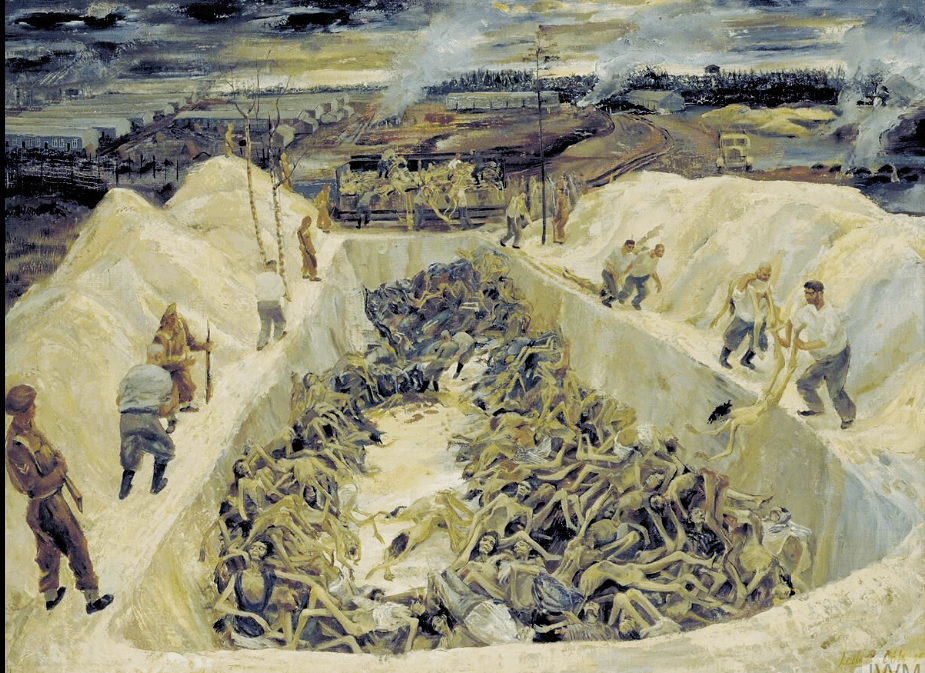
One of the Death Pits, Belsen. SS guards collecting bodies, 1945, Leslie Cole
Leslie Cole (1910–1977) trained as an artist at the Royal College of Art in London and began teaching at Hull College of Art in 1937. Determined to document the unfolding events of the Second World War, he initially faced rejection from the War Artists Advisory Committee (WAAC). Still, he later secured a salaried position as a war artist. He traveled extensively, capturing the aftermath of war in Malta, Greece, Germany, and the Far East.
Cole’s work consistently focused on human suffering, and in three oil paintings, he bore witness to the horrific conditions at Bergen-Belsen following its liberation. In “One of the Death Pits, Belsen,” he depicts former SS guards mechanically collecting and discarding corpses into mass graves as British soldiers look on. The guards appear as faceless figures, almost indistinguishable from the dead, emphasizing the dehumanization of both victim and perpetrator.

Pavel Fantl (1903–1945)
The Song is Over, Theresienstadt Ghetto, 1942–1944
Pavel Fantl (1903, Prague – 1945, Hirschberg, Germany) studied medicine while also taking private art lessons. In 1935, he married and was inducted into the Czechoslovak Army as a medical officer. Dismissed in 1939 for being Jewish, he and his family relocated to Kolín, Bohemia, where he was conscripted into forced labor.
In June 1942, Fantl was deported to the Theresienstadt ghetto with his mother, Ida, his wife, Marie, and their son, Tomáš. There, he directed the hospital for quarantined typhus patients and led an underground group of Jewish doctors. Using his position to relay information beyond the ghetto, he fell under Nazi suspicion and was imprisoned in the Small Fortress, where he was interrogated and tortured. Upon release, he managed to smuggle out around eighty of his sketches.
In October 1944, Fantl was deported to Auschwitz with his wife and seven-year-old son, who were murdered upon arrival. He was later sent to the Schwarzheide camp in Germany. During a death march in January 1945, he was shot and killed.
Sources
https://www.yadvashem.org/yv/en/exhibitions/art/index.asp
https://www.un.org/en/exhibits/exhibit/responsibility-for-memory
https://www.iwm.org.uk/history/artists-responses-to-the-holocaust
Please support us so we can continue our important work.
Donation
Your readership is what makes my site a success, and I am truly passionate about providing you with valuable content. I have been doing this at no cost and will continue to do so. Your voluntary donation of $2 or more, if you are able, would be a significant contribution to the continuation of my work. However, I fully understand if you’re not in a position to do so. Your support, in any form, is greatly appreciated. Thank you. To donate, click on the credit/debit card icon of the card you will use. If you want to donate more than $2, just add a higher number in the box left from the PayPal link. Your generosity is greatly appreciated. Many thanks.
$2.00

 History of Sorts
Leave a comment