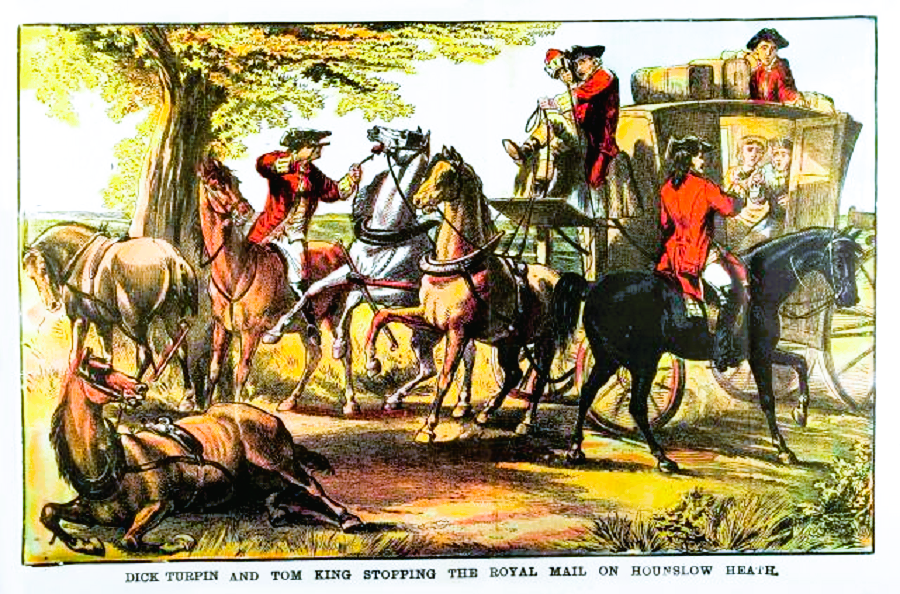
Dick Turpin is one of England’s most famous historical outlaws, known for his exploits as a highwayman during the early 18th century. Over time, he has become a legendary figure, celebrated in folklore and literature as a daring and gallant rogue. However, the reality of Turpin’s life is far less romantic. While he was indeed a criminal, the popular image of him as a heroic bandit is largely a product of myth-making in the centuries following his death. This essay explores the historical facts about Turpin, his criminal activities, and the development of his legendary status.
Early Life and Criminal Beginnings
Richard Turpin was born in 1705 in Essex, England, the son of a butcher. Unlike the dashing highwayman of legend, Turpin’s early criminal career began with poaching and cattle theft. He became associated with a gang of deer thieves known as the Essex Gang, who engaged in violent home invasions and thefts. Their activities often included torture and brutality, which starkly contrasts with the later romanticized image of Turpin as a chivalrous outlaw.
After the gang was dismantled by law enforcement, Turpin turned to highway robbery, a crime that was common in 18th-century England. Highwaymen would ambush stagecoaches and travelers on remote roads, demanding money and valuables. Turpin became notorious for his daring robberies, often in the company of accomplices such as Tom King, another infamous highwayman.
The Myth of the Great Ride
One of the most enduring myths about Dick Turpin is the legendary ride from London to York on his horse, Black Bess. According to folklore, Turpin made this journey overnight to establish an alibi and escape justice. This tale was popularized in the 19th century by the novelist William Harrison Ainsworth in Rookwood, a novel that transformed Turpin into a heroic figure. However, historical records show no evidence that Turpin ever undertook such a ride. In reality, this story may have been inspired by earlier highwaymen, but it became firmly attached to Turpin’s name due to its dramatic appeal.
Capture and Execution
Despite his skill at evading capture, Turpin’s criminal career came to an end in 1737 when he was arrested for horse theft in Yorkshire. Under the alias John Palmer, he was imprisoned in York Castle. His true identity was discovered , on February 23,1739, when a former teacher recognized his handwriting on a letter he had sent from jail. He was subsequently tried and sentenced to death.

On April 7, 1739, Turpin was executed by hanging in York. In keeping with tradition, he reportedly faced his death with bravado, bowing to the crowd and climbing the gallows with confidence. His execution attracted a large audience, further cementing his place in public memory.
The Making of a Legend
Following his death, Turpin’s reputation as a ruthless criminal gradually transformed into that of a noble highwayman. This shift was largely due to the influence of literature, particularly the works of Ainsworth, which romanticized his exploits. Over time, he became an almost Robin Hood-like figure—an outlaw who defied authority rather than a violent thief.
In modern times, Turpin’s story has been retold in numerous books, films, and television adaptations. While historians strive to present an accurate account of his life, the legend remains more compelling to the public. His name continues to evoke images of adventure, danger, and rebellion, despite the harsh reality of his crimes.
Dick Turpin’s life was far from the romanticized version that has endured in popular culture. He was a thief, a violent criminal, and ultimately a man who paid the price for his crimes. However, his story illustrates how history and myth can intertwine, shaping public perception in ways that often diverge from the truth. While the real Turpin was a far cry from the gallant highwayman of legend, his name endures as one of the most famous outlaws in English history.
sources
https://thehistorypress.co.uk/article/the-myth-of-highwayman-dick-turpin-outlives-the-facts
http://www.historyofyork.org.uk/themes/georgian/dick-turpin
https://en.wikipedia.org/wiki/Dick_Turpin
Donation
Your readership is what makes my site a success, and I am truly passionate about providing you with valuable content. I have been doing this at no cost and will continue to do so. Your voluntary donation of $2 or more, if you are able, would be a significant contribution to the continuation of my work. However, I fully understand if you’re not in a position to do so. Your support, in any form, is greatly appreciated. Thank you. To donate, click on the credit/debit card icon of the card you will use. If you want to donate more than $2, just add a higher number in the box left from the PayPal link. Your generosity is greatly appreciated. Many thanks.
$2.00
 History of Sorts
Leave a comment