
On May 7, 1945, Life Magazine published a harrowing series of photographs revealing the atrocities uncovered by American troops as they advanced through Germany in the final days of World War II. Among them was the photograph below, depicting the charred remains of concentration camp prisoners who were burned alive inside a barn near the medieval walled town of Gardelegen, in eastern Germany, on the night of April 13, 1945.

The Gardelegen massacre stands as one of the most horrific, yet lesser-known atrocities committed during the final days of World War II. Occurring on April 13, 1945, in the small German town of Gardelegen, this brutal event resulted in the murder of over 1,000 concentration camp prisoners by German military personnel and local civilians. As the Allied forces closed in on Nazi Germany, the massacre exemplified the regime’s desperation and its continuing commitment to inhumane policies, even in the face of imminent defeat.
Background
In early 1945, as the Allied armies advanced from both the west and east, the Nazi regime began evacuating concentration camps in a desperate attempt to hide the evidence of their crimes. Prisoners were forced on so-called “death marches,” often with little food or shelter, in hopes of relocating them to camps deeper within German territory. One such evacuation involved prisoners from the Mittelbau-Dora and Hannover-Stöcken camps, who were being transported eastward by train. When the rail line was blocked near Gardelegen, the SS and local authorities decided to detain the prisoners in the town.
The Massacre
Over 1,000 prisoners—mostly political detainees, forced laborers, and resistance fighters from across Europe—were forced into a large barn on the outskirts of Gardelegen. With assistance from local civilians, Hitler Youth members, and Volkssturm (a last-ditch militia composed of older men and young boys), the German guards set the barn on fire, using gasoline and explosives. Anyone who tried to escape the flames was shot. By the time the fire subsided, nearly all the prisoners had perished, either burned alive or executed.
The massacre was not an act of chaos or spontaneous violence; it was a calculated, premeditated act designed to eliminate witnesses and maintain Nazi secrecy. The willingness of local civilians to participate—some even volunteering their help—highlighted the depth of ideological indoctrination and the complicity of ordinary Germans in Nazi crimes.
Discovery and Aftermath
Just one day later, on April 14, 1945, soldiers from the U.S. 102nd Infantry Division arrived in Gardelegen and discovered the charred remains of the victims. Shocked by the brutality, American troops forced local residents to exhume and properly bury the dead. A temporary cemetery was established at the site, and each grave was marked with a cross or a star of David, depending on the presumed religion of the deceased. General Dwight D. Eisenhower ordered that the massacre site be preserved as a memorial to Nazi barbarity.
The U.S. Army conducted a preliminary investigation, identifying some of the perpetrators, though many escaped justice. After the war, the Gardelegen massacre became one of many examples used to demonstrate the widespread nature of Nazi crimes and the need for post-war accountability.
The man widely regarded as the main instigator of the Gardelegen massacre was 34-year-old Gerhard Thiele, the Nazi Party district leader of Gardelegen. On April 6, 1945, Thiele convened a meeting with his staff and other local officials, during which he relayed an order he had received days earlier from Gauleiter Rudolf Jordan: any prisoners caught looting or attempting to escape were to be shot immediately.
Photographers from the U.S. Army Signal Corps soon arrived to document the atrocity, and by April 19, 1945, news of the Gardelegen massacre began to appear in the Western press. That same day, both The New York Times and The Washington Post published reports on the massacre, quoting an American soldier who reflected on the scene:
“I never was so sure before of exactly what I was fighting for. Before this, you would have said those stories were propaganda, but now you know they weren’t. There are the bodies, and all those guys are dead.”
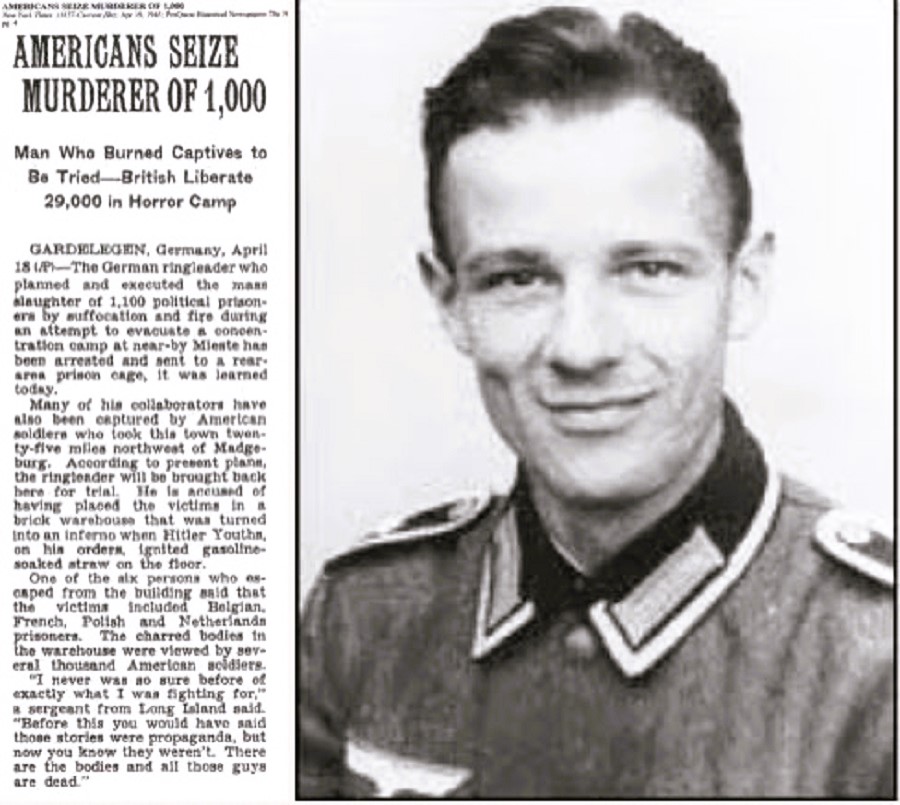
Gerhard Thiele, a 34-year-old Nazi Party district leader in Gardelegen, is widely regarded as the primary instigator of the Gardelegen massacre. On April 6, 1945, Thiele convened a meeting with his staff and other local officials, during which he relayed an order he had received days earlier from Gauleiter Rudolf Jordan: any prisoners caught looting or attempting to escape were to be shot on sight.
German civilians were ordered to exhume 586 bodies from mass graves and recover another 430 from the barn, placing each victim in an individual grave. On April 25, 1945, the U.S. Army’s 102nd Infantry Division held a solemn ceremony to honor the dead. A memorial tablet was erected, declaring that the people of Gardelegen bore the responsibility to ensure that “the graves are forever kept as green as the memory of these unfortunates will be kept in the hearts of freedom-loving men everywhere.”
That same day, Colonel George Lynch addressed the gathered German civilians with a powerful message:
“The German people have been told that stories of German atrocities were Allied propaganda. Here, you can see for yourself. Some will say that the Nazis were responsible for this crime. Others will point to the Gestapo. The responsibility rests with neither—it is the responsibility of the German people… Your so-called Master Race has demonstrated that it is master only of crime, cruelty, and sadism. You have lost the respect of the civilized world.”
At a ceremony held on September 15, 2020—75 years after the Gardelegen massacre—German President Frank-Walter Steinmeier emphasized the enduring importance of remembrance amid a resurgence of “authoritarian and nationalist thought.” Speaking in the presence of two survivors, Steinmeier noted, “The massacre here at Gardelegen was one of the last. It is essential that we remember—that we safeguard the memory of crimes which many Germans, even today, know nothing about.” He pointed out that the Nazis “killed until the last minute” of the war and lamented the lack of accountability for those responsible in its final days.
Steinmeier expressed particular regret over the fact that so few perpetrators were prosecuted, calling it “shameful” that Gerhard Thiele—the local Nazi Party leader accused of ordering the barn to be set on fire—escaped justice. Though arrested by American forces in 1945, Thiele was released for reasons that remain unclear and went on to live for decades under an assumed name.
Although overshadowed by larger-scale atrocities like Auschwitz or Buchenwald, the Gardelegen massacre remains significant for several reasons. It illustrates how Nazi ideology permeated German society to the point where ordinary people participated in mass murder. It also underscores the cruelty that continued even as the Third Reich crumbled, reflecting the regime’s unwavering commitment to destruction.
Today, the site of the massacre is preserved as a memorial and educational center. The preserved barn, cemetery, and interpretive displays serve as powerful reminders of the atrocities committed and the importance of remembering history to prevent future genocides.
In conclusion, the Gardelegen massacre is a chilling example of how ideology, fear, and complicity can lead to unimaginable violence. As a singular event near the war’s end, it represents not only the cruelty of the Nazi regime but also the urgent need for historical remembrance and moral vigilance in the face of dehumanization.
sources
https://archives.norwich.edu/digital/collection/p16663coll1/id/3684/
https://portal.ehri-project.eu/units/us-005578-irn503708
https://www.jewishvirtuallibrary.org/massacre-at-gardelegen-april-1945
https://encyclopedia.ushmm.org/content/en/article/gardelegen
https://www.jewishvirtuallibrary.org/gardelegen-massacre
Please support us so we can continue our important work.
Donation
Your readership is what makes my site a success, and I am truly passionate about providing you with valuable content. I have been doing this at no cost and will continue to do so. Your voluntary donation of $2 or more, if you are able, would be a significant contribution to the continuation of my work. However, I fully understand if you’re not in a position to do so. Your support, in any form, is greatly appreciated. Thank you. To donate, click on the credit/debit card icon of the card you will use. If you want to donate more than $2, just add a higher number in the box left from the PayPal link. Your generosity is greatly appreciated. Many thanks.
$2.00
 History of Sorts
Leave a comment