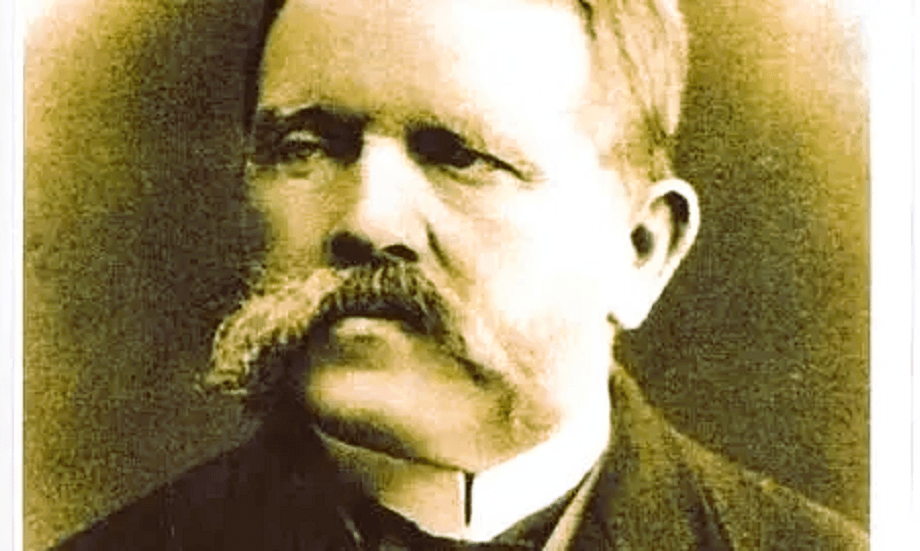
Alois Hitler was born on June 7, 1837, in the small village of Strones, in the Waldviertel region of Lower Austria, near the Bohemian border. His mother, Maria Anna Schicklgruber, was unmarried at the time of his birth, which led to uncertainty surrounding his paternity.
For the first several years of his life, Alois bore his mother’s surname: Schicklgruber. It wasn’t until 1842—when he was five years old—that Johann Georg Hiedler, a miller who had married his mother, was registered retroactively as his legal father. Even so, the name “Hitler” (a variation of Hiedler or Hüttler) didn’t appear in official records until 1876, when Alois, then nearly 40, had his name legally changed to Hitler. The reasons for this change are not entirely clear, but some historians speculate it was connected to his ambition and desire for social respectability.
Career
Alois joined the Austrian customs service in 1855, working diligently up the ranks. He became a mid-level customs official (a Zollbeamter), a solid, respectable government position in the Habsburg bureaucracy. Known for being strict and methodical, he was also ambitious, a trait that helped him ascend the ranks but reportedly made him harsh toward subordinates and his own family.
Throughout his career, Alois moved frequently due to job assignments. This constant relocation disrupted family life and added strain to his relationships at home.
Personal Life and Family
Alois Hitler married three times:
Anna Glasl-Hörer (married in 1873) – She was older than Alois and became ill soon after their marriage. They had no children together, and Alois began an affair with a much younger woman, Franziska Matzelsberger, during this time.
Franziska Matzelsberger – They married in 1883 after Anna’s death. She gave birth to two children, including Alois Jr., but died young from tuberculosis in 1884.
Klara Pölzl – Perhaps the most significant of his spouses historically, Klara was Alois’s third wife and also his niece (through the Hiedler line). Their marriage required special dispensation from the Catholic Church due to their familial relation. Klara gave birth to six children, but only two survived into adulthood: Adolf (born 1889) and Paula.
Alois was known to be authoritarian, strict, and emotionally distant, particularly with his children. He expected discipline and obedience and was reportedly often violent toward young Adolf. Their relationship was strained, and Alois showed little understanding of or patience with his son’s interests, especially Adolf’s fascination with art.
Death
Alois Hitler died suddenly on January 3, 1903, at the age of 65. He collapsed in a pub in Leonding, near Linz, after suffering a stroke. His death left the family without its stern patriarch, and his son Adolf, then 13, reportedly showed little outward grief.
Legacy and Historical Significance
While Alois Hitler was not a major historical figure in his own right, his role as the father of Adolf Hitler has drawn considerable interest. Scholars have long debated how much influence Alois’s harsh parenting and authoritarian demeanor may have had on his son’s personality and eventual worldview. The domestic environment Alois fostered—dominated by discipline, order, and emotional distance—is often cited as a formative factor in Adolf’s development.
A deeper psychological and historical analysis of Alois Hitler’s relationship with Adolf Hitler reveals a complex and often turbulent dynamic that had profound effects on Adolf’s development. While we must be cautious about drawing direct lines from childhood to later actions, patterns in this father-son relationship help illuminate parts of Adolf Hitler’s personality and worldview.

1. Authoritarian Father, Rebellious Son
Alois Hitler embodied the strict, authoritarian figure typical of the Austro-Hungarian bureaucratic class. He demanded discipline, obedience, and practical success from his children—values he had internalized during his own difficult rise through the ranks of the civil service. Unfortunately, he used intimidation, control, and physical punishment to enforce those expectations.
Adolf, on the other hand, was a sensitive, artistic, and withdrawn child. From a young age, he clashed with his father over his future. Alois wanted Adolf to follow in his footsteps and become a customs official, while Adolf was drawn to painting, architecture, and German nationalist ideals. The more Alois insisted, the more Adolf resisted. Their relationship became a power struggle, with neither willing to compromise.
Historians and psychologists have argued that this intense conflict contributed to Adolf’s deep mistrust of authority figures and his later insistence on absolute control when he himself rose to power. It may also have nurtured his need to prove himself—to assert dominance in areas his father had dismissed or devalued.
2. Emotional Coldness and Control
Alois was emotionally distant, rarely offering praise or warmth. Adolf reportedly feared his father more than he loved him. This lack of emotional connection likely left Adolf with feelings of insecurity, resentment, and a craving for recognition.
This dynamic may explain Adolf’s later need for admiration and his ability to cultivate mass loyalty and devotion—possibly as a compensatory mechanism for the lack of personal validation he received as a child. His ability to captivate crowds and demand loyalty may have roots in this early emotional void.
3. The Mother as the Opposite
While Alois represented force, discipline, and rejection, Klara Hitler (Adolf’s mother) was the emotional anchor of the household. She was doting and protective, and Adolf adored her. This stark contrast between mother and father created a psychological split: the father was the oppressor; the mother, the nurturer. After Klara’s death in 1907, Adolf became deeply emotionally unmoored. The loss intensified his already present idealization of the maternal and rejection of paternal authority.
This split may have carried over into his adult worldview, where Hitler often framed the world in rigid dichotomies: good vs. evil, loyalty vs. betrayal, German vs. Jew, Führer vs. enemy.
4. The Father as a Symbol of the State
There’s also a symbolic dimension: Alois, as a mid-level official of the Austro-Hungarian Empire, can be seen as representing the old imperial order—multinational, bureaucratic, and conservative. Adolf’s rebellion against his father mirrored his rejection of the Austro-Hungarian monarchy and his embrace of a radical, nationalist German identity.
Hitler’s political ideology often emphasized discipline and obedience, but only under his own command. It was a reversal of roles: where he had once been the subordinate child, he would become the ultimate father-figure to the German people—the Führer.
5. Historical Debate
Some historians and psychoanalysts, notably Erik Erikson and Robert G. L. Waite, have explored the idea that Hitler’s psychological development was deeply affected by trauma stemming from his father’s behavior. Others, like Ian Kershaw, are more cautious, arguing that the “tyrannical father” narrative must be considered alongside broader historical and social influences.
There is also debate about how much of Adolf’s portrayal of his father in Mein Kampf is truth versus myth. In that book, Hitler paints a picture of a stern but not unusually abusive father. However, family recollections and other historical sources suggest a more volatile and sometimes violent man.
Alois Hitler was more than just a father; he was a living embodiment of the values and structures Adolf came to reject—rigid authority, the Austro-Hungarian system, and emotional detachment. In rebelling against his father, Adolf not only shaped his identity but also crafted a political vision that replaced the father’s world with one of his own making—totalitarian, nationalistic, and emotionally charged.
While it would be overly simplistic to blame Alois for Adolf’s later atrocities, it’s equally naive to ignore the formative role this family dynamic likely played in Hitler’s psychological makeup.
sources
https://en.wikipedia.org/wiki/Alois_Hitler
https://allthatsinteresting.com/alois-hitler
https://spartacus-educational.com/GERhitlerA.htm
Donation
Your readership is what makes my site a success, and I am truly passionate about providing you with valuable content. I have been doing this at no cost and will continue to do so. Your voluntary donation of $2 or more, if you are able, would be a significant contribution to the continuation of my work. However, I fully understand if you’re not in a position to do so. Your support, in any form, is greatly appreciated. Thank you. To donate, click on the credit/debit card icon of the card you will use. If you want to donate more than $2, just add a higher number in the box left from the PayPal link. Your generosity is greatly appreciated. Many thanks.
$2.00
 History of Sorts
Leave a comment