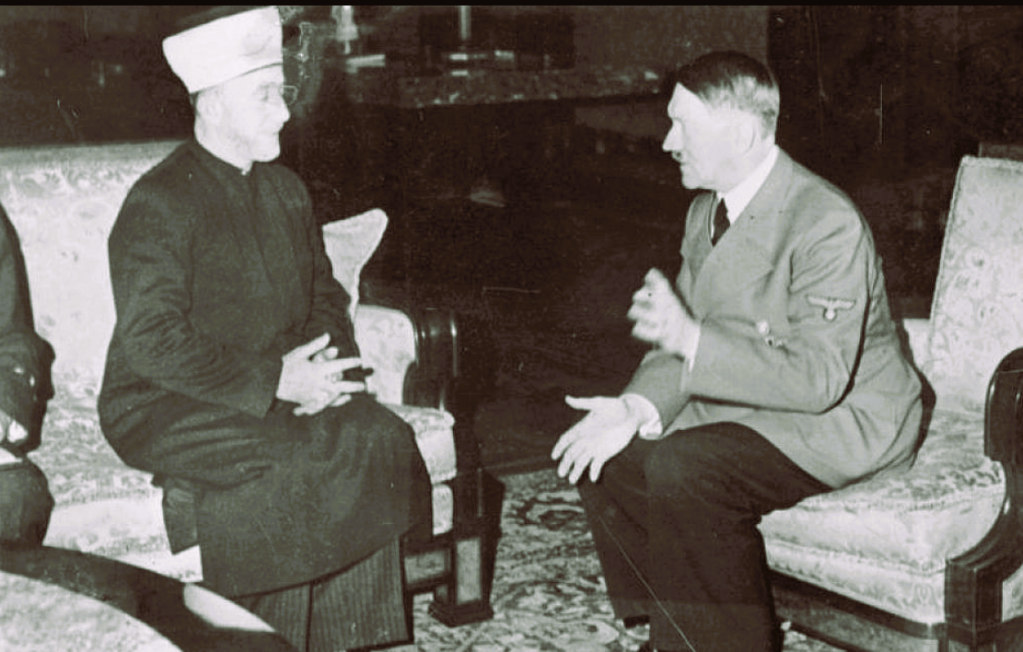
The meeting between Adolf Hitler and Hajj Amin al-Husayni on November 28, 1941, in Berlin represents a significant, though often overlooked, episode in the broader context of World War II and the Middle Eastern political landscape of the time. Hajj Amin al-Husayni, the Grand Mufti of Jerusalem, was a key Palestinian nationalist leader, and his visit to Berlin marked a convergence of political interests between the Arab nationalist movement and Nazi Germany. This meeting was emblematic of shared strategic interests, including opposition to British colonialism and mutual hostility toward Jews.
Background: The Political Climate of the 1930s and 1940s
The 1930s and 1940s were tumultuous years for both Europe and the Middle East. Adolf Hitler’s Nazi regime was seeking to expand its influence across Europe and beyond, while also pursuing its genocidal campaign against the Jewish people. At the same time, Hajj Amin al-Husayni emerged as a prominent leader in the Arab world, particularly in Palestine, where Arab opposition to Jewish immigration was intensifying.
Al-Husayni had risen to prominence during the British Mandate in Palestine, becoming an ardent advocate for Palestinian nationalism and Palestinian independence. His opposition to Zionism and the British authorities led him to seek allies who could support Arab efforts to resist both. His ambitions was for a pan-Arab state, free from British and French colonial rule, aligned with Germany’s interest in destabilizing the British Empire—particularly in the strategically important Middle East.
The Context of the Meeting
By the time of their meeting in 1941, Hajj Amin al-Husayni had been living in exile in Europe, primarily due to his involvement in the Arab Revolt (1936-1939) against British rule and Jewish immigration in British Mandated Palestine. After the revolt was suppressed, he fled, eventually finding refuge in fascist Italy and then Nazi Germany. Al-Husayni’s primary concern was securing Arab independence from British colonial rule and preventing the establishment of a Jewish state in Palestine. This goal which aligned, to some extent, with Nazi Germany’s objectives.
For Hitler, the Middle East was strategically important in his war against Britain. Germany had already made inroads into North Africa, where General Erwin Rommel’s Afrika Korps were engaged in a battle against British forces. Hitler saw the possibility of an Arab uprising against the British as a way to stretch British military resources and weaken their imperial hold. Al-Husayni, for his part, sought to secure German support for an Arab state and hoped to prevent further Jewish immigration to Palestine.
The Meeting: November 28, 1941
The meeting between Adolf Hitler and Hajj Amin al-Husayni took place in the Reich Chancellery in Berlin. The minutes of the meeting, documented by German officials, reveal the nature of their conversation, which centered on shared strategic interests. Al-Husayni expressed his gratitude to Hitler for Germany’s opposition to the Jews and their alleged control over world affairs. He framed the Jewish presence in Palestine as part of a global Jewish conspiracy that threatened both the Arab and the German peoples.
Hitler assured al-Husayni that once Germany had achieved victory in the war, he would not forget the Arab cause. He affirmed that Germany’s policy was the destruction of the Jewish population in Europe and that his goal was to expand this policy to the Middle East, where he assured the Grand Mufti that Jews would face the same fate. In this way, Hitler sought to win al-Husayni’s support and solidify the alliance between Nazi Germany and Arab nationalist forces opposed to British imperialism.
During the meeting, Hitler made vague promises about the post-war order, assuring al-Husayni that Germany would support Arab independence and that he would champion the cause of Arab liberation from British colonialism.
The Führer meets the Grand Mufti of Jerusalem, one of the most influential men of Arab nationalism. The Grand Mufti is the religious leader of the Arabs in Palestine and simultaneously their highest judge and financial manager. Because of his nationalism, the British persecuted him bitterly and put a price of 25,000 pounds on his head. His adventurous voyage brought him over to Italy and Germany.
Significance and Legacy
The meeting between Hitler and al-Husayni holds significant historical importance for several reasons. Firstly, it illustrates the degree to which al-Husayni was willing to collaborate with Nazi Germany in the hope of advancing Arab nationalist aims. His alignment with Hitler’s regime, which was responsible for the Holocaust, has tainted his legacy and remains a controversial aspect of his political career. His collaboration with the Nazis is often cited as evidence of the intersection between European fascism and certain strains of Arab nationalism during this period.
Moreover, the meeting reflected the broader geopolitical dynamics of World War II, when anti-colonial movements often sought alliances with the Axis powers as a way to challenge British and French colonial dominance. Al-Husayni’s collaboration with Hitler was not an isolated event, but part of a wider pattern of nationalist leaders seeking support from the Axis powers in their fight against imperialism.
In the decades following the war, the meeting has been used as a point of contention in historical narratives about the Israeli-Palestinian conflict. Some historians and commentators have used al-Husayni’s association with Hitler to cast Arab resistance to Zionism in a particularly negative light, while others argue that his actions should be viewed within the broader context of anti-colonial struggles.
The meeting between Adolf Hitler and Hajj Amin al-Husayni on November 28, 1941, was a convergence of two leaders with distinct but overlapping agendas. While Hitler sought to exploit Arab nationalism to weaken the British Empire, al-Husayni hoped to use Germany’s military might to advance the cause of Arab independence and prevent the establishment of a Jewish state in Palestine. The meeting symbolizes the complex and often morally fraught alliances that emerged during World War II, as nationalist movements sought to navigate the global struggle between the Axis and Allied powers.
Though no significant military or political outcomes emerged directly from this meeting, it remains an important episode in the history of both the Arab nationalist movement and the Holocaust. Al-Husayni’s wartime collaboration with Nazi Germany has cast a long shadow over his legacy, serving as a reminder of the difficult choices faced by nationalist leaders during one of the most turbulent periods of the 20th century.
Sources
https://www.timesofisrael.com/full-official-record-what-the-mufti-said-to-hitler/
https://time.com/4084301/hitler-grand-mufi-1941/
https://encyclopedia.ushmm.org/content/en/article/hajj-amin-al-husayni-wartime-propagandist
https://honestreporting.com/hitlers-palestinian-ally-grand-mufti-amin-al-husseini/
Please support us so we can continue our important work.
Donation
Your readership is what makes my site a success, and I am truly passionate about providing you with valuable content. I have been doing this at no cost and will continue to do so. Your voluntary donation of $2 or more, if you are able, would be a significant contribution to the continuation of my work. However, I fully understand if you’re not in a position to do so. Your support, in any form, is greatly appreciated. Thank you. To donate, click on the credit/debit card icon of the card you will use. If you want to donate more than $2, just add a higher number in the box left from the PayPal link. Your generosity is greatly appreciated. Many thanks.
$2.00

 History of Sorts
Leave a comment