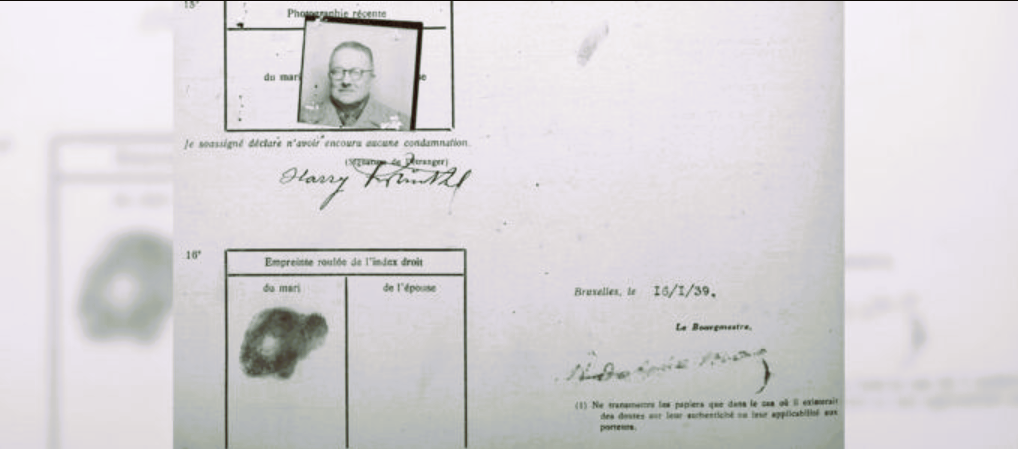
I have done blogs on the New Apostolic Church during WW2 before, and I am doing research for further blogs. However, this time I want to focus on one member in particular. Many of you know I am a New Apostolic Christian and for many years I have san in the choir. One of my favourites choir hymns is “Take thy shoes off” which is a reference to the bible text Exodus 3-5 : Then He said, “Do not draw near this place. Take your sandals off your feet, for the place where you stand is holy ground.”
Harry Fränkel adapted that bible text into the lyrics for the afore mentioned hymn, the original German title is “Ziehe deine Schuhe aus”
Harry Fränkel was born on 27 April 1882 in Grasberg, near Bremen, in northern Germany. His parents, Salomon and Eliese Fränkel, were Jewish.
On 23 July 1908, Harry converted to the New Apostolic faith. Just a year later, in 1909, he was already serving as a Sunday School teacher in Dortmund. In 1911, he was ordained as a Deacon and, around 1922, as a Priest.
On 6 June 1907, Harry Fränkel married Wilhelmine Augustine, a woman from a Protestant background. She was sealed into the New Apostolic Church on 20 November 1907. Six years his senior, Wilhelmine had been widowed before and brought a son, Gottfried, into the marriage.
Together, Harry and Wilhelmine had three sons: Harry Jr., Erich, and Herbert. The entire family embraced the New Apostolic faith, actively participating in church life.
A successful textile merchant, Harry was able to provide well for his family. His three children attended college, and the household employed domestic help. Life was stable—until 1933, the year the Nazi regime came to power in Germany.
Under Persecution
As a so-called “full Jew”—meaning both parents were Jewish—Harry Fränkel lost his position as managing director of the company Mayer & Günther. Undeterred, he started his own business. Advertisements in Unsere Familie, a German-language church magazine, attest to this endeavor. But in 1938, new Nazi laws barred Jews from owning businesses. Harry’s son, Erich, briefly took over, but he too was soon forbidden from continuing operations.
Meanwhile, the Church asked Priest Fränkel to suspend his ministerial duties—for the Church’s own protection. His name was removed from reprints of hymnals where he had been credited as a hymn writer. His son, Harry Jr., a talented graphic designer and illustrator, was denied admission to the Academy of Arts and found it increasingly difficult to secure work. It was then that Harry Fränkel Sr. resolved to emigrate.
On the Run
Harry first sought refuge in South Africa and wrote to Assistant Chief Apostle Heinrich Franz Schlaphoff. Schlaphoff, sympathetic but powerless, informed him that South Africa had closed its borders to European Jews. He did, however, provide Harry with a contact address in Argentina.
At the time, Belgium served as a more welcoming gateway for refugees than many of its European neighbors. Harry spent 17 months in Brussels, moving through five different addresses—isolated from his family, friends, and congregation—while fighting for legal residency. All the while, the Gestapo was aware of his location. Then came 10 May 1940: Germany invaded Belgium.
Deported and Interned
That same day, Belgian authorities arrested some 10,000 men, suddenly classifying them as “enemy foreigners.” They were deported by train to France in inhumane conditions—overcrowded, sweltering train cars without seating, toilets, or adequate drinking water.
This journey took Harry close to the French-Spanish border. He was first interned at the Saint-Cyprien camp (Block 1, Barrack No. I42), and later transferred to Gurs—widely considered the most horrific concentration camp in France. The camp was plagued by hunger, cold, vermin, disease, and death.
Then, on 22 June 1940, France surrendered to Nazi Germany.
The Final Journey
Following the armistice, France and Germany signed an extradition treaty. Harry Fränkel was among those handed over to the Nazis. He was first detained in Frankfurt, then imprisoned in the infamous Steinwache in Dortmund—less than two kilometers from his home and family.
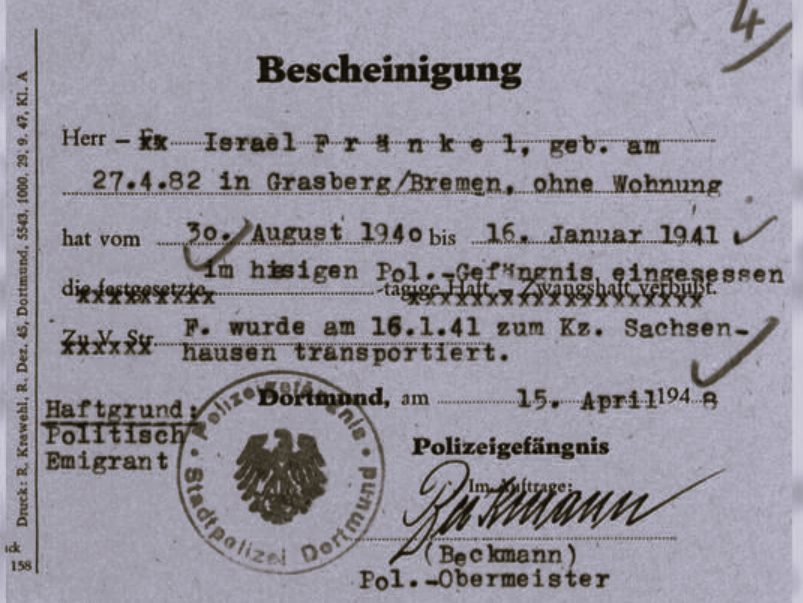
His final destination was the Sachsenhausen concentration camp near Berlin. From there, he was deported to Auschwitz.
There, on 5 November 1942 at 8:00 a.m., Harry Fränkel was murdered, according to records held by the International Holocaust Remembrance Center, Yad Vashem.
Yet his name lives on. He is remembered as the author of the New Apostolic hymn, “Take off your shoes, for the place where you stand is holy.” The place where he was murdered was anything but holy, a hell on earth.
A man of deep faith, Harry Fränkel’s voice continues to echo through the words of worship he left behind—an enduring testimony to dignity, devotion, and hope in the face of unspeakable persecution.
sources
https://www.apostolische-geschichte.de/wiki/index.php?title=Harry_Fr%C3%A4nkel#cite_note-1
https://collections.yadvashem.org/de/names/11498826
Please support us so we can continue our important work.
Donation
Your readership is what makes my site a success, and I am truly passionate about providing you with valuable content. I have been doing this at no cost and will continue to do so. Your voluntary donation of $2 or more, if you are able, would be a significant contribution to the continuation of my work. However, I fully understand if you’re not in a position to do so. Your support, in any form, is greatly appreciated. Thank you. To donate, click on the credit/debit card icon of the card you will use. If you want to donate more than $2, just add a higher number in the box left from the PayPal link. Your generosity is greatly appreciated. Many thanks.
$2.00
 History of Sorts
Leave a comment