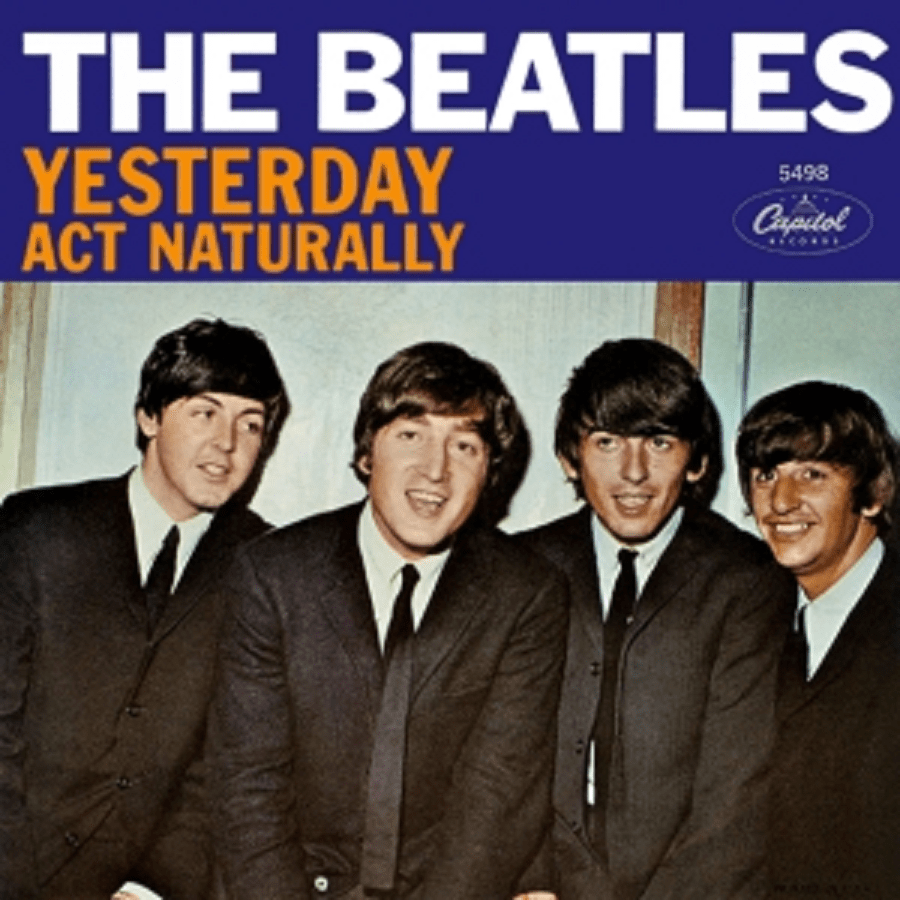
“Yesterday” is a song by the English rock band the Beatles, written by Paul McCartney and credited to Lennon–McCartney. First released on the 1965 album Help!, it was issued as a U.S. single the following September, reaching number one on the Billboard Hot 100. In the UK, it appeared on the EP Yesterday in March 1966 and later on the North American compilation Yesterday and Today.
The recording, featuring McCartney’s voice and acoustic guitar with a string quartet, was effectively the Beatles’ first solo-style performance. With more than 2,200 cover versions, it is among the most recorded songs in history. Yesterday was named the greatest song of the 20th century in a 1999 BBC Radio 2 poll, ranked the No. 1 pop song of all time by MTV and Rolling Stone in 2000, and inducted into the Grammy Hall of Fame in 1997. Broadcast Music, Inc. estimates it was performed over seven million times in the 20th century.
Origins
According to McCartney, the melody came to him in a dream while staying at the Wimpole Street home of his then-girlfriend Jane Asher. Afraid he had unconsciously copied another song, he played it to numerous musicians before concluding it was original. Initially titled Scrambled Eggs with humorous placeholder lyrics (“Scrambled eggs / Oh my baby how I love your legs”), it became a running joke among the Beatles.
During the filming of Help!, McCartney frequently worked on the tune at a studio piano, testing the patience of both director Richard Lester and his bandmates—George Harrison quipped, “Blimey, he’s always talking about that song. You’d think he was Beethoven!”
McCartney developed the final lyrics while holidaying in Portugal in May 1965, later completing the song in Albufeira on a borrowed guitar. The definitive title, Yesterday, replaced Scrambled Eggs—a change Lennon later said he regretted in jest, as the working version had provided much amusement.
Composition and Structure
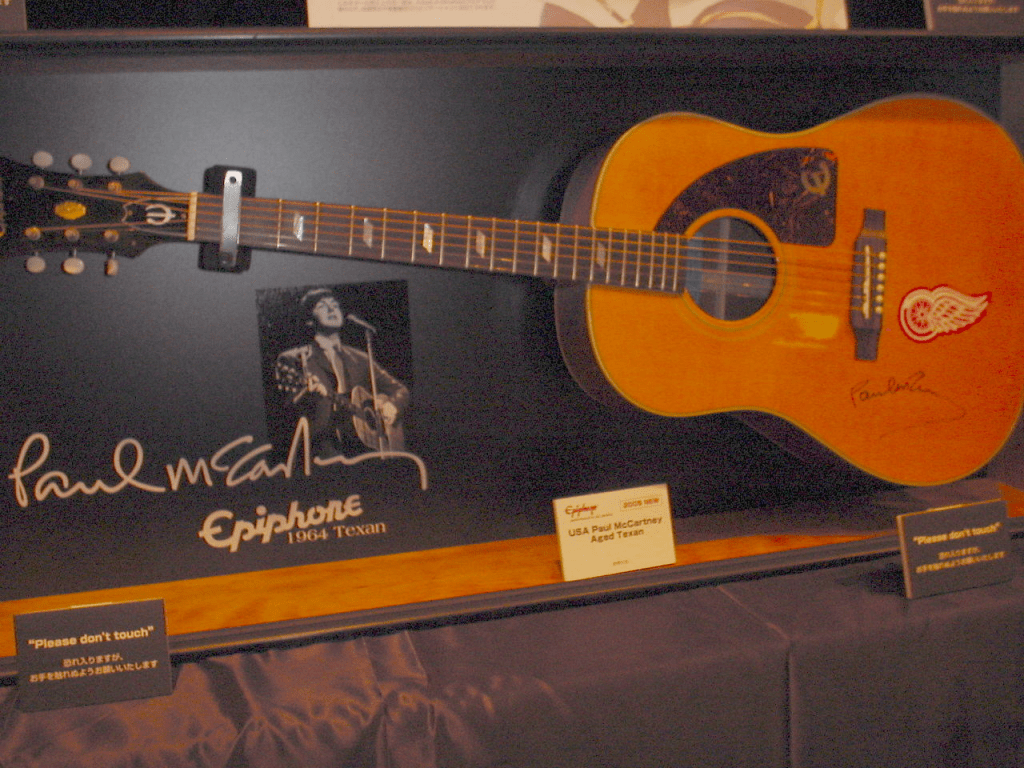
Musically, Yesterday is deceptively simple. It features McCartney on an Epiphone Texan steel-string acoustic guitar, accompanied by a string quartet arranged with minimal vibrato for a stark, plaintive quality. The song has two contrasting sections: a seven-bar main melody, unusual in popular music, and a more conventional eight-bar bridge.
The harmonic progression, shifting between F major and D minor with unexpected secondary dominants, creates a melancholic atmosphere. The string arrangement—highlighted by descending viola and “blue note” cello phrases—intensifies the sense of longing. Musicologist Alan Pollack praised the work as “a fine piece of art with something going for it in virtually every department: the unique arrangement, an attractive tune, asymmetrical phrasing, and off-beat chord progressions.”
Recording
The track was recorded at Abbey Road Studios on 14 June 1965, just before McCartney’s 23rd birthday. Accounts differ, but it appears the Beatles first experimented with fuller instrumentation before producer George Martin persuaded McCartney to record it solo, later adding the string quartet.
Two takes were recorded, with take two chosen as the master. On 17 June, McCartney’s vocal and the quartet were overdubbed. The unused take, without strings, was later released on Anthology 2. Harrison’s voice is faintly audible on the session tapes, though he did not play on the final track.
Martin later recalled technical challenges: microphones for McCartney’s guitar and vocal picked up spill from each other, while the quartet refused to wear headphones, meaning their microphones also captured McCartney’s performance. This “leakage” became a notable feature of the recording.
Release
Because Yesterday differed so markedly from the Beatles’ established sound, the group vetoed its release as a single in the UK. Matt Monro issued the first cover version in late 1965, which entered the UK top ten.
Capitol Records, however, released it as a U.S. single on 13 September 1965, backed with “Act Naturally.” It topped the Billboard Hot 100 for four weeks and sold over a million copies within five weeks. It was the fifth of six consecutive Beatles No. 1 singles in America.
The song later appeared on the British EP Yesterday (1966), the U.S. album Yesterday and Today (1966), and the UK compilation A Collection of Beatles Oldies (1966). In March 1976, it was finally issued as a single in Britain, peaking at No. 8.
Reception and Legacy
Yesterday quickly became one of the most covered songs in history. By 1986, Guinness World Records listed 1,600 versions; by the 1990s, Muzak alone had recorded 500 arrangements.
The song is credited with sparking interest in baroque and classical-infused pop, influencing works like the Rolling Stones’ “As Tears Go By” and the Moody Blues’ orchestral rock experiments.
It won the 1965 Ivor Novello Award for Outstanding Song and has appeared consistently in “greatest song” rankings: No. 13 on Rolling Stone’s “500 Greatest Songs of All Time” (2004) and No. 4 on its “100 Greatest Beatles Songs” (2010). In 1999, BMI ranked it the third most-performed song of the century in the U.S., behind “Never My Love” and “You’ve Lost That Lovin’ Feelin’.”
Reactions among musicians have varied: Chuck Berry wished he had written it, while Bob Dylan dismissed it as unoriginal. Lennon later called it “beautiful” but lyrically insubstantial, though he also teased McCartney in his solo song “How Do You Sleep?” with the line: “The only thing you done was yesterday.”
The song has remained a live favorite for McCartney since his 1975 Wings tour, and in 2012, the BBC reported it had earned £19.5 million in royalties, making it one of the most lucrative songs ever written.
Finishing with the original
sources
https://en.wikipedia.org/wiki/Yesterday_(song)
https://www.thebeatles.com/yesterday

 History of Sorts
Leave a comment