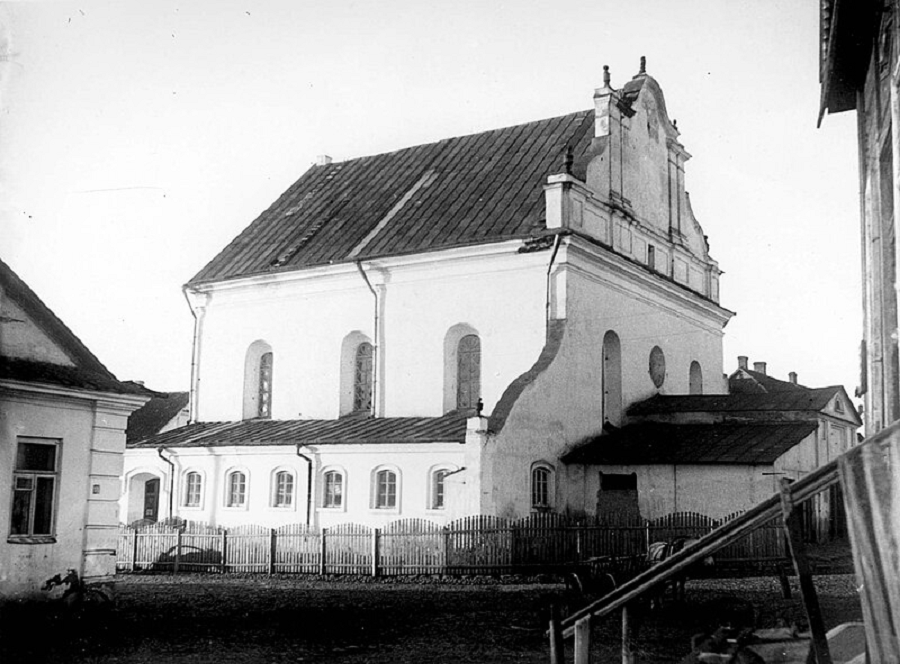
The massacre that took place in Slonim on November 14, 1941, stands as one of the many tragic and brutal episodes in the systematic annihilation of Jewish communities across Eastern Europe during the Holocaust. Located in what is now western Belarus, Slonim was home to a vibrant and historically significant Jewish population before the German invasion of the Soviet Union in June 1941. The community had deep cultural, religious, and economic roots extending back centuries. All of this was destroyed within months of the Nazi occupation, culminating in the mass murder carried out on that grim November day.
The Context of Occupation
When German forces captured Slonim in late June 1941, they immediately implemented anti-Jewish policies that mirrored those unfolding across occupied Eastern territories. Jews were subjected to forced labor, humiliation, property seizure, and restrictions on movement. Violent attacks began quickly, conducted both by German Einsatzgruppen and by local auxiliary collaborators who assisted enthusiastically or under coercion. The early weeks of occupation saw dozens killed, but worse atrocities were planned as the Nazi leadership moved toward full-scale extermination.
By the autumn of 1941, the Jewish population of Slonim—swollen by refugees from surrounding towns—was forced into a ghetto. Conditions were dire: overcrowding, hunger, lack of sanitation, and the constant threat of violence created a climate of terror. Although some Jewish residents still hoped that their work for the German authorities might offer temporary protection, the fate of the community had already been sealed by the broader genocidal policies unfolding across the occupied Soviet territories.
The Massacre of November 14, 1941
The massacre began early in the morning on 14 November 1941, carried out by German security forces, including members of the Gestapo and Einsatzgruppen, with the assistance of local collaborators. Under the guise of a “registration” or work inspection, thousands of Jews were ordered to assemble. Panic spread quickly as armed units surrounded the ghetto, and the truth became unmistakable.
Victims were seized from homes, streets, and hiding places. Many were beaten or shot on the spot. The majority, however, were marched or transported to execution sites outside the city—most commonly cited is the Czepelovo (Chepelev) forest area. There, mass graves had been pre-dug.
Eyewitness accounts describe scenes of horrific brutality: people forced to undress in freezing temperatures, families torn apart, children murdered alongside parents. The shootings continued throughout the day. Estimates vary, but historians generally conclude that approximately 8,000 to 9,000 Jews were murdered in a single operation—effectively destroying most of the Jewish population of Slonim in one da
A Personal Narrative Reflection
I often imagine what it must have felt like to wake up on the morning of 14 November 1941 in the Slonim ghetto. Historians describe the day in terms of battalions, orders, and casualty estimates—but when I try to understand it, I think of families waking in cold wooden houses, trying to start a fire, trying to believe the rumors of “another inspection” were only rumors. No one yet knew that almost an entire community would disappear before nightfall.
Slonim, before the war, was thick with Jewish life: Hebrew schools, Yiddish theaters, bustling workshops, loud marketplaces. By November 1941, all of that had been crushed under the German occupation. The ghetto was overcrowded, hungry, sick, and constantly afraid. Still, people woke each day trying to hold onto something human.
The Morning of the Aktion
Survivor testimonies describe how the ghetto was surrounded at dawn. Shouts in German and the harsh barking of dogs echoed through the narrow streets. Armed men poured in—members of the German Sicherheitspolizei (Security Police) and units of the Ordnungspolizei, along with local auxiliary police who had aligned themselves with the occupiers.
Though Germany’s top civilian authority in the region was Generalkommissar Wilhelm Kube, the local German civil administration in Slonim played a more immediate role.

The Gebietskommissar for Slonim, Heinrich Carl, is frequently mentioned in postwar accounts as one of the officials who oversaw anti-Jewish policy in the district. Under him, the ghetto’s affairs were managed with cruelty and cold efficiency; he was known to have coordinated with the German police leadership in the city.
Survivors also recalled a German police chief in Slonim—commonly referred to in testimonies as “Grabow” (a name that appears in multiple accounts), who took an active role in both earlier shootings and the November Aktion. Some witnesses described him walking through the streets with a pistol, personally directing the violence.
Although the precise composition of the shooting units on November 14 varies across documents, historians agree that the massacre involved detachments of the Order Police (Orpo) who were active in the Slonim region in late 1941. These units operated under the broader command structures of the German police regiments active in Belarus, whose senior officers—such as Major Franz Lechthaler, commander of Police Regiment 15—were involved in planning or supervising mass shootings across the region. While Lechthaler’s regiment operated over a wide area and not every unit was present in every action, his name appears repeatedly in scholarship about mass shootings in western Belarus during 1941.

A Community Led to Its Death
People were ordered to gather for a “registration.” In every occupied town, Jews had learned that words like “registration,” “resettlement,” or “labor selection” were often preludes to something worse, though hope forced them to cling to ambiguity.
Parents clutched their children. Older people struggled to walk. Many tried to hide in cellars or behind false walls, but armed men broke into homes, dragging people into the freezing streets.
Then came the march.
Survivors described how thousands were pushed toward the Chepelev (Czepelovo) forest outside the city. The air smelled of wet soil and pine needles. Some people whispered prayers. Others held each other silently.
At the forest pits—already dug, as if the fate of the victims had been decided long before their arrival—German policemen and their collaborators carried out the shootings. Witnesses remembered the mechanical cruelty: victims ordered to undress, families separated, children screaming for their parents. Those who resisted or broke down were shot on the spot.
By the end of the day, approximately 8,000–9,000 Jews were dead. Nearly the entire Jewish population of Slonim had been destroyed in less than twelve hours.
The Aftermath
The few who survived—by hiding, escaping, or being temporarily spared for forced labor—emerged into a hollow city. Houses stood empty. Shops remained shuttered. The sounds of children, prayer, argument, laughter—all the ordinary noises of Jewish life—were gone.
The ghetto lingered until June 1942, when the remaining Jews of Slonim were murdered in another Aktion. A community that had lived for centuries vanished almost completely.
Memory and Historical Responsibility
Writing about the massacre in Slonim means confronting not only the scale of the violence but its intimacy. This was not an anonymous industrial genocide carried out from a distance. It happened face-to-face. People could see the expressions of the men who killed them.
Names like Heinrich Carl, Grabow, and Franz Lechthaler matter not because they explain everything, but because acknowledging them asserts that these crimes did not simply “happen”—they were committed by individuals who made decisions, gave orders, and pulled triggers.
Yet the heart of the story lies with the victims: tailors, rabbis, shoemakers, mothers, toddlers, teachers, musicians, merchants. They woke up that morning believing they still belonged to a world that valued them as human beings. By nightfall, their world had been erased.
Documented Perpetrators Involved in the Slonim Massacres (Including November 14, 1941)
1. Gebietskommissar Heinrich Carl
Role: German civil administrator for the Slonim district (Gebietskommissariat), appointed under the civilian authority of Reichskommissariat Ostland.
Documentation:
- Appears in German administrative records of Reichskommissariat Ostland as Gebietskommissar of Slonim.
- Referenced in postwar testimonies from survivors and trials related to crimes in western Belarus.
- Known to have coordinated with the local Sicherheitsdienst (SD) and Ordnungspolizei (Orpo) in the “management” of Jewish labor, ghetto regulations, confiscation of Jewish property, and the preparation of mass shooting actions.
Involvement in killings:
While Carl did not personally participate in shootings, he played a central role in authorizing, organizing, and enabling the Aktionen, including providing logistical and administrative coordination for the November 14 massacre.
Carl’s administration ensured:
- compilation of Jewish population lists
- delivery of forced laborers to the police
- preparation of mass graves
- cooperation with police commanders carrying out the massacre
Survivors frequently described him as one of the most feared figures in Slonim’s occupation regime.
2. “Grabow” (frequently cited as Fritz Grabow or simply Grabow)
Role: Chief of the German Police (Orpo) in Slonim.
Documentation:
- Appears repeatedly in survivor testimony collected after the war (notably Polish, Soviet, and Yiddish-language sources).
- Recalled as personally violent, involved in beatings, shootings, and the organization of earlier mass executions in mid-1941.
- Credited by multiple testimonies with directing armed units during major killing operations.
Involvement on Nov. 14, 1941:
Multiple Slonim survivors described Grabow as physically present during the November action—supervising roundups, shouting orders, and personally shooting victims.
Historic scholarship generally accepts his involvement, although some archival gaps remain.
3. Franz Lechthaler (Major), Commander of Police Regiment 15
Role: Senior commander of the Ordnungspolizei forces operating in western Belarus in 1941.
Documentation:
- Extensively documented in German police records, postwar trials, and scholarly works on the Belarus massacres.
- Regiment 15 units participated in mass shootings in Baranovichi, Brest region, and many other sites, including the Slonim district.
Involvement in Slonim:
While Lechthaler’s regiment operated across a wide area, members of his police battalions were stationed in or near Slonim and took part in major shooting actions throughout late 1941.
Scholars infer that the November 14 Aktion could not have occurred without logistical support or approval within his regional command structure, although there is no evidence he was physically present.
4. Karl Hollack (or Hollak), SD / Sicherheitspolizei Officer for the Slonim Region
Role: Local representative of the SD (Security Service) and Sipo (Security Police).
Documentation:
- Mentioned in Soviet investigative files and some German records related to SD activities in Slonim.
- Identified as being associated with interrogations, terror actions, and coordination between the SD and the civil administration.
Involvement:
The SD played a crucial role in defining Jewish policy, identifying targets, and coordinating actions. Hollack’s unit worked closely with the Orpo during mass shootings, including preparations for the November Aktion.
5. Local Auxiliary Police (Belarusian & Lithuanian Collaborators)
Role: Assisted German forces by sealing off ghetto streets, beating and rounding up victims, and guarding the execution pits.
Documentation:
- Numerous survivor testimonies mention local police, often naming individuals by first name only or by nickname (many of these cannot be reliably verified and are not included here to avoid misattribution).
- The auxiliary forces were under German command, primarily the Orpo and Sipo.
Involvement:
Auxiliaries carried out home raids, dragged people from hiding, beat victims during the march, and shot people at the pits under German supervision.
Testimony
Alisa (Lisa) Nussbaum Derman recounts her escape from Slonim during a 1941 roundup.
Born into a religious Jewish family, Lisa was one of three children. After the German occupation of her hometown in 1939, her family fled first to Augustow and later to Slonim, then under Soviet control. German forces captured Slonim in June 1941 during the invasion of the Soviet Union. Later that year, following the massacre of thousands of Jews—particularly those unable to prove they were employed—the Germans established a ghetto in the town.
Lisa managed to escape and joined the anti-Nazi resistance. She became part of a partisan unit operating from bases in the Naroch Forest, fighting against German forces until Soviet troops liberated the region in 1944.
“There came, uh, armies in, in black uniforms, uh, with, with sort of, um, sleeves and, and with certain insignias on their sleeves that were Ukrainians, there were Latvians that served the Nazis–not all, but in, in great number–Estonians, some. Uh, and a panic started in the ghetto–what are all these armies invading, coming to do in this, in this town? And on the very same day, on Thursday, some people returned from work and they received a, uh, uh, it was called, the German called it a “Schein.” Um, it means really a passport, a tiny little card, an I.D. card that had the person’s name and number and a stamp from the Gebietskommissar [regional commissioner], which would be equivalent, uh, to the, to the governor. And a panic started. Only very few, very quote-unquote “desirable” people received it, the rest of us didn’t have it. My family didn’t have it. And my mother, before we went to the ghetto, first spoke to our Christian neighbor, that if there is trouble in the ghetto she wants to send her girls to her, would she take her girls if there was trouble? And the woman said, “Yes, send them to me.” When mother visualized that there was danger, she really wanted to save her girls. In a haste we were dressed, she took us to the barbed wires. And you know it was loosely yet, they were not charged with any high-voltage electricity, and anything of that, of that sort. Mother took us to the barbed wires. It was November 13, 1941. I was not quite 15 years old. My sister and I took off our yellow stars. Mother lifted the barbed wires, we snuck out. There were always guards around the barbed wires. All of us already had to wear a marking. In Slonim the first marking we wore was a round yellow patch, a round patch, in the front of the garment and in the back of the garment. And, um, we took it off, naturally. Mother lifted the barbed wires, she stood inside, in the ghetto, the barbed wires. We stood on the outside. I turned my head back, and that was the last time I saw my mother“
Conclusion
The massacre of November 14, 1941, is not just a date on a historical timeline. It is a wound carried by descendants, a lesson for humanity, and a reminder of how quickly ordinary life can be destroyed by ideology and violence.
To remember Slonim is to honor those who lived there—not only in their final hours, but in the rich centuries that came before. Their story, like so many others from the Holocaust, demands that we continue to name, to witness, and to mourn.
sources
https://en.wikipedia.org/wiki/S%C5%82onim_Ghetto
https://search.worldcat.org/title/21595303
Donation
Your readership is what makes my site a success, and I am truly passionate about providing you with valuable content. I have been doing this at no cost and will continue to do so. Your voluntary donation of $2 or more, if you are able, would be a significant contribution to the continuation of my work. However, I fully understand if you’re not in a position to do so. Your support, in any form, is greatly appreciated. Thank you. To donate, click on the credit/debit card icon of the card you will use. If you want to donate more than $2, just add a higher number in the box left from the PayPal link. Your generosity is greatly appreciated. Many thanks.
$2.00

 History of Sorts
Leave a reply to tzipporahbatami Cancel reply