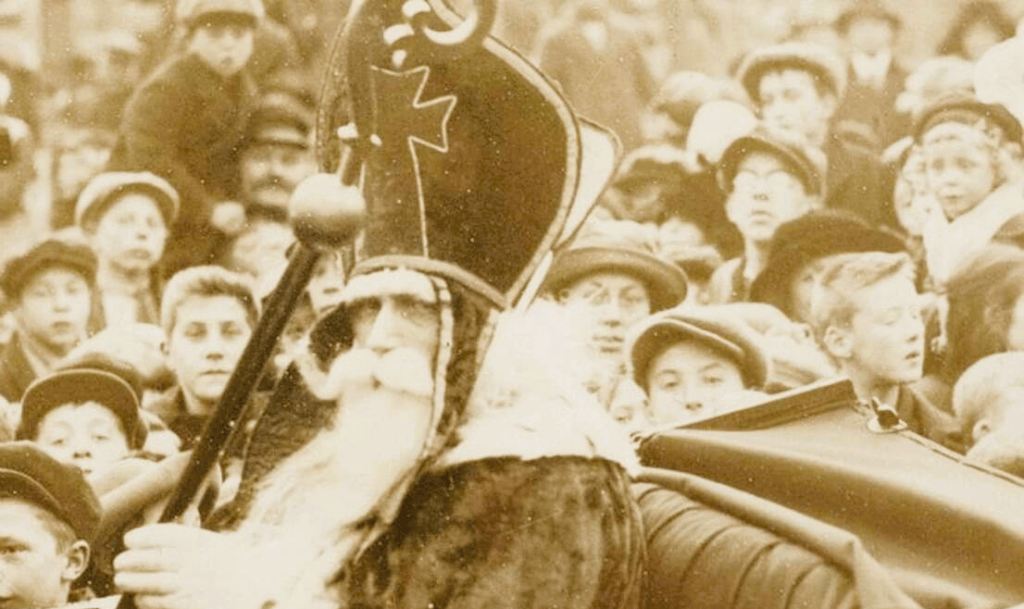
Before diving into the story, let me first give a brief explanation of who Sinterklaas is for those who may want to become more familiar with him.
Sinterklaas is a traditional holiday figure celebrated primarily in the Netherlands, Belgium, and parts of Germany. The festival, which has roots in both Christian and pre-Christian traditions, takes place annually on December 5th (the eve of St. Nicholas’s feast day) in the Netherlands and December 6th in Belgium. He is based on St. Nicholas of Myra, a 4th-century Christian bishop known for his generosity, particularly toward children and the poor. Over time, the religious aspects merged with folklore to create the modern figure of Sinterklaas, a kind, wise, and magical gift-giver.
Sinterklaas is depicted as an elderly man with a long white beard, dressed in a red bishop’s robe with a mitre (a bishop’s hat) and holding a golden crosier (a staff). He rides a white horse named Amerigo (or Ozosnel in newer traditions) and is accompanied by his helpers.
Zwarte Piet (Black Pete)
Sinterklaas is traditionally accompanied by helpers called Zwarte Pieten, who assist in delivering gifts and entertaining children.

The Sinterklaas tradition has long been a cherished cultural celebration in the Netherlands and other parts of Europe. But during World War II ), this beloved holiday took on new meanings, challenges, and forms. Against the backdrop of occupation, scarcity, and war, Sinterklaas became a symbol of resilience, hope, and subtle defiance.
A Tradition Under Threat
Sinterklaas, celebrated on December 5th, faced significant obstacles during World War II, especially in the Netherlands, which was under Nazi occupation from May 1940 to May 1945. The war created a scarcity of resources, restricting the availability of traditional Sinterklaas treats like pepernoten (a small, chewy, spiced cookie), chocolate letters, and marzipan. Toys, another hallmark of the holiday, were also hard to come by as factories shifted production to support the war effort. Families often made do with handmade gifts or small tokens of affection, keeping the spirit of the holiday alive despite material challenges.

The German occupiers sought to suppress Dutch cultural identity, including celebrations like Sinterklaas. However, the holiday couldn’t be entirely eradicated because it was too deeply rooted in Dutch society. Instead, it became an act of quiet resistance, with families and communities celebrating as a way to preserve their cultural heritage and spirit.
Adapting Traditions in Wartime
Despite the hardships, creativity flourished. During the war, children would often receive practical gifts like socks, scarves, or other necessities. Families crafted toys from scraps of wood or fabric, turning everyday objects into sources of joy.

The traditional Sinterklaas poems—lighthearted and often humorous verses accompanying gifts—became a vehicle for subtle social commentary. Some poems poked fun at the occupiers or expressed hope for liberation, hidden in clever wordplay to avoid attracting attention.
In some communities, Sinterklaas parades and public festivities were scaled back or canceled due to wartime restrictions. Yet, the holiday persisted in homes, where families gathered to sing traditional songs and share simple meals, creating a sense of togetherness amid the turmoil.
Sinterklaas as a Symbol of Hope
For many, Sinterklaas became more than a holiday during the war—it became a symbol of hope. In occupied territories, where daily life was marked by fear and uncertainty, the holiday reminded people of better times and their shared cultural identity.
The figure of Sinterklaas, with his red robes and bishop’s miter, served as a comforting presence for children and adults alike. His enduring image provided a sense of continuity, reassuring families that their traditions and values could survive even in the darkest times.

Liberation and Renewal
As the war ended in 1945, Sinterklaas celebrations resumed with renewed vigor. Families could once again enjoy traditional foods and gifts, and public parades returned to towns and cities. The holiday became a way to celebrate not only the festive season but also the resilience of the Dutch people and their culture.
The post-war period also saw a heightened appreciation for the holiday’s deeper meaning. Sinterklaas was no longer just about gifts and festivities; it was a reminder of the strength and unity that had carried communities through the war.
Legacy of Sinterklaas During WORLD WAR II
The story of Sinterklaas during World War II is one of resilience, adaptability, and quiet defiance. It shows how traditions can serve as a source of strength and continuity in times of upheaval. For those who lived through the war, the holiday was a beacon of hope, a reminder of their identity, and a celebration of their enduring spirit that continues to inspire us today.
Today, the Sinterklaas tradition continues to thrive, enriched by its history and the memories of those who preserved it during one of the most challenging periods of modern history. In remembering how Sinterklaas was celebrated during the war, we honor not just the holiday itself but the resilience and creativity of the people who kept its flame alive.
Sources
https://www.iamexpat.nl/lifestyle/lifestyle-news/sinterklaas-tradition-lived-through-world-war-ii
https://www.theroadtoengland.com/single-post/2017/12/01/sinterklaas-celebration-during-the-war
Donation
Your readership is what makes my site a success, and I am truly passionate about providing you with valuable content. I have been doing this at no cost and will continue to do so. Your voluntary donation of $2 or more, if you are able, would be a significant contribution to the continuation of my work. However, I fully understand if you’re not in a position to do so. Your support, in any form, is greatly appreciated. Thank you. To donate, click on the credit/debit card icon of the card you will use. If you want to donate more than $2, just add a higher number in the box left from the PayPal link. Your generosity is greatly appreciated. Many thanks.
$2.00
 History of Sorts
Leave a comment