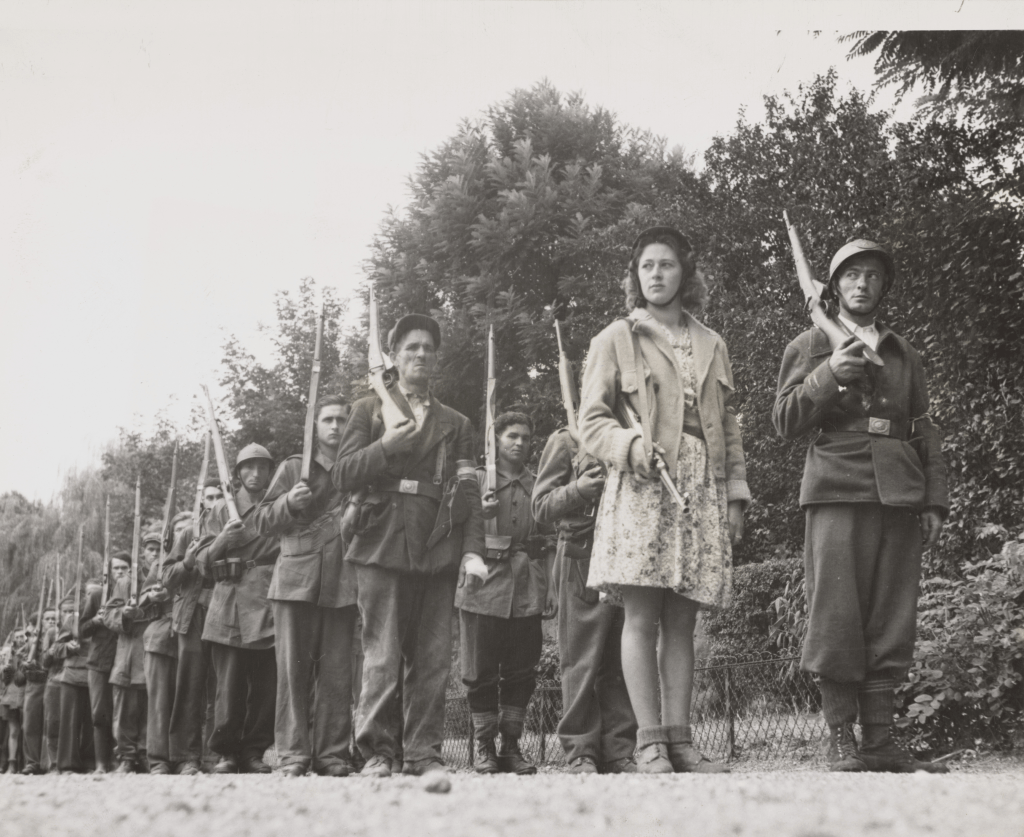
The Maquis were among the most emblematic forces of the French Resistance during the Second World War. Emerging in the countryside after France’s defeat in 1940 and the subsequent German occupation, these clandestine guerrilla groups played a decisive role in undermining Nazi control and preparing the ground for the liberation of France in 1944. Their significance lies not only in their military contributions but also in what they represented: a form of popular, decentralized resistance rooted in the landscape and social fabric of rural France.
The term maquis originally referred to dense Mediterranean scrubland, particularly in Corsica, where bandits and fugitives could hide from authorities. During the occupation, the word took on a political and military meaning, designating resistance groups that withdrew to forests, mountains, and remote rural areas to evade German forces and the collaborationist Vichy regime. These environments offered concealment, mobility, and access to sympathetic local populations, making them ideal bases for irregular warfare.
The Maquis grew substantially after 1942, when Germany began demanding forced labor from French civilians through the Service du Travail Obligatoire (STO). Thousands of young men, unwilling to work in German factories, fled to the countryside and joined or formed maquisard groups. As a result, the Maquis were often composed of young, politically diverse recruits—communists, Gaullists, socialists, and apolitical patriots—united more by opposition to occupation than by ideology.
Initially, the Maquis were poorly armed and loosely organized. They relied on hunting rifles, stolen weapons, and improvised explosives. Over time, however, they became increasingly effective due to coordination with larger Resistance networks and support from the Allies. British Special Operations Executive (SOE) and later American Office of Strategic Services (OSS) agents parachuted into France to train maquisards in sabotage, communications, and guerrilla tactics. Allied airdrops supplied modern weapons, radios, and explosives, transforming the Maquis into a serious military threat.
The primary activities of the Maquis included sabotage of railways, bridges, and communication lines; attacks on German convoys; intelligence gathering; and assistance to downed Allied airmen. These operations were designed to disrupt German logistics and troop movements, particularly in the lead-up to and aftermath of the D-Day landings in June 1944. In regions such as the Vercors Plateau, the Limousin, and Brittany, the Maquis briefly controlled significant territory, forcing German forces to divert troops from the front lines.
However, the Maquis paid a heavy price for their resistance. German reprisals were often brutal and indiscriminate. Entire villages suspected of aiding maquisards were destroyed, and civilians were executed or deported. The massacre at Oradour-sur-Glane in June 1944 stands as one of the most infamous examples of collective punishment linked to resistance activity. Maquis fighters themselves faced torture, summary execution, or deportation if captured. Despite these risks, local populations frequently supported them with food, shelter, and information, underscoring the deep social roots of the movement.
Politically, the Maquis also played a role in shaping postwar France. Their integration into the Forces Françaises de l’Intérieur (FFI) helped unify disparate resistance groups under a common command aligned with Charles de Gaulle’s Free French forces. This unification strengthened France’s claim to having liberated itself, countering the narrative of passive defeat and collaboration. After the war, the Maquis became a powerful symbol in French collective memory, embodying courage, sacrifice, and national dignity.
In conclusion, the Maquis were far more than bands of rural guerrillas. They represented a grassroots response to occupation, blending military action with moral resistance. Operating under extreme conditions and facing overwhelming force, they contributed materially to the Allied victory and symbolically to the restoration of French sovereignty. The legacy of the Maquis endures as a reminder that resistance can arise from ordinary people, armed with little more than determination, solidarity, and an intimate knowledge of their land.
sources
https://en.wikipedia.org/wiki/Maquis_(World_War_II)
https://www.britannica.com/topic/maquis-French-history
Donation
Your readership is what makes my site a success, and I am truly passionate about providing you with valuable content. I have been doing this at no cost and will continue to do so. Your voluntary donation of $2 or more, if you are able, would be a significant contribution to the continuation of my work. However, I fully understand if you’re not in a position to do so. Your support, in any form, is greatly appreciated. Thank you. To donate, click on the credit/debit card icon of the card you will use. If you want to donate more than $2, just add a higher number in the box left from the PayPal link. Your generosity is greatly appreciated. Many thanks.
$2.00

 History of Sorts
Leave a comment