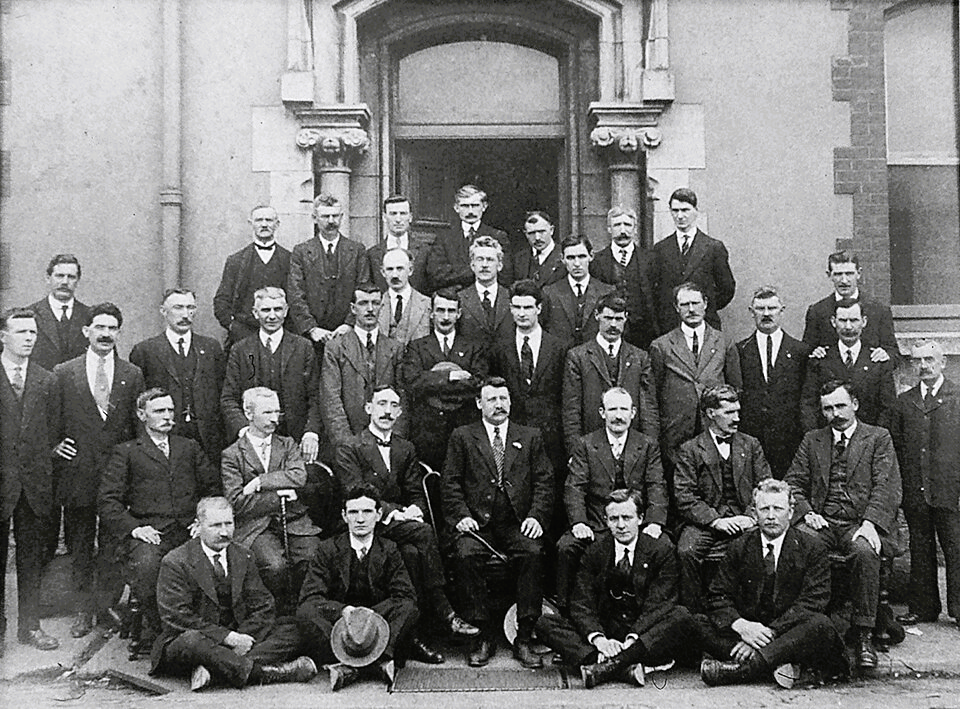
The Limerick Soviet, which existed for a brief period in April 1919, stands as one of the more intriguing yet often overlooked episodes in Irish labor history. It was a striking instance of workers asserting direct control over their city in response to both political and economic pressures, reflecting the global currents of labor militancy in the early twentieth century. Though short-lived, the event offers insights into the tensions between nationalism, labor activism, and the emergent idea of workers’ self-governance.
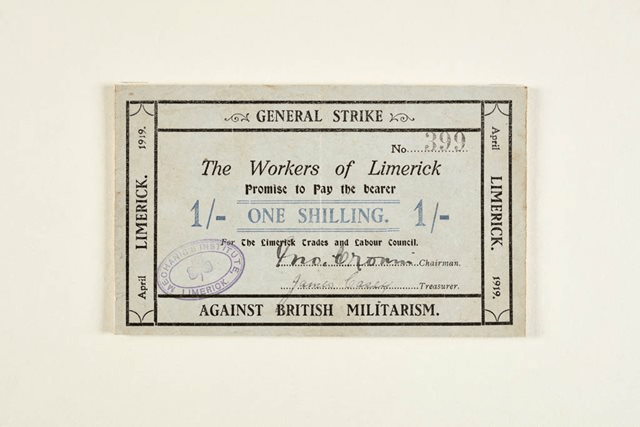
The Limerick Soviet (Irish: Sóivéid Luimnigh) was one of several self-declared Irish soviets that emerged around Ireland circa 1919. It existed for two weeks, from 14 to 27 April 1919. At the start of the Irish War of Independence, the Limerick Trades and Labour Council organized a general strike in protest against the British Army’s declaration of a “Special Military Area” under the Defence of the Realm Act, which encompassed most of Limerick city and part of the county. During this period, the soviet effectively ran the city, printed its own currency, and organized food distribution. The Limerick Soviet was among several Irish soviets declared between 1919 and 1923.
Creation
From January 1919, the Irish War of Independence developed as a guerrilla conflict between the Irish Republican Army (IRA), backed by Sinn Féin’s Dáil Éireann, and the British government. On 6 April 1919, the IRA attempted to rescue Robert Byrne, who was hospitalized after a hunger strike. In the attempt, Constable Martin O’Brien was fatally wounded, another policeman was seriously injured, and Byrne later died of his wounds.
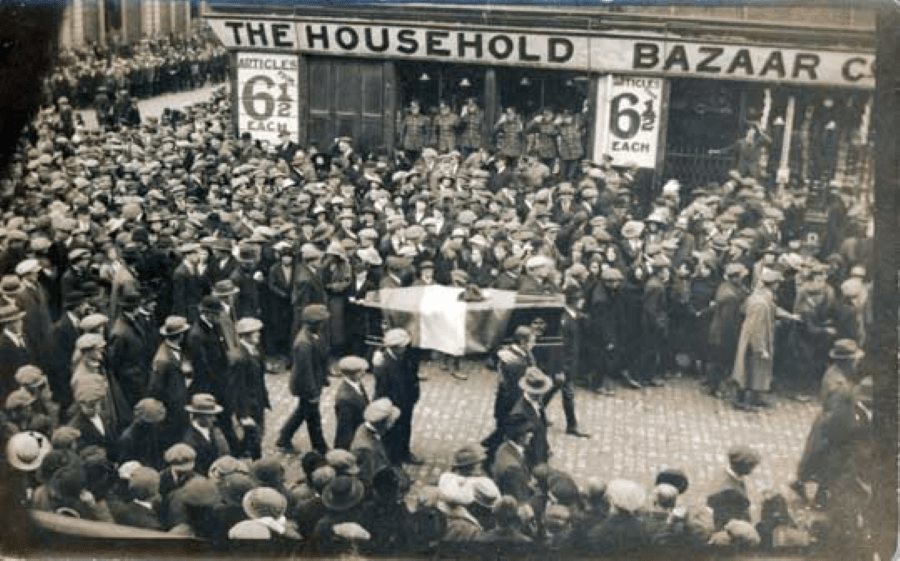
In response, on 9 April, British Army Brigadier Griffin declared Limerick a Special Military Area, requiring RIC permits for anyone entering or leaving the city from 14 April. British troops and armored vehicles were deployed to enforce the order.
On 11 April, the United Trades and Labour Council, of which Byrne had been a delegate, met. Sean Dowling of the Irish Transport and General Workers’ Union (ITGWU) proposed that trade unions take over the Town Hall for meetings, though this was not voted on. On 12 April, ITGWU workers at Cleeve’s factory voted to strike. After a twelve-hour discussion on 13 April, the United Trades and Labour Council called a general strike, with leadership devolved to a committee that declared itself a “soviet” on 14 April. Influenced by the Dublin general strike of 1913 and the Russian soviets of 1917, the term signified a self-governing workers’ committee.
On Monday, 14 April, workers at Cleeve’s Condensed Milk and Butter Factory went on strike. The Trades Council soon called a citywide general strike, bringing 15,000 workers out. The Evening Herald described it as a “struggle between organised labour and government.” The Trades Council transformed into a strike committee, with John Cronin appointed chairman.
The Limerick Soviet was officially declared on 15 April 1919, with the strike committee stating it was “a protest against the decision of the British Government in compelling them to procure permits in order to earn their bread.” Sinn Féin and the Catholic Church faced a dilemma: openly supporting or condemning the strike. Condemnation risked alienating the working-class base that overwhelmingly supported it. They therefore condemned the military cordon and called for the British Army’s withdrawal from the city.
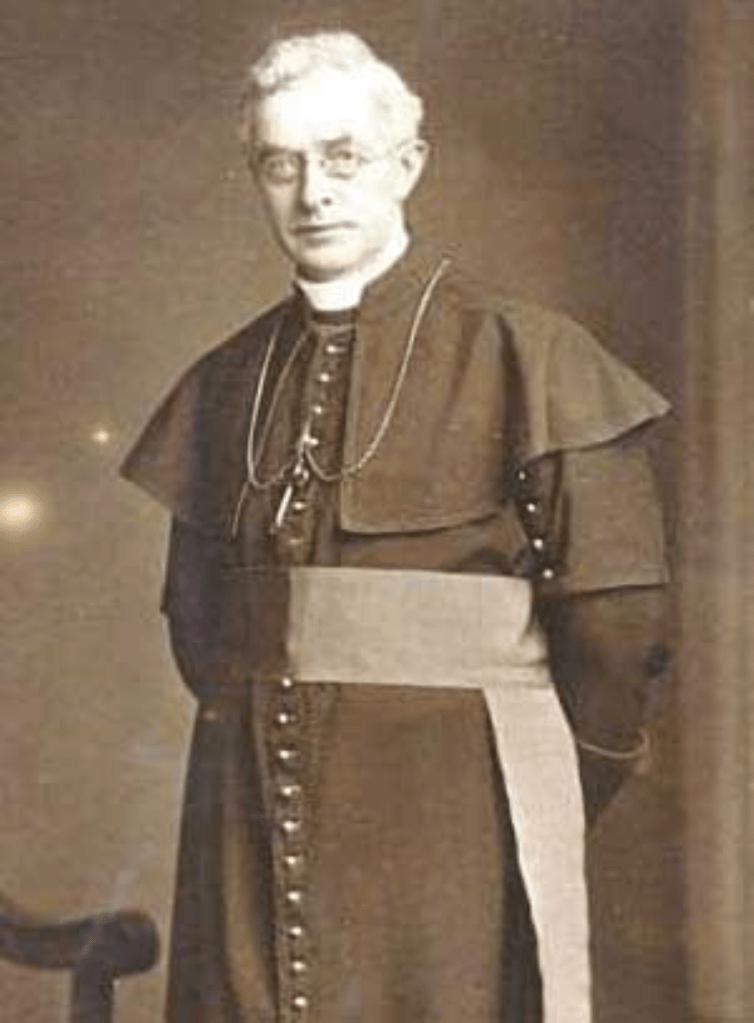
The Catholic Church played a significant supportive role in the Soviet’s early stages. Clergy appealed to the public to provide food for Limerick, acting with the sanction of Most Revd. Dr. Fogarty, Bishop of Killaloe. The appeal received a generous response, including a donation of twenty tons of potatoes.
Media Attention
A transatlantic air race planned for Bawnmore, County Limerick, was canceled due to the strike, drawing international journalists who covered the Limerick Soviet. Trades Council chairman John Cronin was called the “father of the baby Soviet.” Ruth Russell of the Chicago Tribune noted the religiosity of the committee, describing guards pausing to bless themselves at the Angelus. Sinn Féin Mayor Phons O’Mara insisted there was no prospect of socialism in Limerick, stating, “There can’t be; the people here are Catholics.”
British Response
The British Army was caught off guard by the strike, despite martial law being relatively common during the War of Independence. Within half an hour of the strike’s declaration, local police chiefs contacted Dublin Castle requesting 300 additional constables; 50 were dispatched. For safety, police and military personnel were confined to barracks while commanders deliberated on their response.
Commander General Griffith led the British military and diplomatic reaction, focusing on the Chamber of Commerce as potential allies. He proposed a compromise allowing city employers, rather than the military, to issue permits to their employees, making the process faster and more practical. On 17 April, Bishop Dr. Denis Hallinan and Mayor Alphonsus O’Mara met secretly with Griffith, who agreed to lift the military permit order within the week provided no further disturbances occurred.
Operations
The strike committee extended the strike to a boycott of British troops, printing its own currency, regulating food prices, and publishing The Worker’s Bulletin. Local businesses accepted the strike currency, and cinemas operated under the committee’s authority. Newspapers could publish weekly with the caption “Published by Permission of the Strike Committee.”
On 21 April, The Worker’s Bulletin proclaimed: “A new and perfect system of organisation has been worked out by a clever and gifted mind, and ere long we shall show the world what Irish workers are capable of doing when left to their own resources.” The paper clarified that the strike was independent of Sinn Féin politics.
Historian Liam Cahill notes that the soviet’s approach to private property was pragmatic: as long as shopkeepers complied with its directives, their premises were not commandeered. While some described the strike as revolutionary, Cahill concludes it was largely an emotional, spontaneous protest rooted in nationalist and humanitarian concerns rather than socialist or trade unionist ideology.
After two weeks, pressure from Sinn Féin Mayor Phons O’Mara and Catholic Bishop Denis Hallinan led the Strike Committee to end the strike with a proclamation on 27 April 1919.
Significance and Legacy
Though it lasted only two weeks, the Limerick Soviet had symbolic and practical significance. It represented a rare moment in which Irish workers directly challenged authority and demonstrated organizational capability on a city-wide scale. Politically, it highlighted the intersection between nationalist and labor struggles: the Soviet was as much about resisting British military control as it was about advancing workers’ interests. However, the Soviet ultimately collapsed due to economic pressures, lack of broader political support, and the pragmatic need to resume normal commerce.
The event remains an important milestone in Irish labor history. It reflected broader trends in early twentieth-century Europe, where workers’ councils, strikes, and soviets were emerging as tools for challenging both state and capitalist power. Moreover, the Limerick Soviet has inspired subsequent labor movements in Ireland and beyond, serving as a reminder that organized workers can wield real power, even under extraordinary political constraints.
Conclusion
The Limerick Soviet was a short-lived but remarkable episode of worker-led governance. Emerging from the pressures of militarization and political unrest, it demonstrated the potential of organized labor to maintain social order and exercise economic control. While it did not endure, the Soviet left a lasting legacy as a symbol of workers’ solidarity, civic responsibility, and resistance to oppression. In the broader history of labor movements, it stands as an Irish counterpart to the revolutionary councils seen elsewhere in Europe, a testament to the power of collective action even in the face of overwhelming odds.
sources


Leave a comment