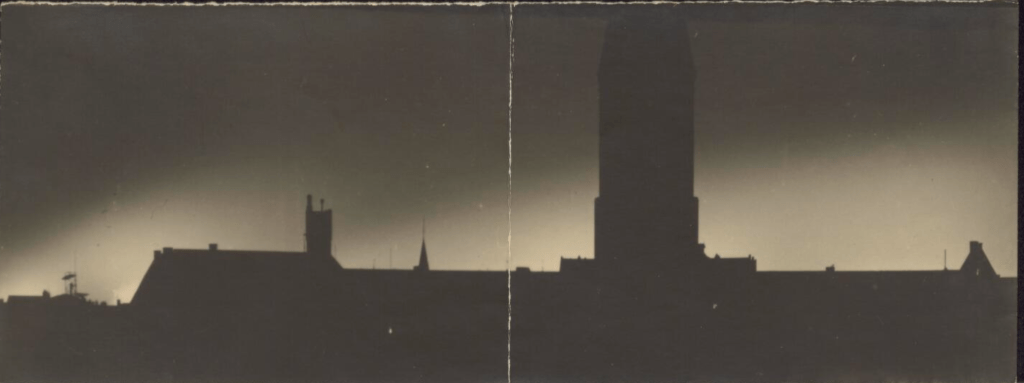
A Rain of Bombs
March 1945, two months before the liberation. Den Haag has by then been occupied by the Germans for nearly five years. It is the tail end of the Hongerwinter, and there is a shortage of almost everything.
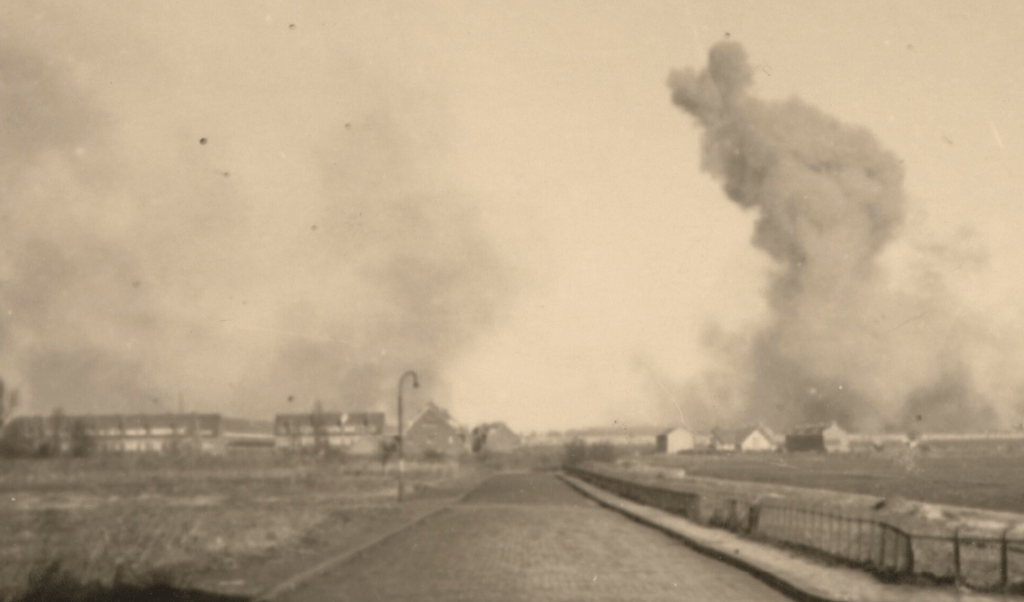
On March 3, an additional great tragedy strikes the residents of the Bezuidenhout district of The Hague. At 9 a.m., they are startled by a rain of bombs. Before long, the entire neighborhood is engulfed in flames.
On 3 March 1945, the Bezuidenhout district of The Hague was devastated by a British air raid intended to destroy German V-2 launch installations in the nearby Haagse Bos. Instead, more than 500 civilians were killed and hundreds injured when the bombs fell on residential streets.
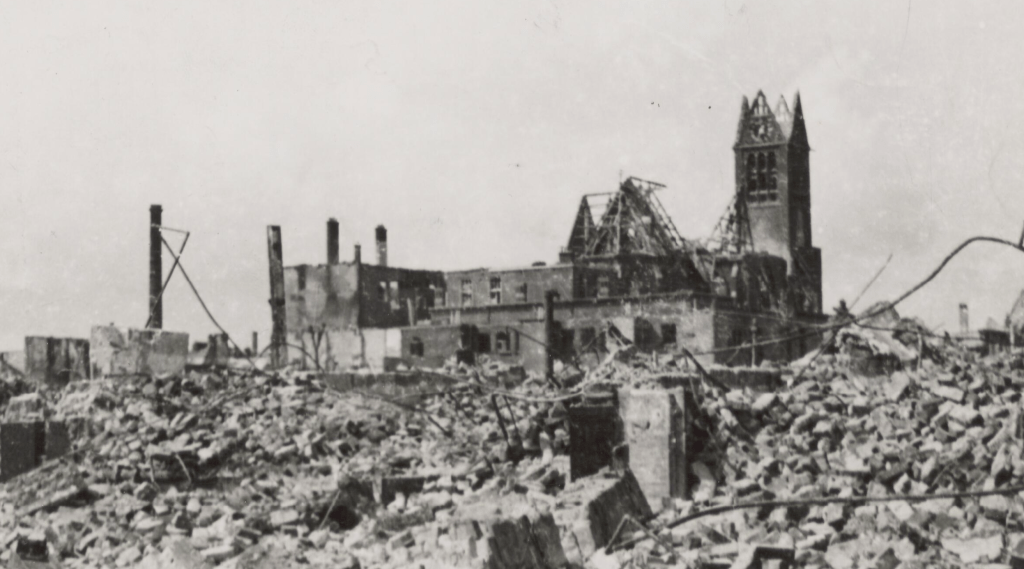
During the Second World War, The Hague had largely escaped large-scale destruction. That changed on 3 March 1945. Seeking to neutralise V-2 launch sites used by the occupying German forces, the RAF Second Tactical Air Force dispatched 56 Mitchell and Boston bombers from bases in Belgium and northern France. The operation failed catastrophically.
From the Daily Report of the Air Protection Service (No. 62) for Saturday, March 3, 1945
8:02 – Air raid alarm
8:24 – End of air raid alarm
8:38 – Air raid alarm
8:48 – End of air raid alarm
8:59 – Air raid alarm, Post 4 reports: “bomb hits at 360º North”
9:00 – Post 1 reports: “heavy smoke clouds and flames toward Bezuidenhout
12:50 – Post 1 reports: “planes dropping bombs on Bezuidenhout; due to heavy smoke development, nothing can be observed.”
A navigational error—caused by incorrect target coordinates—combined with poor visibility due to low-hanging fog meant that the aircraft crews were unable to identify the intended target area. A strong northerly wind further displaced the bomb loads. Released in several waves, the bombs fell primarily over the densely populated Bezuidenhout district; the Korte Voorhout was also struck. Explosives hit the Louise de Colignyplein, at the heart of the residential area, rather than the V-2 installations in the Haagse Bos.
In total, approximately 67,000 kilograms of high-explosive and anti-personnel bombs were dropped. More than 520 people were killed and over 250 seriously injured. Thousands were left homeless as houses, shops, schools, churches, and businesses were reduced to rubble. Many victims perished in the fires that spread rapidly through the neighbourhood.
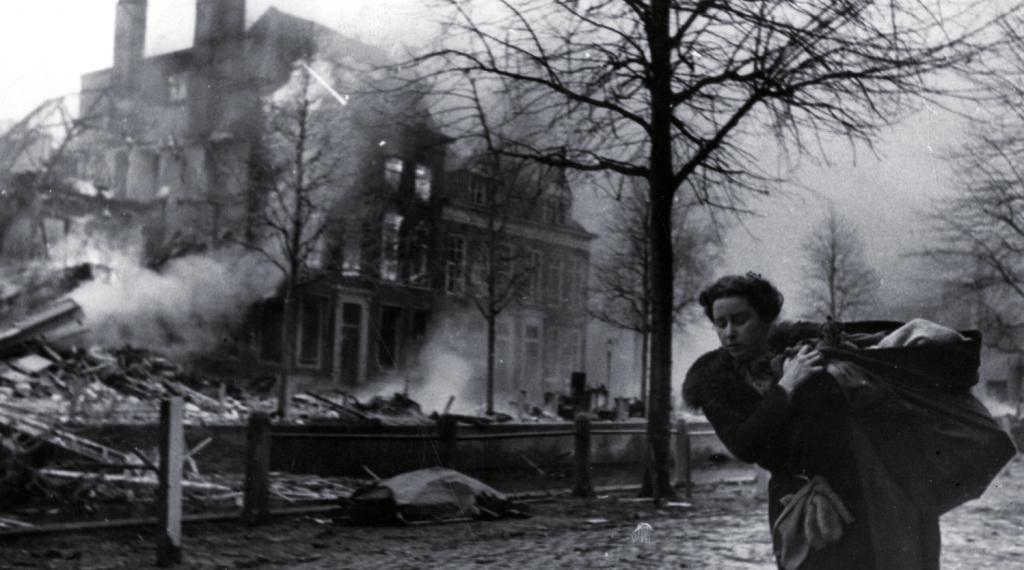
Although emergency services responded swiftly, their capacity was severely limited. A shortage of firefighters and equipment—exacerbated by wartime conditions—and ruptured water mains hampered efforts to control what survivors later described as an “inferno.” Entire streets burned unchecked.
Those who escaped the bombing and subsequent fires fled en masse toward Voorburg and Binckhorst. Access to Benoordenhout was blocked by German fortifications associated with the Atlantic Wall in the Haagse Bos. In panic, residents gathered whatever belongings they could carry, including Swedish relief bread distributed the previous day. Many refugees arrived in neighbouring districts with little more than the clothes they were wearing. They were taken in by local families and, despite the scale of their losses, were grateful simply to have survived.
A survivor later recalled:
“Everyone went out and into the street. You saw people running, running, running everywhere. But whichever way you ran, there was fire everywhere.”
At the time of the attack, Bezuidenhout was more crowded than usual, as it housed evacuees from The Hague and Wassenaar. Tens of thousands were left homeless and were subsequently relocated to other parts of the eastern and central Netherlands.
Response and Aftermath
Firefighting efforts were severely constrained. Many firemen had been conscripted for forced labour in Germany or had gone into hiding to avoid deportation, and the available equipment was inadequate for a blaze of such magnitude. The resulting fires burned largely unchecked.
The bombing killed 532 people in total, including ten firemen at the Schenkkade. In addition to the fatalities, hundreds were injured and vast sections of the neighbourhood were destroyed.
When British authorities realised the scale of the devastation, aircraft dropped leaflets over the area expressing regret for the civilian casualties caused by the navigational error.
The Dutch resistance newspaper Trouw described the event in stark terms, portraying The Hague as a frontline city engulfed in smoke and flames. It recounted the sight of burning buildings, fleeing families, and the eerie spectacle of V-2 rockets launching from within residential districts. The article conveyed a city overwhelmed by fire, chaos, and the cumulative horrors of war.
Casualties, Losses, and Damage
Fatalities: 532
Wounded: 344
Homeless: 30,000
Residences:
3,300 completely destroyed
3,250 burned out
3,241 damaged
391 irreparably damaged
Businesses: 290 completely destroyed
Churches: 5 completely destroyed
Schools: 9 completely destroyed
Public Buildings: 10 completely destroyed

Brave and Strong Rescuers
At great risk to their own lives, the rescuers did what they could amid the fiercely burning rubble. Yet, once again, things went wrong through no fault of their own.
Because the Germans had previously requisitioned ambulances, the nursing staff had to make do with horse-drawn carts or handcarts. The remaining ambulances stood idle at the roadside due to a lack of fuel. Hospitals were overcrowded.
It was no different for the fire brigade. Equipment was scarce, having been seized by the Germans, and personnel were depleted because firefighters had been sent to work in Germany. A group of ten firefighters on the Schenkkade was fatally struck by a German V2 rocket.
And to make matters worse: there was a lack of water to fight the inferno. Water pipes had been severely damaged by the bombing and the fires. As if that weren’t enough, a strong north wind continually fanned the flames.
Ultimately, all professional rescuers struggled with poor and delayed communication. Telephone and radio connections were no longer possible due to the bombing—or because the Germans had already confiscated the necessary equipment.
sources
https://en.wikipedia.org/wiki/Bombing_of_the_Bezuidenhout
https://nos.nl/bevrijdingsjaar/bericht/2325540
https://www.bb45.nl/het-bombardement
https://www.haagsetijden.nl/tijdlijn/de-wereldoorlogen/bombardement-bezuidenhout
https://www.wo2sporen.eu/3-maart-1945
https://www.liberationroute.com/en/stories/166/bombardement-op-bezuidenhuit
Donation
Your readership is what makes my site a success, and I am truly passionate about providing you with valuable content. I have been doing this at no cost and will continue to do so. Your voluntary donation of $2 or more, if you are able, would be a significant contribution to the continuation of my work. However, I fully understand if you’re not in a position to do so. Your support, in any form, is greatly appreciated. Thank you. To donate, click on the credit/debit card icon of the card you will use. If you want to donate more than $2, just add a higher number in the box left from the PayPal link. Your generosity is greatly appreciated. Many thanks.
$2.00


Leave a Reply