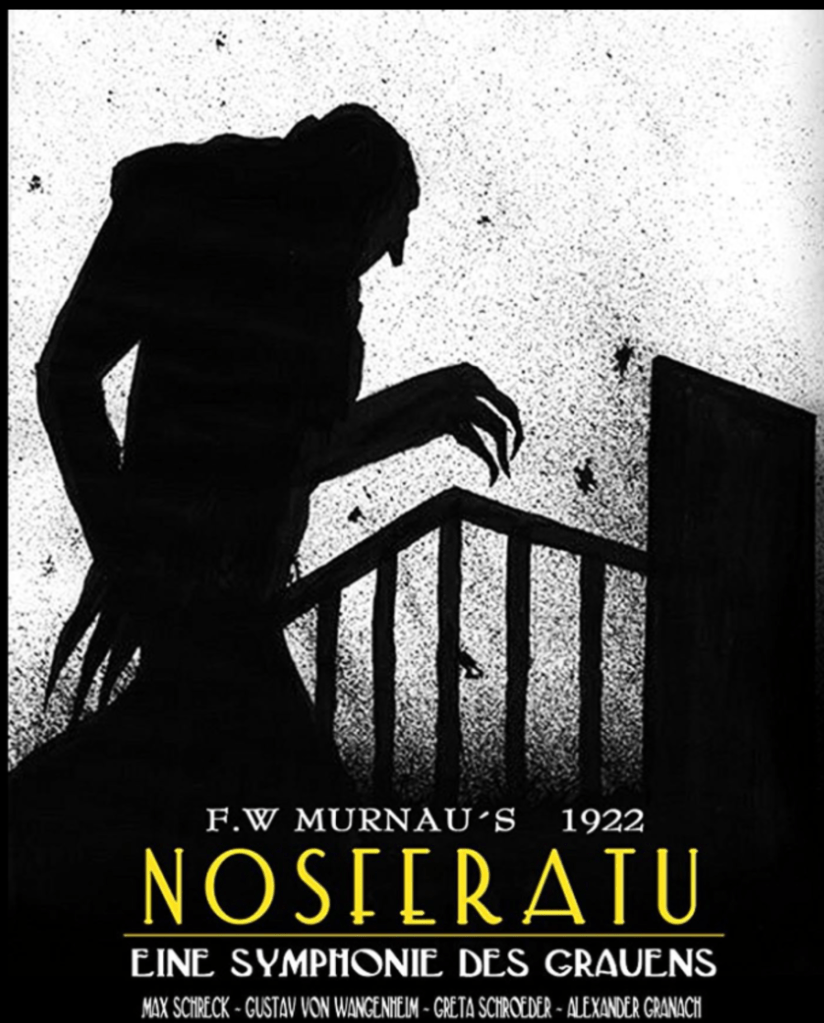
The 1922 silent masterpiece Nosferatu: A Symphony of Horror (Nosferatu – Eine Symphonie des Grauens) isn’t just a film; it’s a survivor. Directed by F.W. Murnau, it remains the foundational text of cinematic horror, having narrowly escaped a court-ordered destruction to become the definitive visual language of the vampire mythos.
The Birth of a Shadow
In the early 1920s, German Expressionism was hitting its stride, characterized by distorted sets and high-contrast lighting. Murnau, however, took a different approach. Unlike the stage-bound The Cabinet of Dr. Caligari, Murnau filmed Nosferatu on location in Orava, Slovakia, and Lübeck, Germany.
By blending naturalistic settings with the supernatural presence of Count Orlok, Murnau created a “uncanny” feeling—the sense that the monstrous was invading the real world rather than existing in a dreamscape.
The Legal Battle for Blood
One of the most famous aspects of Nosferatu is its status as an unauthorized adaptation of Bram Stoker’s Dracula. Prana Film failed to secure the rights from Stoker’s widow, Florence Stoker. To avoid litigation, they changed the names:
- Count Dracula became Count Orlok.
- Vampires were called Orlok’s kin (or “Nosferatu”).
- Jonathan Harker became Thomas Hutter.
The effort was unsuccessful. Florence Stoker sued, won, and a court ordered every print of the film destroyed. Thankfully, a few copies had already been distributed globally, allowing this “symphony” to be reconstructed for future generations.
Max Schreck and the Visage of Death
While modern vampires are often portrayed as seductive or tragic figures, Max Schreck’s Orlok is a revolting personification of pestilence. With his rat-like teeth, elongated talons, and stiff, mechanical movements, he represented the “Old World” coming to infect the “New.”
The film utilizes several groundbreaking techniques for the time:
- Negative Film: Used to depict the “White Land” leading to the castle, giving the trees a ghostly, skeletal appearance.
- Stop-Motion: Used to make the lid of Orlok’s coffin slide off as if by magic.
- Shadowplay: The iconic shot of Orlok’s shadow creeping up the stairs toward Ellen’s bedroom remains one of the most parodied and celebrated images in art history.
Themes: Plague and Paranoia
Released shortly after World War I and the Spanish Flu pandemic, Nosferatu tapped into a collective societal trauma. Orlok doesn’t just kill individuals; he brings the plague.
As his ship, the Empusa, arrives in Wisborg, it carries coffins filled with “cursed earth” and rats. The film equates the vampire with a virus—an invisible, unstoppable force of nature that feeds on the living. It shifted the vampire from a folkloric ghost to a biological threat.
The Ending: A Cinematic Sacrifice
In Stoker’s novel, Dracula is defeated by a group of men with knives and Winchesters. Murnau introduced a poetic, high-stakes conclusion that forever changed vampire lore: The sun.
Before Nosferatu, vampires in folklore were often active (though weakened) during the day. Murnau invented the concept that sunlight is fatal to the vampire. Ellen Hutter’s decision to distract Orlok until the sun rises—sacrificing her own life to save the city—transformed the horror story into a tragic, religious allegory of purity overcoming darkness.
Legacy
Without Nosferatu, the visual shorthand for horror—creeping shadows, the pale monster, the vulnerability of the night—would look entirely different. It paved the way for the Universal Monsters of the 1930s and continues to influence directors like Robert Eggers, who is releasing a highly anticipated remake this year.
Fun Fact: Max Schreck’s performance was so convincing that a legend persisted for decades that he was an actual vampire—a myth explored in the 2000 film Shadow of the Vampire.
Sources
 History of Sorts
Leave a comment