
Before detailing the capture of Rudolf Höss on 11 March 1946, it is important to highlight this pre–World War II event, which provides insight into the kind of man he was.
On 31 May 1923 in Mecklenburg, Rudolf Höss and members of the Freikorps murdered local schoolteacher Walther Kadow at the instigation of farm supervisor Martin Bormann, who later became Adolf Hitler’s private secretary. Kadow was suspected of informing the French occupation authorities about sabotage operations carried out by Freikorps member Albert Leo Schlageter against French supply lines. After Schlageter’s arrest and execution on 26 May 1923, Höss and several accomplices, including Bormann, killed Kadow in retaliation.
Later that year, after one of the perpetrators confessed to a local newspaper, Höss was arrested and tried as the ringleader. Although he later claimed another man had directed the attack, he accepted responsibility as the group’s leader. In March 1924 he was sentenced to ten years in prison, while Bormann received a one-year sentence. Höss served his term in Brandenburg penitentiary, where his reported exemplary conduct earned him certain privileges, including extended cell lighting, biweekly correspondence with relatives, and administrative work. These privileges were partly due to his classification as a “delinquent motivated by conviction” and partly because some prison officials sympathized with his political views.

The capture of Rudolf Höss, the longest-serving commandant of Auschwitz, is a story of meticulous detective work, a family’s desperate silence, and the eventual unmasking of one of history’s most prolific mass murderers. While many high-ranking Nazis fled to South America or committed suicide in the ruins of the Reich, Höss nearly slipped through the cracks of history by transforming into a simple farmhand.
The Disappearance of “Franz Lang”
As the Third Reich collapsed in May 1945, Höss followed the advice of Heinrich Himmler: disappear into the German Navy. He donned the uniform of a petty officer and assumed the identity of Franz Lang.
For nearly a year, the man responsible for the deaths of over a million people lived a quiet, agrarian life on a farm in Gottrupel, near the Danish border. To his neighbors, he was just another displaced veteran of a lost war. To the British investigators, however, he was a “Priority 1” target who had seemingly vanished into thin air.
The Hanns Alexander Investigation
The breakthrough didn’t come from a massive military sweep, but from the persistence of a small team of investigators led by Hanns Alexander, a German-born Jew who had fled Berlin for Britain and joined the British Intelligence Corps.
Alexander was fueled by a personal drive to bring the architects of the Holocaust to justice. His investigation eventually led him to Höss’s wife, Hedwig, and their children, who were living in an old sugar factory in northern Germany.
The Breakthrough: A Mother’s Choice
Hedwig Höss was initially defiant, insisting her husband was dead. However, Alexander utilized a combination of psychological pressure and a ticking clock. On the night of March 11, 1946, Alexander entered the family home and presented Hedwig with a choice: reveal her husband’s location or see her eldest son, Klaus, deported to Siberia.
Faced with the threat to her children, Hedwig broke. She scrawled the location of the “Lang” farm on a piece of paper.
The Arrest at the Farm
In the middle of the night, Alexander’s team descended on the farm in Gottrupel. They found “Franz Lang” sleeping in a barn. When confronted, Höss initially clung to his alias, but the charade ended when Alexander demanded he remove his wedding ring.
Höss claimed the ring was stuck, but a threat to cut off his finger prompted him to surrender it. Inside the gold band, the investigators found the engraved initials “R.H.” > “He looked like a common gardener,” Alexander later remarked. “It was hard to believe this small man was the commandant of the largest death camp in history.”
Aftermath and Legacy
Höss’s capture was a pivotal moment for the Nuremberg Trials. Unlike many of his peers who claimed ignorance or “Sonderbehandlung” (special treatment) as a euphemism, Höss was chillingly bureaucratic. He confessed to his crimes with a cold, mathematical precision, even correcting prosecutors when they underestimated the death toll at Auschwitz.
From his cell on 16 March 1946, Höss wrote: “I personally arranged, on orders from Himmler in May 1941, the gassing of two million people between June/July 1941 and the end of 1943, during my tenure as commandant of Auschwitz.”
Key Facts of the Post-Capture Proceedings:
Testimony: He served as a witness at Nuremberg, where his matter-of-fact descriptions of gas chambers horrified the world.
Extradition: He was later handed over to Polish authorities.
Execution: On April 16, 1947, he was hanged on a gallows specifically constructed at the Auschwitz I camp, within sight of the villa where he had lived with his family.
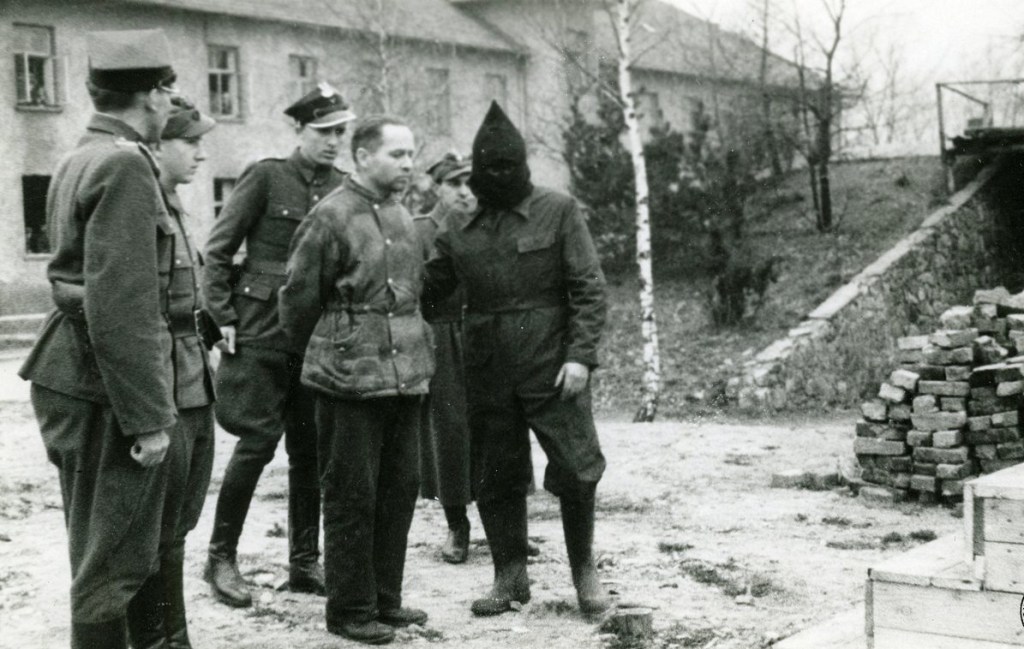
The capture of Rudolf Höss remains a testament to the fact that even the most “ordinary” facade can hide extraordinary evil. It was a victory not just for the British military, but for the survivors who needed the world to hear the truth from the mouth of the perpetrator himself.
sources
https://www.annefrank.org/en/timeline/120/the-execution-of-auschwitz-commander-rudolf-hoss/
https://www.bbc.com/news/uk-england-northamptonshire-66875251
https://www.britannica.com/biography/Rudolf-Franz-Hoss
https://en.wikipedia.org/wiki/Rudolf_H%C3%B6ss
Donation
Your readership is what makes my site a success, and I am truly passionate about providing you with valuable content. I have been doing this at no cost and will continue to do so. Your voluntary donation of $2 or more, if you are able, would be a significant contribution to the continuation of my work. However, I fully understand if you’re not in a position to do so. Your support, in any form, is greatly appreciated. Thank you. To donate, click on the credit/debit card icon of the card you will use. If you want to donate more than $2, just add a higher number in the box left from the PayPal link. Your generosity is greatly appreciated. Many thanks.
$2.00

 History of Sorts
Leave a comment