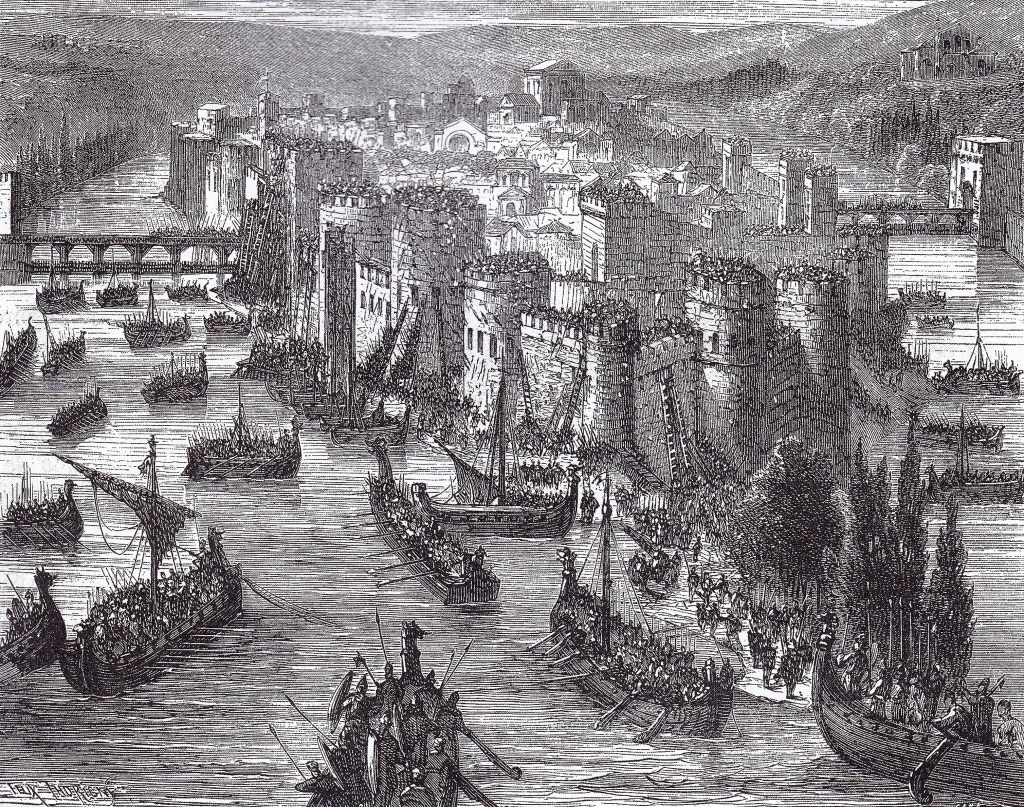
The Viking Siege of Paris of 845, stands as one of the most dramatic and consequential incursions of the early medieval Viking Age. Occurring during a period of political fragmentation in the former Carolingian Empire, the siege exposed both the vulnerability of Frankish defenses and the growing sophistication of Viking raiding strategies.
In the mid-9th century, the territory of West Francia—ruled by Charles the Bald, a grandson of Charlemagne—was beset by internal instability and external threats. Viking groups, originating from Scandinavia, had increasingly shifted from hit-and-run coastal raids to deeper incursions along river systems. The Seine River, which flows directly into the heart of Paris, became a strategic route for these expeditions.
In 845, a large Viking fleet—traditionally said to consist of around 120 ships and several thousand warriors—sailed up the Seine under the leadership often attributed to Ragnar Lodbrok, though the historicity of this attribution remains debated. Regardless of the exact leader, the force demonstrated careful planning and coordination, targeting monasteries and settlements along the river before advancing toward Paris itself.
At the time, Paris was not yet the grand capital it would later become, but it was still a significant political and cultural center. The Vikings attacked on or around Easter, a detail noted in Frankish chronicles that underscores both the shock and symbolic weight of the assault. Frankish forces attempted to resist but were decisively defeated. According to contemporary accounts, captured defenders were executed in a brutal display meant to intimidate the population and weaken morale.
Faced with the inability to repel the invaders militarily, Charles the Bald resorted to negotiation. He agreed to pay a substantial ransom—reported to be 7,000 livres of silver and gold—to persuade the Vikings to withdraw. This payment, one of the earliest recorded instances of what would later be called Danegeld, set a precedent that would have lasting implications. While it secured the immediate safety of Paris, it also signaled to Viking leaders that such campaigns could yield enormous profits with relatively limited risk.
The consequences of the siege were far-reaching. In the short term, it exposed the defensive weaknesses of West Francia and encouraged further Viking incursions. In the longer term, it prompted changes in military and administrative strategies, including the fortification of key cities and bridges along rivers to prevent similar attacks. The psychological impact was equally significant: the sack of Paris became emblematic of the broader Viking threat to Christian Europe.
Historiographically, the event occupies an important place in understanding the evolution of Viking activity. Earlier raids had focused primarily on monasteries and coastal settlements, but the 845 siege demonstrated a transition toward more ambitious operations targeting major inland centers. It also illustrates the interplay between warfare and diplomacy, as rulers like Charles the Bald balanced resistance with pragmatic concessions.
In conclusion, the Viking Siege of Paris in 845 was not merely an isolated raid but a pivotal episode in early medieval European history. It revealed the adaptability and reach of Viking forces, highlighted the political fragility of the Carolingian successor states, and reshaped defensive and fiscal policies in response to external threats. Its legacy persisted for generations, influencing both the trajectory of Viking expansion and the development of medieval European statecraft.
sources
https://historymedieval.com/the-siege-of-paris-city-under-fire/
https://app.ar-tour.com/guides/researching-paris/siege-of-paris-845.aspx
 History of Sorts
Leave a comment