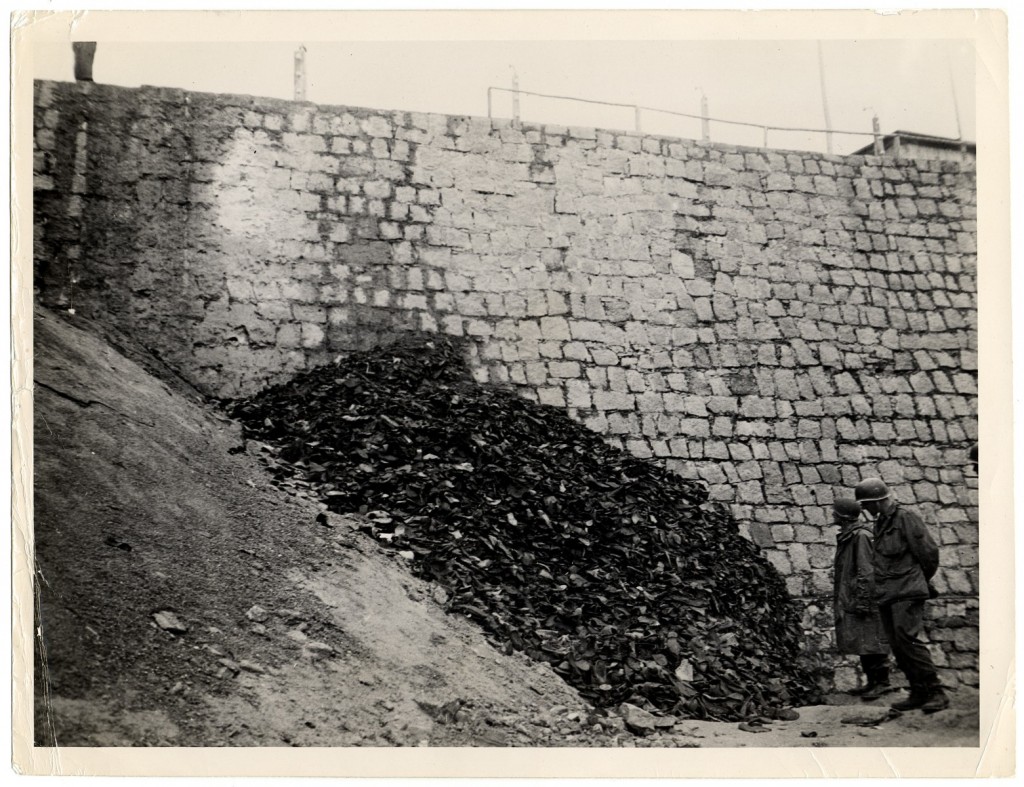
As U.S. forces approached in mid-April 1945, the SS began forcibly evacuating prisoners from Flossenbürg, leaving behind only those too weak to walk. Between April 15 and April 20, they removed most of the roughly 9,300 prisoners still held in the main camp—including about 1,700 Jews—along with an additional 7,000 prisoners recently transferred from Buchenwald. The prisoners were driven toward Dachau, either on foot or by train. An estimated 7,000 died along the way from exhaustion, starvation, or execution by SS guards when they could no longer keep pace.
Thousands of others escaped, were liberated by advancing U.S. troops, or found themselves free when their guards deserted under cover of darkness. Fewer than 3,000 of those evacuated from Flossenbürg reached Dachau, where they joined approximately 3,800 prisoners from its subcamps. When units of the 358th and 359th U.S. Infantry Regiments (90th Infantry Division) liberated Flossenbürg on April 23, 1945, just over 1,500 prisoners remained in the camp.
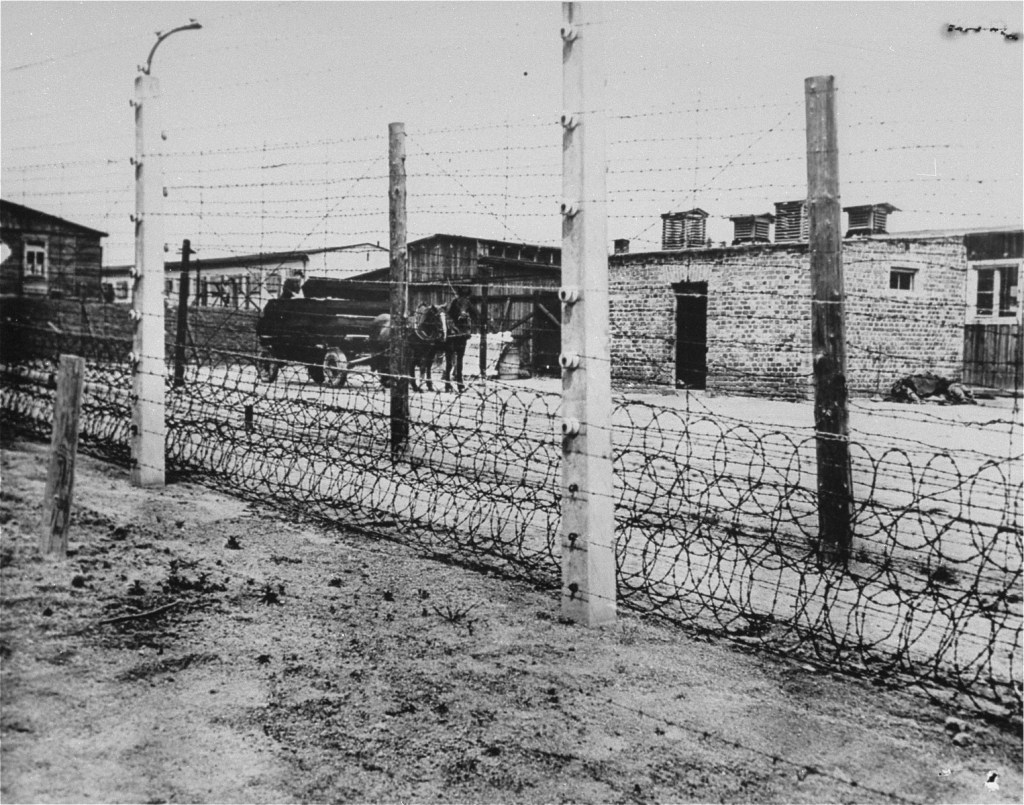
Three officers were among the first Americans to pass through the gates that day: an intelligence officer, an interpreter, and a regimental surgeon—Maj. James Campbell.
He was 27 years old.
The war was still ongoing. Shelling and gunfire echoed in the distance. But what Campbell encountered inside Flossenbürg was something altogether different: a humanitarian catastrophe unfolding in real time.
Naked men lay crammed onto wooden bunks, too weak even to lift their heads. Lice covered their bodies and infested the soiled straw beneath them. Disease—typhus, tuberculosis, dysentery—spread unchecked. Starvation had reduced many to such extremes that even basic medical diagnosis was no longer possible.
In a written report, Campbell described prisoners as being “in extremis from privation and starvation,” beyond the reach of ordinary medicine.
Near the crematorium, still smoking, he counted 46 corpses “stacked like cordwood.” More bodies lay scattered across the camp. The chief attendant, a Czech prisoner, explained through a Polish interpreter that he had been forced to burn up to 50 bodies a day for nearly six years.
Inside the camp’s so-called hospital, an emaciated inmate—a former nurse from France—showed Campbell a heavy sack filled with human teeth containing gold and silver fillings. Many, the man said, had been pulled from living prisoners, whether necessary or not.
Another inmate, a young Belgian resistance fighter, had risked his life to keep a secret ledger. It recorded the names of 73,246 people he believed had died at Flossenbürg since 1939.
“No exact diagnosis was even possible,” Campbell wrote.
One eyewitness, U.S. Army Sgt. Harold C. Brandt of the 11th Armored Division, took part in the liberation of three camps—Flossenbürg, Mauthausen, and Gusen. Reflecting years later on what he had seen, he said it was “as bad as—or worse than—anything depicted in films or written accounts of the Holocaust. … I cannot describe it adequately. It was sickening. How can one human being treat another this way?”
sources
https://encyclopedia.ushmm.org/content/en/article/flossenbuerg
https://www.army.mil/article/8441/u_s_army_liberates_flossenburg_concentration_camp
https://en.wikipedia.org/wiki/Flossenb%C3%BCrg_concentration_camp
Donation
Your readership is what makes my site a success, and I am truly passionate about providing you with valuable content. I have been doing this at no cost and will continue to do so. Your voluntary donation of $2 or more, if you are able, would be a significant contribution to the continuation of my work. However, I fully understand if you’re not in a position to do so. Your support, in any form, is greatly appreciated. Thank you. To donate, click on the credit/debit card icon of the card you will use. If you want to donate more than $2, just add a higher number in the box left from the PayPal link. Your generosity is greatly appreciated. Many thanks.
$2.00


Leave a Reply