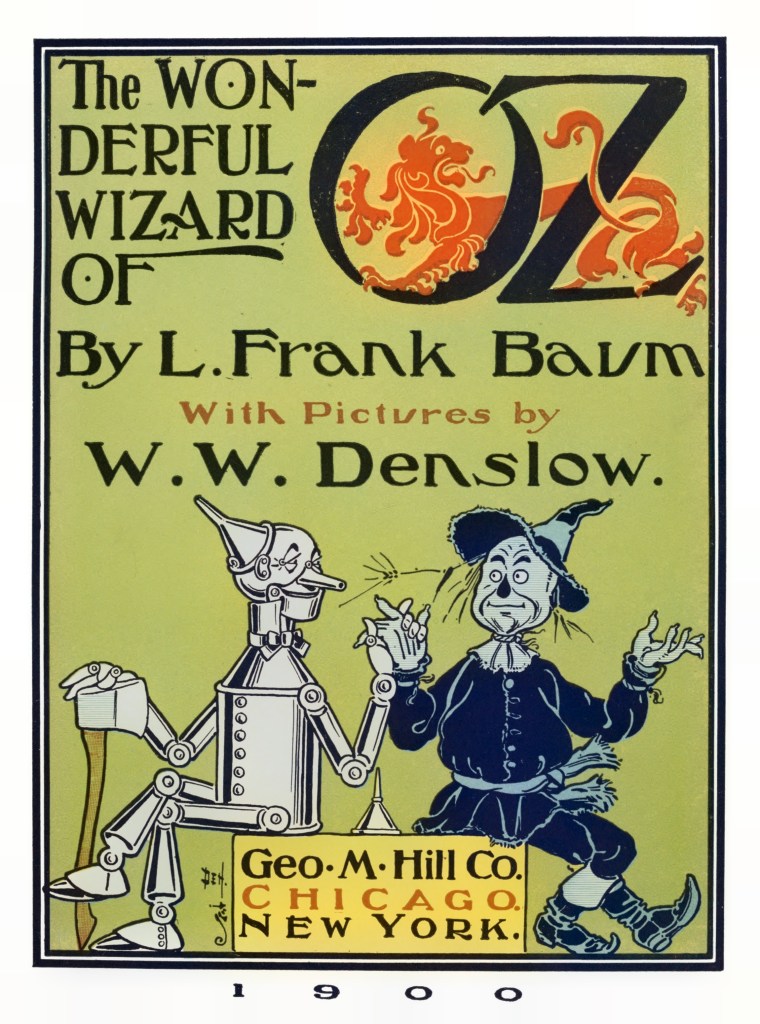
The Wonderful Wizard of Oz is a landmark 1900 children’s fantasy novel written by L. Frank Baum and illustrated by W. W. Denslow. The first installment in the Oz series, the novel follows Dorothy Gale, a young farm girl from Kansas who is swept away by a cyclone along with her dog, Toto, and transported to the magical Land of Oz. To return home, Dorothy must journey along the Yellow Brick Road to the Emerald City and seek the aid of the mysterious Wizard of Oz.
First published in 1900 by George M. Hill Company, the novel quickly became a major cultural success. By the time it entered the public domain in 1956, it had sold more than three million copies. Frequently republished under the shortened title The Wizard of Oz—shared by both the enormously successful 1902 Broadway adaptation and the iconic 1939 MGM film—the story has become one of the foundational works of American popular culture. The Library of Congress has described it as “America’s greatest and best-loved homegrown fairytale.”
Publication History
The First Edition
The first printed copy of The Wonderful Wizard of Oz emerged from the press on May 17, 1900. Baum personally assembled this inaugural copy and presented it to his sister, Mary Louise Baum Brewster. The book debuted publicly at a Chicago book fair in July 1900 before entering wide distribution that September.
Its success was immediate. The initial print run of 10,000 copies sold out within weeks, prompting a second printing of 15,000 copies that was also rapidly exhausted.
The Stage Adaptation
Publisher George M. Hill initially doubted the commercial potential of Baum’s manuscript. He agreed to publish the novel only after Fred R. Hamlin, manager of Chicago’s Grand Opera House, committed to adapting the work for the stage.
Premiering on June 16, 1902, the theatrical adaptation transformed the story into a lavish musical extravaganza aimed primarily at adult audiences. The production drew heavily upon Denslow’s illustrations, with costumes and stage designs modeled directly after his artwork.
Publishing Transitions
Following the bankruptcy of the George M. Hill Company in 1901, publishing rights passed to the Indianapolis-based Bobbs-Merrill Company. In 1903, the publisher briefly retitled the novel The New Wizard of Oz to capitalize on the popularity of the stage production. Cost-cutting measures also led to the removal of Denslow’s original colored page backgrounds.
Baum’s own financial instability further complicated the book’s publication history. After the collapse of his ambitious “Fairylogue and Radio-Plays” project in 1911, the rights were temporarily licensed to the M. A. Donahue Company, which issued inexpensive editions that competed directly with Baum’s newer works.
Only after the novel entered the public domain in 1956 did richly illustrated editions featuring restored artwork become widely available.
Narrative Summary
Arrival in Munchkin Country
Dorothy Gale lives a bleak existence on a Kansas prairie farm with Aunt Em, Uncle Henry, and her dog, Toto. A violent tornado lifts the farmhouse into the sky and deposits it in Munchkin Country within the Land of Oz. The house lands atop the Wicked Witch of the East, killing her instantly and freeing the oppressed Munchkins.
The Good Witch of the North greets Dorothy, gives her the dead witch’s magical silver shoes, and advises her to follow the Yellow Brick Road to the Emerald City, where the Wizard of Oz may help her return home.
Gathering Companions
During her journey, Dorothy befriends three companions, each convinced they lack an essential quality:
The Scarecrow, who longs for a brain
The Tin Woodman, who desires a heart
The Cowardly Lion, who seeks courage
Together they continue toward the Emerald City in hopes that the Wizard can fulfill their wishes.
The Wizard of Oz
Upon reaching the Emerald City, the travelers are required to wear green-tinted spectacles to protect their eyes from the city’s dazzling brilliance. During separate audiences, the Wizard appears to each visitor in a different terrifying form: a giant head, a beautiful woman, a monstrous beast, and a blazing sphere of fire.
The Wizard agrees to grant their requests only if they destroy the Wicked Witch of the West.
The Wicked Witch of the West
As Dorothy and her companions travel westward, the Witch unleashes a series of attacks against them. Wolves are destroyed by the Tin Woodman, crows are neutralized by the Scarecrow, bees perish against the Woodman’s metal body, and soldiers flee from the Lion’s roar.
Finally, the Witch summons the Winged Monkeys using the magical Golden Cap. The companions are defeated: the Scarecrow is torn apart, the Tin Woodman is badly damaged, and the Lion is imprisoned. Dorothy and Toto are captured and forced into servitude.
The Witch’s Defeat
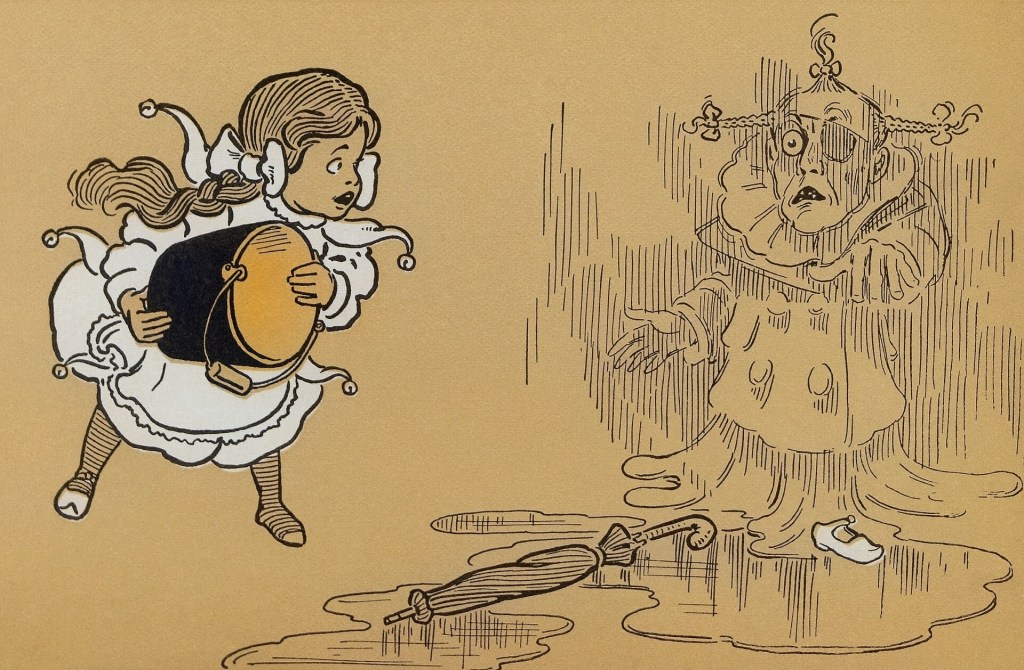
When the Witch steals one of Dorothy’s silver shoes, Dorothy retaliates by throwing a bucket of water over her. To Dorothy’s astonishment, the water causes the Witch to melt away completely.
The liberated Winkies repair the Scarecrow and Tin Woodman, while Dorothy uses the Golden Cap to command the Winged Monkeys to carry the group back to the Emerald City.
The Wizard Unmasked
Back in the throne room, Toto accidentally reveals that the fearsome Wizard is merely an ordinary man from Omaha who arrived in Oz years earlier in a runaway hot-air balloon.
Although powerless, the Wizard provides symbolic tokens that reinforce the companions’ existing virtues:
Bran and pins for the Scarecrow’s “brain”
A silk heart stuffed with sawdust for the Tin Woodman
A courage-inducing potion for the Lion
The Wizard later attempts to carry Dorothy home in a balloon, but the plan fails when Toto jumps into the crowd and Dorothy leaves the basket to retrieve him.
Glinda and the Return Home
Dorothy eventually travels south to seek the guidance of Glinda, the Good Witch of the South. Glinda reveals that Dorothy could have returned home all along: the silver shoes possess the power to transport their wearer anywhere desired.
After bidding farewell to her companions, Dorothy clicks her heels together three times and wishes herself home. She awakens once more on the Kansas prairie, joyfully reunited with Aunt Em.
Creative Origins and Biographical Influences
Baum drew extensively from his personal experiences, family history, and professional setbacks when constructing the world of Oz.
Character / Element Real-Life Inspiration
Dorothy Gale Named after Baum’s infant niece Dorothy Louise Gage, whose death deeply affected the family
The Scarecrow Inspired by Baum’s childhood nightmares and his anxieties surrounding fire
The Tin Woodman Influenced by Baum’s early work creating store-window displays from scrap metal
Uncle Henry Modeled after Baum’s reserved father-in-law, Henry Gage
The Witches Shaped partly by the feminist ideas of Baum’s mother-in-law, suffragist Matilda Joslyn Gage
The Emerald City Influenced by the “White City” architecture of the 1893 Chicago World’s Fair
The Yellow Brick Road Possibly inspired by a yellow-brick road near Peekskill Military Academy
The name “Oz” Allegedly taken from a filing cabinet drawer labeled “O–Z”
The Denslow Collaboration
Illustrator W. W. Denslow played a crucial role in shaping the novel’s enduring visual identity. Denslow co-held the copyright alongside Baum, and his artwork was deeply integrated into the storytelling structure. Each chapter featured distinct color schemes corresponding to different regions of Oz.
Several iconic visual details originated entirely from Denslow rather than Baum’s text, including the Tin Woodman’s famous funnel hat. The illustrations became so popular that they inspired a wave of merchandise, including toys, soaps, and figurines.
Critical Reception and Controversies
Early Reception
Contemporary reviews were highly favorable. The New York Times praised the novel’s “bright and joyous atmosphere” and commended its departure from the harsher violence common in traditional fairy tales.
Despite its popularity, the novel was long dismissed by academics and librarians, who often regarded fantasy literature and children’s series fiction as lacking literary merit.
Censorship Efforts
The novel became the subject of several censorship controversies during the twentieth century.
The Detroit Ban (1957)
The director of the Detroit Public Library removed the book from circulation, claiming it had “no value” for modern children and encouraged negativity and cowardice.
The Tennessee Lawsuit (1986)
A group of Fundamentalist Christian families sued a Tennessee school district over the novel’s inclusion in the curriculum. They objected to its depiction of benevolent witches, supernatural themes, talking animals, and perceived advocacy of gender equality. The court ultimately ruled that parents could exempt their children from reading the text.
Literary Legacy
By the late twentieth century, The Wonderful Wizard of Oz had become firmly established as a classic of American literature. Critics frequently emphasize the novel’s enduring psychological message: that intelligence, compassion, courage, and self-worth already exist within individuals who believe themselves deficient.
Baum initially intended the book to stand alone, but overwhelming public demand led him to continue the series with The Marvelous Land of Oz in 1904. He eventually wrote thirteen official sequels. After Baum’s death in 1919, author Ruth Plumly Thompson continued the franchise with twenty-one additional novels.
Adaptations and Global Influence
The Oz stories have been translated into dozens of languages and adapted across numerous media. In the Soviet Union, author Alexander Volkov produced an unauthorized reinterpretation titled The Wizard of the Emerald City, which evolved into its own independent series.
The story’s cultural legacy remains inseparable from its celebrated adaptations, especially:
The Wizard of Oz, starring Judy Garland and renowned for its groundbreaking Technicolor cinematography
The Wiz, the 1974 influential African-American reinterpretation of Baum’s story. This musical was adapted into the 1978 feature film The Wiz, a musical fantasy adventure produced by Universal Pictures and Motown Productions.
More than a century after its publication, The Wonderful Wizard of Oz continues to endure as one of the defining myths of American literature and popular imagination.
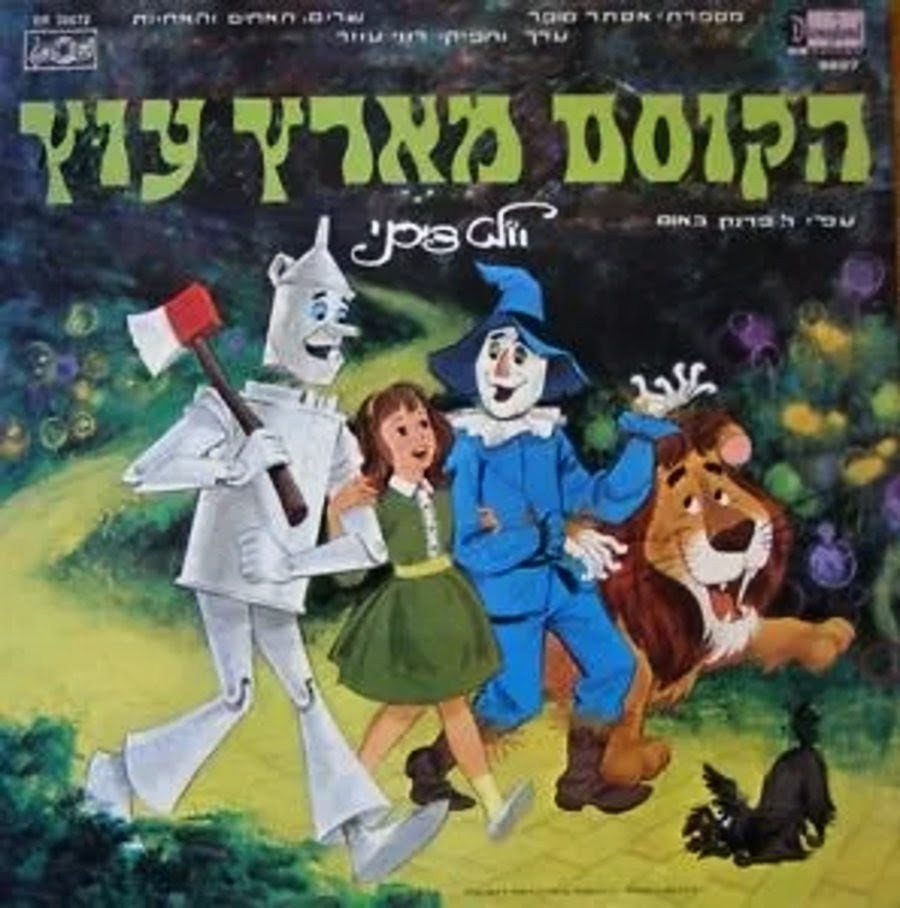
Several Hebrew translations of The Wonderful Wizard of Oz have been published in Israel. Beginning with the earliest translation and preserved in later editions, the Land of Oz was rendered in Hebrew as Eretz Uz (ארץ עוץ), the same name used in the Hebrew Bible for the Land of Uz, the homeland of Job. This translation choice introduced Biblical associations for Hebrew readers that are absent from the original English text.
In 2018, the “Lost Art of Oz” project was launched to locate and catalogue surviving original illustrations created for the Oz series by artists including John R. Neill, W. W. Denslow, Frank Kramer, Dirk Gringhuis, and Dick Martin.
In 2020, an Esperanto translation of the novel was used by researchers to demonstrate a new method of encoding text into DNA while preserving readability after repeated copying.
Allegorical Interpretations
Scholars have frequently interpreted The Wonderful Wizard of Oz through the framework of Joseph Campbell’s “hero’s journey” or “monomyth,” outlined in The Hero with a Thousand Faces. Under this interpretation, Dorothy’s adventure follows the classic narrative stages of Departure, Initiation, and Return.
Critics arguing for this reading contend that Dorothy’s quest transcends the simple objective of returning home. Like many mythic heroes, she undergoes personal growth and self-discovery during her journey, while her companions likewise uncover qualities they believed they lacked.
Political Interpretations and 19th-Century America
Long after its publication, The Wonderful Wizard of Oz became the subject of extensive political interpretation, particularly in relation to the nineteenth-century American Populist movement.
In a widely discussed 1964 American Quarterly article, educator Henry Littlefield argued that the novel functioned as an allegory for the era’s debate over bimetallism and monetary policy. According to Littlefield’s interpretation:
The Yellow Brick Road symbolized the gold standard
Dorothy’s silver shoes represented silver currency
The Scarecrow embodied the American farmer
The Tin Woodman represented industrial laborers
The Cowardly Lion alluded to populist politician William Jennings Bryan
Although influential, Littlefield’s thesis remains controversial and has been challenged by numerous historians and literary scholars, many of whom argue that Baum primarily intended the novel as imaginative entertainment rather than political allegory.
Additional interpretations emerged in subsequent decades. In 1971, historian Richard J. Jensen suggested in The Winning of the Midwest that the name “Oz” may have been derived from the abbreviation “oz.” for “ounce,” a unit commonly associated with measurements of gold and silver.
sources
https://www.loc.gov/item/03032405
https://en.wikipedia.org/wiki/The_Wonderful_Wizard_of_Oz
https://www.britannica.com/topic/The-Wonderful-Wizard-of-Oz
https://www.pbs.org/wgbh/americanexperience/features/american-oz-why-wizard-oz-so-wonderful


Leave a comment