In the summer of 1947, a battered, repurposed American pleasure steamer groaned under the weight of 4,515 Holocaust survivors. Its official destination on paper was Colombia, but everyone on board—and the British intelligence services tracking it—knew the truth. The ship was headed for Mandatory Palestine.
It was originally named the President Warfield, but midway across the Mediterranean, it was renamed. It became the Exodus 1947.
What followed was not merely a maritime interception. It was a public relations catastrophe for the British Empire, a defining moment for the Zionist movement, and the catalyst that forced the hand of the United Nations.The Floating Scrap MetalTo understand the audacity of the voyage, you have to look at the ship itself. Built in 1911, the President Warfield was a wooden-hulled steamship designed to ferry passengers smoothly across the calm waters of the Chesapeake Bay between Baltimore and Norfolk. It was never meant for the open Atlantic, let alone a naval blockade.
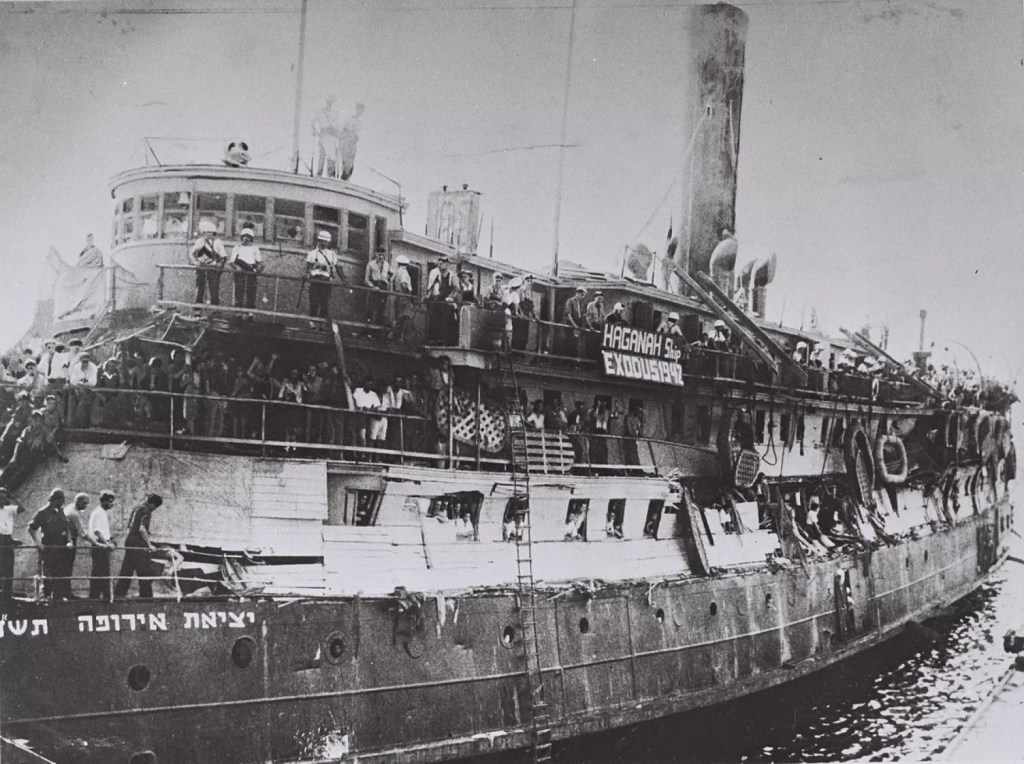
Purchased secretly by the Haganah (the Jewish paramilitary organization in Palestine) through a shell company, the ship was outfitted in Baltimore before slipping away to Europe.The strategy was part of Aliyah Bet—the clandestine, illegal immigration of European Jews to Palestine in defiance of the British White Paper of 1939, which strictly capped Jewish immigration to appease the local Arab population.
The Voyage and the TrapOn July 11, 1947, the Exodus departed from Sète, France. Packed into its retrofitted holds were 4,515 passengers, including 655 children. The conditions were brutally cramped; people slept on multi-tiered wooden bunks with mere inches of breathing room.
The British Royal Navy picked up the ship almost immediately after it cleared French waters. A flotilla of British warships, including the cruiser HMS Ajax and several destroyers, flanked the fragile steamer like wolves around a stray sheep.The plan formulated by the Haganah was to run the blockade, beach the ship on the shores of Tel Aviv, and let the thousands of refugees blend into the local population. But the British had orders to make an example of the Exodus.July 18: Battle in the DarkJust outside Palestine’s territorial waters—roughly 20 miles off the coast of Haifa—the British fleet struck.Under the cover of darkness, two British destroyers rammed the Exodus from both sides, splintering its wooden hull and crushing its lifeboats. British marines boarded the vessel using specialized ramps. [British Destroyer] -> Rammed Port Side
The refugees and the young American crew, led by 23-year-old Captain Ike Aronowicz, fought back with the only weapons they had:Life jackets and wooden planksCanned goods and potatoesSteam hoses and smoke bombsThe fight lasted for hours. British marines opened fire. William Bernstein, an American first mate from San Francisco, was clubbed to death on the bridge. Two Jewish refugees were shot dead, and dozens were severely injured. Realizing that further resistance would lead to a massacre on the listing, damaged ship, the command crew surrendered. The Exodus was towed into Haifa harbor.
The Fatal British Calculation
Normally, intercepted refugees were sent to internment camps on the island of Cyprus. But the British Foreign Secretary, Ernest Bevin, decided on a radical alternative. To deter future illegal voyages, he ordered that the passengers of the Exodus be sent back to their point of origin in Europe.This was a catastrophic miscalculation.The refugees were forced onto three heavily caged British prison ships: the Ocean Vigour, the Runnymede Park, and the Empire Rival.
| Stage | Location | British Objective | Actual Outcome |
| 1. The Attack | Off Haifa Coast | Terminate the voyage swiftly. | Violent clash creates immediate international headlines. |
| 2. The Return | Port-de-Bouc, France | Force France to take the refugees back. | Refugees refuse to disembark; France refuses to force them. |
| 3. The Ultimatum | Hamburg, Germany | Force submission in the British-occupied zone. | Holocaust survivors forced into German camps by British troops—a PR disaster. |
When the ships arrived in southern France, the refugees staged a hunger strike. The French government announced it would welcome anyone who disembarked voluntarily but refused to use force. For over three weeks in the blistering summer heat, the refugees stayed inside the floating iron cages.Frustrated and embarrassed, the British government issued an ultimatum: disembark in France, or be taken to British-occupied Germany. The refugees stayed put.
The Spectacle of Hamburg
On September 8, 1947, the prison ships docked in Hamburg. Members of the United Nations Special Committee on Palestine (UNSCOP) watched in horror alongside international journalists as British troops, using batons and water cannons, forcibly dragged Holocaust survivors off the ships and onto German soil.The irony was devastating. People who had survived Auschwitz, Bergen-Belsen, and Dachau were being guarded by British soldiers behind barbed wire inside DP (Displaced Persons) camps in Germany.The global press had a field day:”The photograph of a young girl being carried off the ship, screaming, by two burly British soldiers, did more to win the battle for a Jewish state than any military victory could have.”— Ruth Gruber, American journalist on the scene.
The Political Aftermath
The Exodus 1947 incident systematically dismantled Britain’s moral authority to govern Palestine.
UNSCOP’s Turning Point: Members of the UN committee were directly influenced by the spectacle. They realized that the status quo was unsustainable and that European Jewish displaced persons would never willingly remain in Europe.
American Public Opinion: The heavy American involvement (the ship was American, funded by American Jews, and crewed partly by American volunteers) galvanized US public opinion, putting massive pressure on President Harry Truman to support the Zionist cause.
The Partition Plan: Just over two months after the Hamburg landing, on November 29, 1947, the United Nations voted overwhelmingly in favor of Resolution 181, partitioning Mandatory Palestine into Jewish and Arab states.

The passengers of the Exodus eventually made it home. Within a year of their forced return to Germany, the State of Israel declared its independence, the British left, and the fences of the camps were torn down for good. The very people who were dragged off the ship in Hamburg were flown or shipped to Israel as free citizens.The Exodus 1947 did not smuggle its passengers past the blockade, but it accomplished something far larger: it exposed the collapse of an empire and forced the world to look at the human cost of its borders.
sources
https://israelforever.org/history/exodus/a_struggle_for_survival_a_testimony_of_life_on_exodus_1947
https://encyclopedia.ushmm.org/content/en/article/exodus-1947
https://www.wrvo.org/station-announcement/2017-05-09/exodus-47


Leave a Reply