The “V for Victory” campaign was one of the most effective psychological warfare and propaganda initiatives of World War II, transforming a single letter into a potent symbol of hope, defiance, and resistance across Nazi-occupied Europe.
The Origin: A Belgian Idea
The “V for Victory” campaign began with Victor de Laveleye, an exiled Belgian politician broadcasting on the BBC’s European Service. On January 14, 1941, he urged his fellow Belgians to adopt the letter “V” as a shared symbol of resistance against Nazi occupation.
The campaign’s brilliance lay in the letter’s multilingual appeal:
Victoire (“Victory”) in French
Vrijheid (“Freedom” or “Liberty”) in Dutch and Flemish
Victory in English
Equally important was its simplicity. A single letter could be chalked onto walls, pavements, railway stations, bridges, or even German military vehicles in just a few seconds, allowing civilians to spread the symbol while minimizing the risk of arrest by the Gestapo. Within weeks, thousands of “V”s had appeared across occupied Belgium, France, and the Netherlands.
The Sound of Resistance
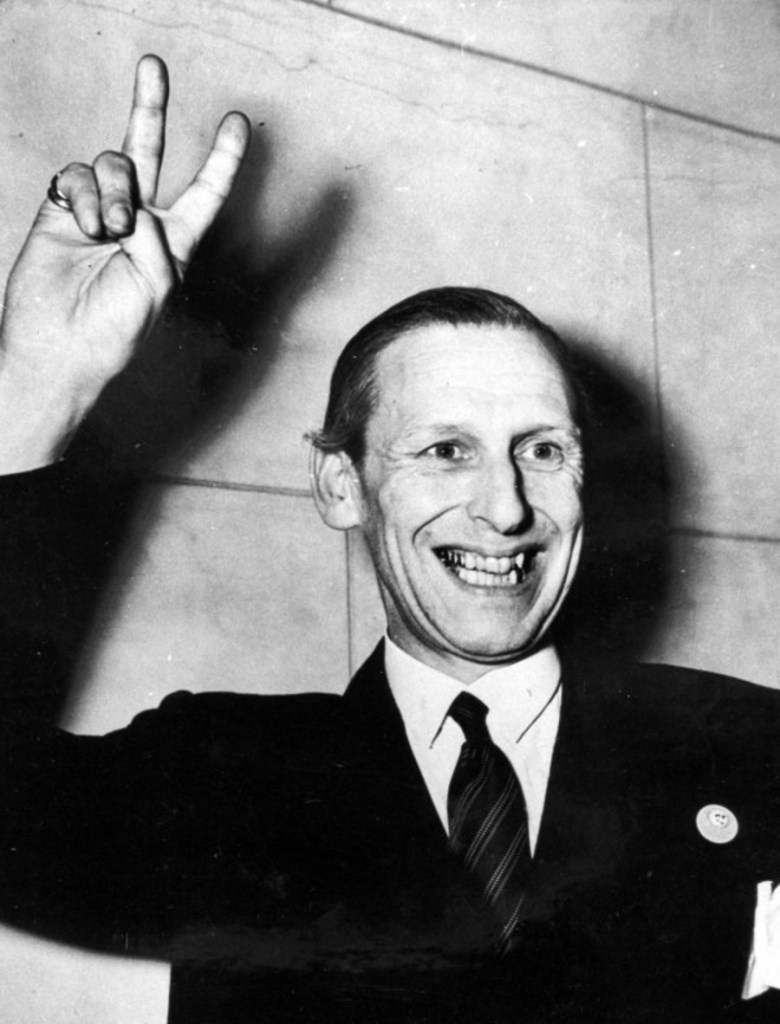
Recognizing the movement’s psychological potential, the BBC officially expanded it into the international “V for Victory” campaign on July 19, 1941. The effort was led by Douglas Ritchie, who broadcast under the pseudonym “Colonel Britton.”
The campaign transformed the visual symbol into an equally powerful auditory one by linking it to Morse code. The letter V is represented by three dots followed by a dash (···–), a rhythm that closely matches the iconic four-note opening of Beethoven’s Fifth Symphony, often described as “fate knocking at the door.”
The BBC began opening its European shortwave broadcasts with this distinctive rhythmic motif. Across occupied Europe, people echoed the pattern by tapping on tables, knocking on doors, blowing train whistles, and flashing car headlights—small yet unmistakable acts of defiance carried out in full view of the occupying forces.
Churchill’s Adoption and Global Impact
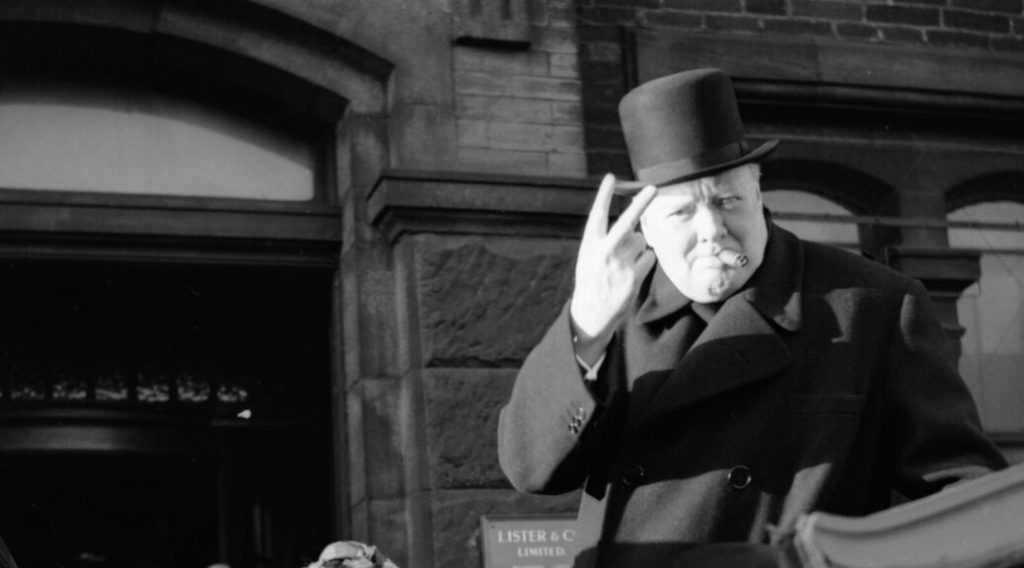
British Prime Minister Winston Churchill officially embraced the campaign in July 1941, popularizing the now-famous two-finger V-sign. He flashed the gesture at public appearances, turning it into one of the defining visual symbols of Allied determination.
A Famous Blunder
Churchill initially made the gesture with his palm facing inward. His staff soon informed him that, in British working-class culture, an inward-facing V-sign was considered a serious insult—roughly equivalent to giving someone the middle finger. Churchill promptly switched to the palm-outward version, although the accidental slight arguably enhanced his image as a defiant opponent of Hitler.
The campaign soon spread far beyond Europe. Even before the United States formally entered the war, the “V” had become an internationally recognized emblem of resistance, appearing on posters, postage stamps, matchbooks, and countless consumer products throughout the Allied world.
The German Counteroffensive
The campaign became so widespread that Nazi authorities felt compelled to respond. After attempts to suppress the symbol through arrests, fines, and censorship proved ineffective, German propagandists sought to appropriate it instead.
Large “V” banners appeared across occupied cities such as Paris and Brussels, accompanied by claims that the letter stood for “Viktoria,” symbolizing Germany’s inevitable victory. The strategy failed spectacularly. Rather than accepting the new meaning, many civilians mocked the propaganda by adding their own interpretations beneath the posters. In the Netherlands, for example, people scrawled “V = verloren voor Hitler” (“V = lost for Hitler”), turning the Nazis’ own campaign into another expression of resistance.
A Symbol That United Millions
The “V for Victory” campaign ultimately succeeded because it gave ordinary people a simple, low-risk way to express solidarity. A single chalk mark, a hand gesture, or a sequence of taps could communicate hope, courage, and shared purpose without a single spoken word.
For millions living under occupation, the letter “V” became more than a symbol of victory—it was proof that they were not alone. It reminded isolated individuals that they were part of a vast, unseen network of resistance stretching across Europe, making one of the most successful psychological warfare campaigns of the Second World War.
sources
https://richardlangworth.com/v-sign
https://en.wikipedia.org/wiki/V_sign
https://www.iwm.org.uk/history/second-world-war/victory/where-does-v-for-victory-come-from


Leave a Reply