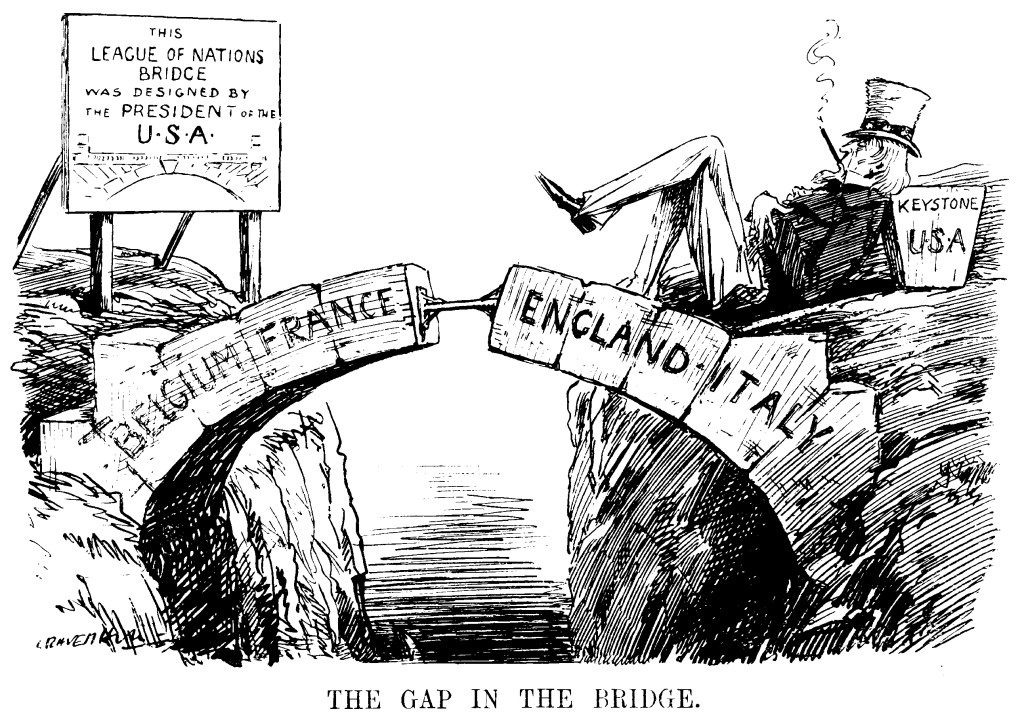
The failure of the League of Nations is one of the most significant geopolitical collapses of the 20th century. Established after World War I to prevent another global conflict, it ultimately proved powerless against the rise of aggressive militarism in the 1930s.
Historians generally attribute its collapse to four interconnected fatal flaws:
- Absence of Major Global Powers
The League was the brainchild of U.S. President Woodrow Wilson, yet the United States Senate refused to ratify the Treaty of Versailles, meaning the U.S. never joined.
Furthermore, other crucial players were absent during critical periods:
The Soviet Union was excluded until 1934 and expelled in 1939.
Germany was banned initially, joined in 1926, and left as soon as Adolf Hitler came to power in 1933.
Japan and Italy both withdrew after the League criticized their imperial expansions.
This left Britain and France to anchor an organization that lacked the global footprint and economic leverage to enforce its mandates.
- No Enforcing Muscle
The League had no military force of its own. If a member state violated international law, the League’s primary weapons were moral condemnation or economic sanctions.
Because there was no international army to back up these threats, aggressive nations quickly realized they could ignore the League without physical consequences. When economic sanctions were attempted—such as against Italy during its invasion of Abyssinia (Ethiopia)—they were half-hearted and excluded vital resources like oil, rendering them useless.
- The Unanimity Rule
Structurally, the League’s Council required a unanimous vote to pass any major resolution. This meant that any nation involved in a dispute could effectively veto any action or sanction leveled against it. This structural gridlock paralyzed the organization during rapid, fast-moving international crises. - Major Crises That Exposed Its Total Impotence
A series of high-profile failures in the 1930s destroyed whatever international credibility the League had left:
The Manchurian Crisis (1931): Japan invaded Northeast China. The League issued a report condemning the action; Japan simply walked out of the League and kept Manchuria.
The Abyssinian Crisis (1935): Italy invaded Ethiopia. The League failed to impose effective sanctions, and Britain and France secretly tried to appease Benito Mussolini behind the League’s back (the Hoare-Laval Pact).
German Rearmament and Expansion (1935–1939): Hitler openly violated the Treaty of Versailles by remilitarizing the Rhineland, annexing Austria, and invading Czechoslovakia. The League was entirely bypassed as Britain and France resorted to direct appeasement.
By the time World War II broke out in September 1939, the League had been completely sidelined. It was formally dissolved in 1946, though its core ideas—and many of its hard-learned lessons regarding veto powers and military enforcement—were used to design the United Nations.
Looking at the UN today and we can see the same mistakes are made again.
sources
https://en.wikipedia.org/wiki/League_of_Nations
https://history.state.gov/milestones/1914-1920/league
https://www.bbc.co.uk/bitesize/guides/zbg4t39/revision/9


Leave a Reply