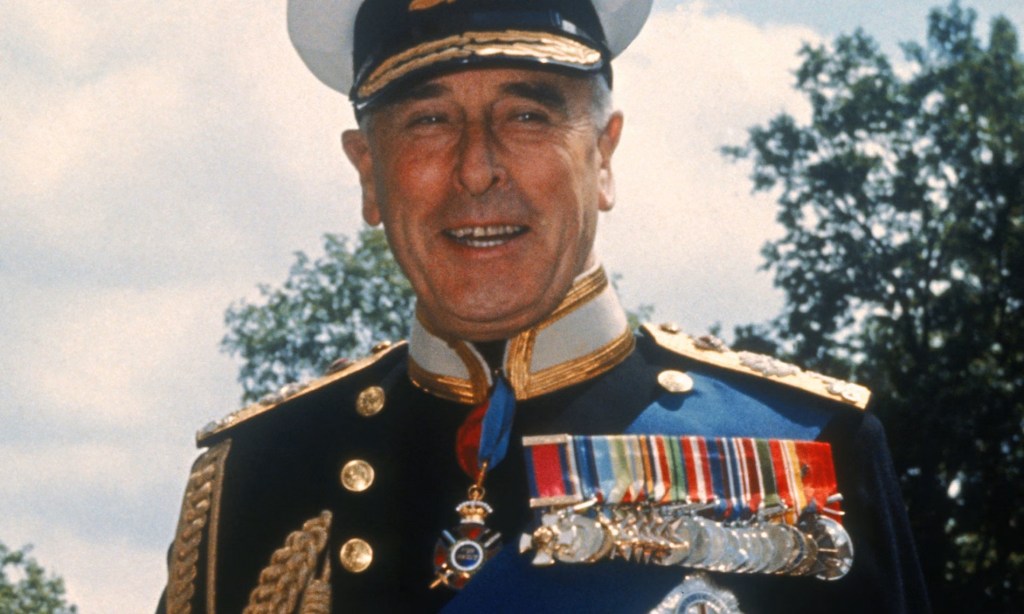
On the morning of 27 August 1979, Louis Francis Albert Victor Nicholas Mountbatten, 1st Earl Mountbatten of Burma, a member of the British royal family and one of the most prominent figures of the twentieth century, was assassinated by the Provisional Irish Republican Army (IRA). The bombing, carried out while Mountbatten was aboard his fishing boat off the coast of County Sligo, was one of the most audacious attacks of the Troubles. It shocked Britain, Ireland and the wider world, not only because of Mountbatten’s extraordinary public profile but because the attack also killed members of his family and crew, including his 14-year-old grandson.
Mountbatten’s life had been closely intertwined with the history of the British Empire, the Second World War and the royal family. Born on 25 June 1900, he was a great-grandson of Queen Victoria and a close relative of the British royal family. He pursued a career in the Royal Navy and became a distinguished officer during the Second World War. He eventually commanded British naval forces in Southeast Asia and played an important role in the defeat of Japanese forces in the region.
After the war, Mountbatten was appointed the last Viceroy of India. In 1947, he oversaw the final stages of British rule and the transfer of power to the newly independent states of India and Pakistan. The partition of India was accompanied by enormous communal violence and the displacement of millions of people, making his role a deeply consequential and controversial one. Mountbatten subsequently returned to a senior naval career and eventually became Chief of the Defence Staff, Britain’s highest-ranking professional military position.
Despite his demanding public career, Mountbatten remained a prominent figure within the royal family. He was an uncle and mentor to Prince Philip and became particularly close to his great-nephew, Prince Charles, later King Charles III. Mountbatten was regarded by Charles as an important father figure and adviser. His assassination therefore represented not merely the killing of a retired naval commander but a deeply personal tragedy for the royal family.
By the late 1970s, Northern Ireland had been engulfed in the Troubles for more than a decade. The conflict involved republican and loyalist paramilitaries, British security forces and political organisations representing competing constitutional aspirations. The Provisional IRA sought to end British sovereignty in Northern Ireland and achieve Irish reunification. Its campaign included bombings and shootings throughout Northern Ireland and, increasingly, attacks in Britain and against prominent British figures.
Mountbatten was particularly vulnerable to an IRA attack because of his symbolic status. He represented the British establishment, the monarchy and Britain’s military tradition. At the same time, he regularly spent part of the summer at Classiebawn Castle in County Sligo, where he enjoyed sailing and fishing. His movements were therefore relatively predictable.
On 27 August 1979, Mountbatten boarded his wooden fishing boat, Shadow V, at Mullaghmore, accompanied by several members of his family and friends. Also aboard were his daughter Patricia Knatchbull, her husband John Knatchbull, their children Nicholas and Timothy, and Nicholas’s grandmother, Doreen, Dowager Lady Brabourne. The boat was also accompanied by a local crewman, Paul Maxwell, a 15-year-old from County Fermanagh.
The IRA had secretly placed a bomb aboard the vessel the previous day. As the boat travelled out to sea, the bomb was detonated remotely. The explosion destroyed the vessel and caused devastating injuries.
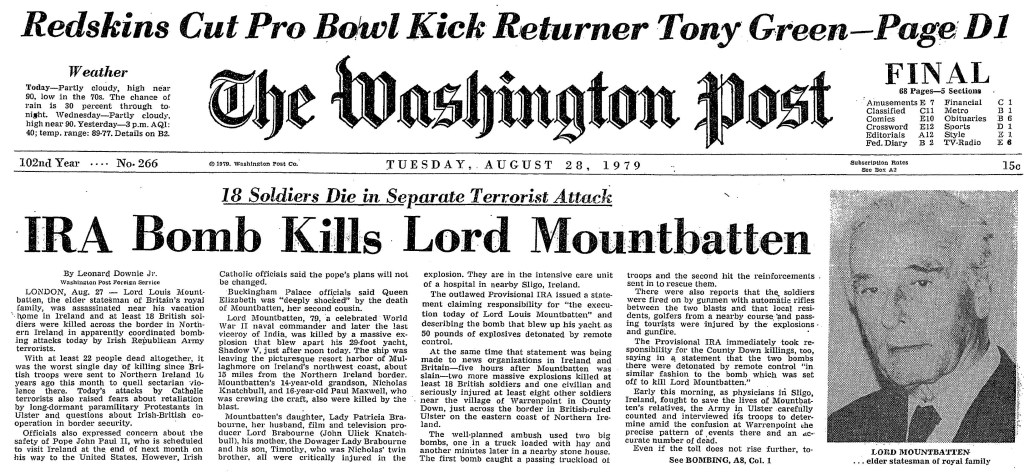
Mountbatten, aged 79, was killed. His 14-year-old grandson Nicholas Knatchbull also died, as did Paul Maxwell. Doreen Knatchbull was critically injured and died the following day. Several other members of the party were seriously wounded.
The assassination caused enormous shock. Mountbatten had been one of the most recognisable British public figures of his generation, and the fact that he had been killed while spending a peaceful family holiday made the attack particularly horrifying. The murder of Nicholas Knatchbull, a teenager with no involvement in the conflict, further intensified public outrage.
The attack was especially significant because it occurred on the same day as another major IRA operation in County Down. Earlier that morning, the IRA ambushed a British Army convoy at Warrenpoint, killing 18 soldiers in what became known as the Warrenpoint ambush. The combination of the two attacks demonstrated the organisation’s ability to strike both symbolic and military targets with devastating effect.
The IRA subsequently claimed responsibility for Mountbatten’s assassination. Thomas McMahon, a member of the organisation, was arrested and convicted for planting the bomb. He received a life sentence. McMahon was later released in 1999 under the terms of the Good Friday Agreement.
For the British royal family, Mountbatten’s death was devastating. Prince Charles was particularly affected. Mountbatten had been an important mentor in his life and had encouraged him in matters of public duty, naval service and family. His death left a profound personal mark on the future king.
The assassination also illustrated the increasingly international and symbolic nature of the Troubles. The IRA was not simply fighting security forces in Northern Ireland; it was attempting to demonstrate that the British state and its most powerful representatives could be reached almost anywhere. Mountbatten’s death provided the organisation with enormous international publicity, although the attack also generated widespread condemnation.
In Ireland, reactions were more complicated. While the assassination was condemned by the Irish government and by many people across the political spectrum, the attack occurred within the broader context of a conflict in which republican militants viewed British sovereignty as the fundamental cause of the violence. Nevertheless, the deliberate killing of civilians—including a child—was widely regarded as an especially disturbing act.
The assassination occurred only months after the death of Airey Neave, a prominent British Conservative politician who had been killed by an INLA bomb at the Palace of Westminster in March 1979. Together, the attacks reinforced fears that political and military figures in Britain were increasingly vulnerable to republican terrorism.
Mountbatten’s assassination did not bring the Troubles closer to an immediate conclusion. Violence continued for almost two more decades. Thousands of people would still be killed or injured before the conflict gradually moved toward the peace process that culminated in the Good Friday Agreement of 1998.
Yet the events of 27 August 1979 remain one of the defining moments of the Troubles. The attack demonstrated the destructive reach of the republican campaign while simultaneously provoking widespread revulsion at the killing of innocent members of Mountbatten’s family.
Lord Mountbatten’s life had spanned an extraordinary period of history. He was born during the reign of Queen Victoria, served in two world wars, witnessed the collapse of the British Empire, helped oversee the independence of India and Pakistan, and remained a prominent figure within the British establishment for decades. His death, however, came not on a battlefield but aboard a small family boat in the waters off the Irish coast.
The assassination remains a grim reminder of the human cost of the Troubles. Mountbatten was undoubtedly a powerful symbol of Britain, and that symbolism made him a significant target for the IRA. But the bomb did not distinguish between political symbolism and human life. It killed a 79-year-old retired statesman, a teenage boy and two others, while severely injuring members of their family.
In that sense, the bombing at Mullaghmore encapsulated one of the darkest characteristics of the Troubles: a political conflict in which historical grievances, competing national identities and questions of sovereignty became intertwined with violence against individuals who were often far removed from the decisions that had created the conflict. Mountbatten’s assassination therefore remains not only a significant episode in the history of the British monarchy and the IRA campaign, but also a stark example of how the violence of the Troubles could reach into the lives of ordinary families.
Sources:
https://www.rte.ie/archives/2014/0827/639649-lord-mountbatten-assassinated
https://en.wikipedia.org/wiki/Assassination_of_Lord_Mountbatten


Leave a Reply