To most modern listeners, “Black Betty” is remembered as a driving, hard-rock anthem—a 1977 powerhouse single by the New York band Ram Jam defined by booming electric guitars, driving drums, and an infectious, repetitive call-and-response refrain. Yet beneath its electrifying rock ‘n’ roll exterior lies a rich, complex history that reaches back into the 19th-century American South. Long before it entered the pop charts, “Black Betty” was an African American work song born out of rural labor and Southern prison farms.
Roots in the Work Song Tradition
The origins of “Black Betty” are rooted in the folk tradition of enslaved field hands and, later, Black chain gangs laboring in Southern penal institutions. In these harsh environments, work songs served a crucial dual function: they established a rhythmic tempo to synchronize collective physical labor—such as chopping wood or swinging pickaxes—and offered a vital outlet for expression under brutal conditions.
The origin and meaning of the lyrics to “Black Betty” remain the subject of debate. Over the centuries, the name “Black Betty” appears to have been applied to a variety of objects and ideas. Historically, it could refer to a bottle of whiskey, a whip, or even a penitentiary transfer wagon. In more modern musical usage, however, “Black Betty” has sometimes been used as a reference to a fast car or motorcycle.
One of the earliest documented meanings connects “Black Betty” with alcohol. In Albion’s Seed: Four British Folkways in America (Oxford University Press, 1989), historian David Hackett Fischer notes that “Black Betty” was a common term for a bottle of whisky in the borderlands of northern England and southern Scotland. The expression appears to have crossed the Atlantic with settlers and eventually became a euphemism in the backcountry regions of the eastern United States.
There is remarkably early evidence for the expression in American usage. In January 1736, Benjamin Franklin published The Drinker’s Dictionary in the Pennsylvania Gazette, a collection of 228 colorful euphemisms for drunkenness. Among them was the phrase, “He’s kiss’d black Betty.” Other historical sources similarly record “Black Betty” as a term for a liquor bottle in the United States, dating back at least to 1827.
The association between “Black Betty” and whiskey also appears in descriptions of American folk customs. Caldwell’s Illustrated Combination Centennial Atlas of Washington Co., Pennsylvania, published in 1876, describes wedding ceremonies and marriage traditions in the region. One custom involved two young men from the bridegroom’s procession being challenged to race for a bottle of whiskey. The contest took place when the wedding party was approximately a mile from the house where the ceremony was to be held.
The prize awaiting the winner was known as “Black Betty.” After winning the race, the young man would carry the bottle back to the bridegroom and his companions. The groom was given the first drink, after which the bottle was passed among his friends. In this context, “Black Betty” was not a woman at all, but a bottle of whiskey transformed by folk tradition into a character with a name.
But alcohol is only one of the historical meanings attached to the name.
In the American South, “Black Betty” acquired a considerably darker association. John A. and Alan Lomax, in their 1934 collection American Ballads and Folk Songs, described a very different “Black Betty.” According to the Lomaxes, she was the whip used in some Southern prisons.
Their account specifically referred to a convict at Darrington State Farm in Texas, where the use of whipping had largely been discontinued by the time they collected the song. The prisoner, according to the Lomaxes, mocked “Black Betty” and imitated her “conversation” in song. The music and lyrics that followed their introduction formed part of the oral tradition surrounding the song.
This is where the history of “Black Betty” becomes particularly complicated. The same name appears in different regions, periods, and traditions, attached to objects as different as a whiskey bottle and a prison whip. It is therefore difficult to establish with certainty that every historical reference to “Black Betty” has the same origin.
What can be said with greater confidence is that the name long predates the twentieth-century recordings that made the song famous. “Black Betty” was already part of American vernacular language in the eighteenth and nineteenth centuries, and by the time the Lomaxes documented the song in the early twentieth century, the name had accumulated several meanings.
The mystery surrounding those meanings is perhaps part of what has allowed the song to survive. “Black Betty” was never simply a woman in a song. Depending on the time, place, and tradition, she could be a bottle passed around at a wedding, a euphemism for drunkenness, or the dreaded whip of a Southern prison.
First Recordings and Field Collections
The song was first documented by pioneering musicologists John A. and Alan Lomax during their field trips across the American South to collect and preserve vernacular folk music for the Library of Congress.
In December 1933, John Lomax recorded an acapella version of “Black Betty” performed by James “Iron Head” Baker and a group of incarcerated men at the Central State Farm in Sugar Land, Texas. Baker’s rendition captured the hypnotic, rhythmic drive of the song in its rawest form, accompanied only by the sharp, synchronized clink of tools.
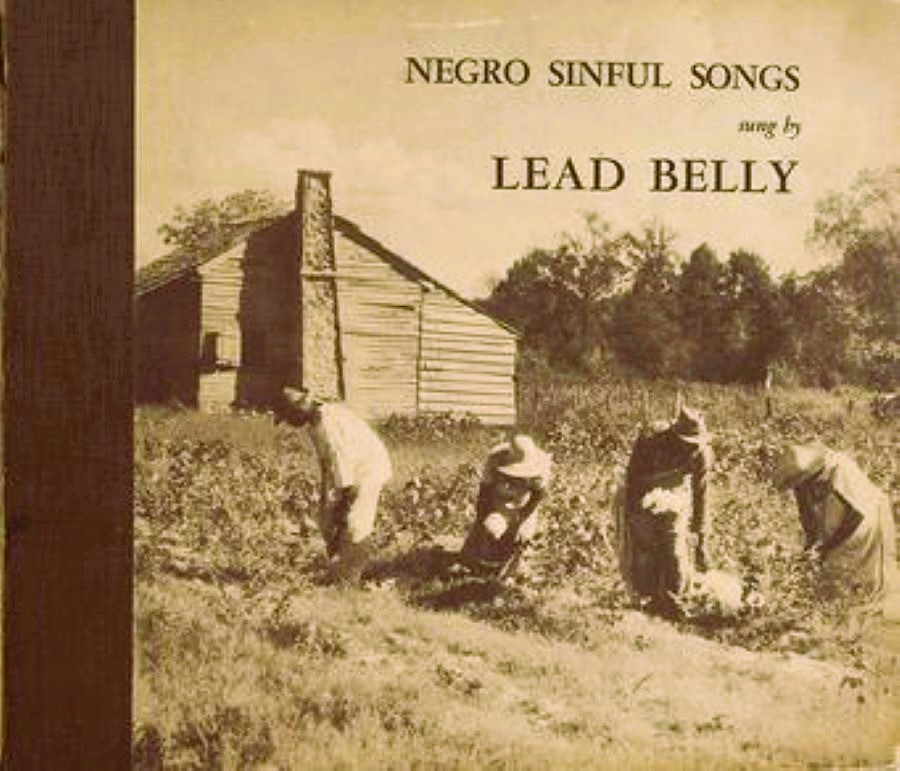
In 1939, legendary blues and folk musician Huddie Ledbetter—better known as Lead Belly—recorded a commercial version of “Black Betty” in New York for Musicraft Records as part of his album Negro Sinful Songs. Lead Belly adapted the traditional field chant into an acoustic folk performance, adding a pulsing guitar rhythm while maintaining the characteristic call-and-response structure:
“Whoa, Black Betty (Bam-ba-lam)
Whoa, Black Betty (Bam-ba-lam)
Black Betty had a baby (Bam-ba-lam)
The damn thing went crazy (Bam-ba-lam)”
Lead Belly’s recording standardized the lyrical cadence that would serve as the template for future adaptations over the next several decades.
Evolution into Rock ‘n’ Roll
In the late 1960s and 1970s, the song caught the attention of rock musicians drawn to its aggressive rhythm and simple, hypnotic lyrical loop. Manfred Mann’s Earth Band performed a version in the early 1970s, but it was the 1977 release by Ram Jam that catapulted “Black Betty” into global commercial success.
Formed by guitarist Bill Bartlett (formerly of the Lemon Pipers), Ram Jam reworked the traditional chant into a heavy, uptempo blues-rock arrangement featuring dual guitar solos and heavy percussion. While the record reached the top ten in the United States and the United Kingdom, it was not without controversy. At the time of its release, civil rights groups such as the NAACP called for a boycott of the song, arguing that its lyrics and rock presentation caricatured Black women.
Despite the controversy, Ram Jam’s arrangement endured, becoming a staple of classic rock radio, sporting events, and film soundtracks. Subsequent covers by artists ranging from Nick Cave and Spiderbait to Meat Loaf underscored the melody’s unusual adaptability across genres.
From its roots as a synchronized labor chant on Southern prison farms to its transformation into an acoustic folk classic by Lead Belly and later a global rock standard, “Black Betty” stands as a vivid example of how American folk traditions evolve across centuries, adapting to new technologies, genres, and cultures while preserving their core rhythmic DNA.
When Ram Jam released its version of “Black Betty,” the song immediately became controversial. The NAACP and the Congress of Racial Equality called for a boycott, objecting to the song’s lyrics and their associations with the historical racial context surrounding the song.
The boycott, however, failed to stop the record’s momentum. In 1977, Ram Jam’s version climbed the charts and became an international hit. The band’s self-titled debut album reached No. 40 in the United States, No. 4 in the Netherlands, and No. 33 in Canada.
It was, by far, Ram Jam’s greatest commercial success—and it remains the band’s biggest hit to this day
Sources:
https://en.wikipedia.org/wiki/Black_Betty
https://pages.stolaf.edu/americanmusic/2019/10/11/bam-a-lam-the-history-of-ram-jams-black-betty/
https://americansongwriter.com/behind-the-meaning-of-the-song-black-betty-by-ram-jam/


Leave a Reply