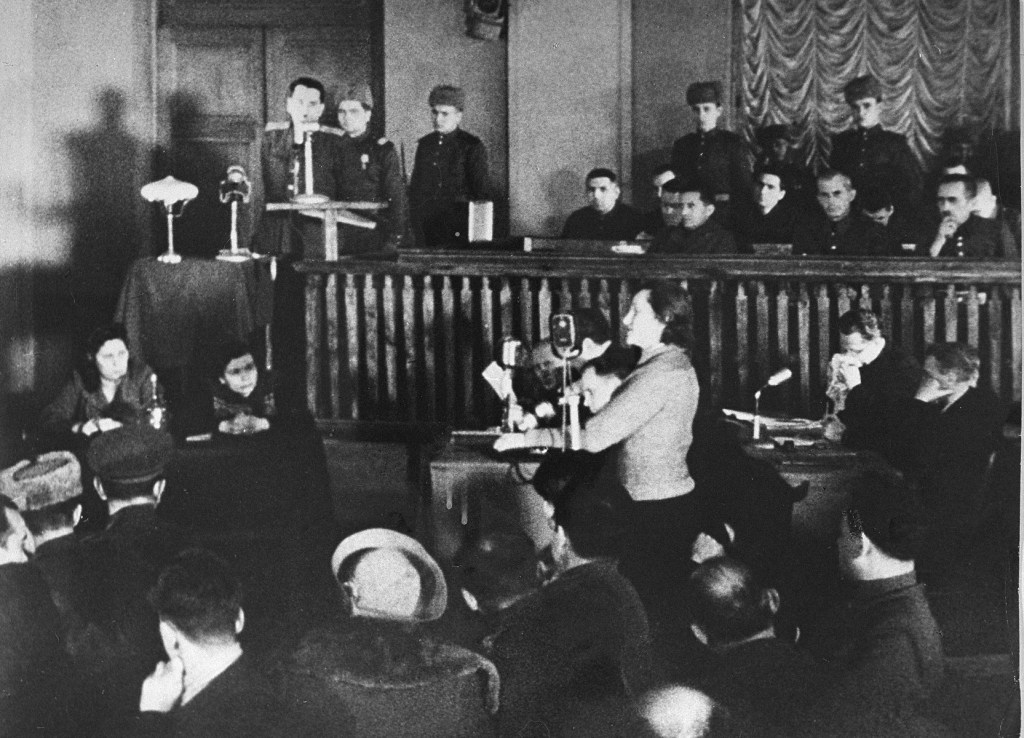
Dina Pronicheva (born Dina Mironovna Wasserman) was a Jewish actress at the Kyiv Puppet Theatre and one of the very few people—fewer than 30—who survived the mass executions at the Babi Yar ravine.
Her detailed testimony remains one of the most significant eyewitness accounts of the atrocity carried out by the Nazi Einsatzgruppen and local collaborators on September 29–30, 1941, during which over 33,000 Jews were murdered in two days. She recounted her story on several occasions, including to Soviet historians in April 1946 and as a witness at the January 1946 Kyiv war crimes trial. Anatoly Kuznetsov also featured her account heavily in his famous documentary novel, Babi Yar.
Below is a summary of the key phases of her testimony, followed by excerpts from her account.
Key Moments from Dina Pronicheva’s Account
- The March to the Ravine
Following the German order posted throughout Kyiv demanding that all Jews report to the corner of Melnyk and Dokhturov Streets, Pronicheva accompanied her mother, sister, and extended family.
“We were living in terror. When I saw the posters on the city’s streets and read the order… in my heart I sensed trouble… Russian husbands accompanied their Jewish wives. Russian wives accompanied their Jewish husbands. Hundreds, no thousands, of Jews were walking the same way… Small children were crying. When we neared Babi Yar, shooting and inhuman cries could be heard. I started to grasp what was going on, but said nothing to my mother.”
- The Stripping and Processing Area
As the crowd moved through a makeshift barrier guarded by soldiers and police, people were forced to drop their luggage, hand over documents, and strip naked. Her mother realized they were going to be killed and urged Dina—whose passport carried her non-Jewish husband’s surname, Pronicheva—to try to pass as Russian to save herself.
“One German approached my mother and tore her gold ring off her finger. Only then did my mother say to me: ‘Dinochka—you are Pronicheva, a Russian. You should save yourself…’”
“Each time I saw a new group of men and women, elderly people, and children being forced to take off their clothes. All of them were being taken to an open pit where submachine-gunners shot them… I saw a young woman, completely naked, nursing her naked baby when a policeman came running up to her, tore the baby from her breast, and threw it into the pit alive. The mother rushed there after her baby. The fascist shot her and she fell down dead…”
- Falling Into the Ravine
Pronicheva initially tried to convince an officer that she was an ethnic Russian who was only accompanying her family. Although an officer set her aside temporarily, another officer later ordered her to be taken to the edge of the pit. Knowing she was about to be shot, she made a split-second decision to jump into the ravine right as the volley fired.
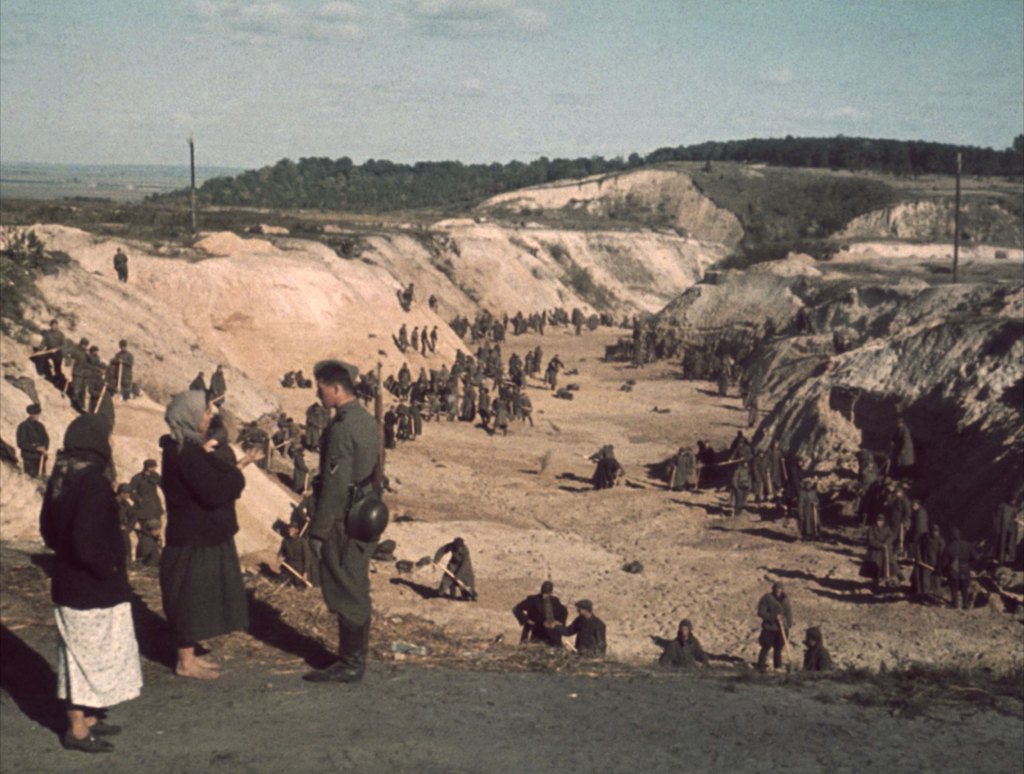
“The policeman ordered me to strip and pushed me to a precipice, where another group of people was awaiting their fate. But before the shots resounded, apparently out of fear, I fell into the pit. I fell onto the bodies of those already murdered…”
- Buried Alive Under the Dead
Pronicheva lay motionless among hundreds of corpses as more bodies fell on top of her. She described how the ground seemed to move beneath her from the living who were dying slowly underneath.
“I was among thousands and thousands of inert corpses, and I became terribly frightened. Here and there the earth was moving—some of the buried were still alive. I was looking at myself and I was terrified. The thin undershirt covering my naked body was soaked with blood…”
“Germans armed with submachine-guns walked around, finishing off the wounded. One SS man caught his foot against me… He shone his torch on me, picked me up, and struck me with his fist. But I hung limp and gave no sign of life.”
- Night Escape
When night fell and the German guards had paused operations, Pronicheva began crawling out from under the pile of bodies.
“I said to myself: ‘Dina, stand up…’ I turned around quietly and felt something moving behind me. I asked: ‘Who are you?’ I was answered by a thin, scared child’s voice: ‘Auntie, don’t be afraid, it’s me, Fima. I am eleven years old. Take me with you. I am very afraid of the dark.’”
She took the young boy, Fimochka, with her as they tried to scale the ledge of the ravine. However, a shot rang out nearby as they reached the top, causing them to flatten themselves onto the dirt.
“When I calmed down, I moved close to Fimochka, took shelter at his side, and asked him quietly: ‘How do you feel, Fimochka?’ There was no answer. In the darkness I felt his arms and legs… There was no sign of life. I lifted myself to look into his face… I realized that the boy was dead.”
Pronicheva managed to crawl away alone into the surrounding woods. After days of hiding, escaping recapture, and being aided by local residents who hid her, she survived the German occupation.
Aftermath and Historical Impact
In January 1946, Pronicheva gave formal, sworn testimony at the Kyiv Trial against German war criminals. Her testimony provided crucial, firsthand account detail that refuted initial German attempts to conceal the scope and nature of the killings, making her one of the foundational eyewitnesses in the documentation of the Holocaust by bullets.
Sources
https://en.wikipedia.org/wiki/Dina_Pronicheva
https://www.bbc.com/audio/play/w3ct1x4l
https://encyclopedia.ushmm.org/content/en/article/kiev-and-babi-yar
https://en.wikipedia.org/wiki/Babi_Yar
https://hmd.org.uk/resource/the-babi-yar-massacre
https://muse.jhu.edu/article/979790
https://collections.ushmm.org/search/catalog/pa15588
Donation
Your readership is what makes my site a success, and I am truly passionate about providing you with valuable content. I have been doing this at no cost and will continue to do so. Your voluntary donation of $2 or more, if you are able, would be a significant contribution to the continuation of my work. However, I fully understand if you’re not in a position to do so. Your support, in any form, is greatly appreciated. Thank you. To donate, click on the credit/debit card icon of the card you will use. If you want to donate more than $2, just add a higher number in the box left from the PayPal link. Your generosity is greatly appreciated. Many thanks.
$2.00


Leave a Reply