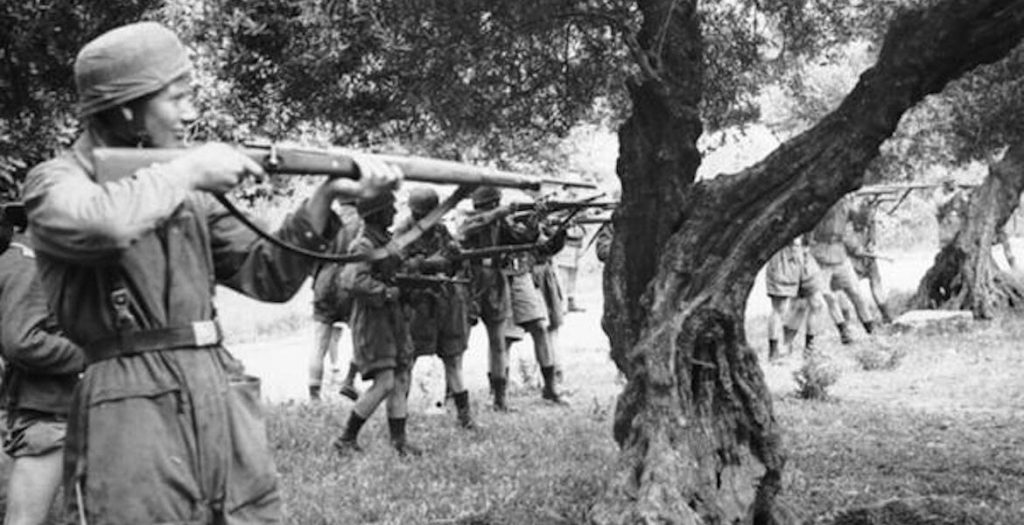
On the morning of October 6, 1943, the mountain village of Kali Sykia fell completely silent. The men had vanished into the ravines; only the women, children, and the elderly remained. By nightfall, thirteen people were dead—trapped inside their own homes as the wood was barricaded from the outside and set alight. Twelve were women, including one eight months pregnant; the thirteenth was a bedridden old man. In the dark machinery of the Axis occupation of Crete, massacres were common—but what happened in Kali Sykia stood apart for its stark, singular horror.
On the morning of October 6, 1943, the mountain village of Kali Sykia fell completely silent. The men had vanished into the surrounding ravines; only the women, children, and the elderly remained. By nightfall, thirteen people were dead—trapped inside their own homes as doors were barricaded from the outside and set alight. Twelve were women, including one who was eight months pregnant; the thirteenth was an elderly, bedridden man. In the brutal history of Axis-occupied Southern Europe, collective punishment was routine, but what happened at Kali Sykia stood apart for one chilling reason: the terror was aimed almost exclusively at women.
The massacre was not an isolated outburst. It was the calculated product of a counter-insurgency doctrine designed to destroy not just armed resistance, but the civilian communities that sustained it.
Terror as Counter-Insurgency
After the fall of Crete during Operation Mercury (Unternehmen Merkur) in May 1941, German occupation forces encountered a civilian resistance movement unlike anything they had prepared for. The island’s rugged topography offered natural sanctuary for partisan bands, while local villagers sheltered Allied agents, shared intelligence, and funneled supplies into the mountains.
The German response was total. Villages suspected of aiding partisans faced immediate, collective reprisals: livestock was seized, homes were razed, and hostages were executed. The principle was simple: if a community supported the resistance, the community became a military target.
Among the most notorious instruments of this doctrine was Jagdkommando Schubert, a specialized counter-insurgency unit commanded by Sonderführer Fritz Schubert. Fluent in Greek, Schubert recruited local collaborators, criminals, and auxiliaries into a unit known to locals as the Schuberai (Σουμπερίτες). Operating with unchecked authority, the unit specialized in torture, intelligence gathering, and punitive expeditions, rapidly blurring the line between military action and outright terrorism.
The Road to Kali Sykia
By the autumn of 1943, the occupation was fracturing. Italy’s capitulation in September shifted the island’s balance of power, prompting resistance groups to step up operations. Following the devastating Viannos massacres—where hundreds of Cretan civilians were murdered by German troops—resistance leader Manolis Bandouvas withdrew his surviving fighters west into the Rethymno mountains.
Kali Sykia lay directly along this corridor. Its inhabitants provided food, water, and shelter to the partisans passing through.
On October 4, a German patrol clashed with Bandouvas’s men near Mount Tsilivdikas. The patrol was wiped out. For the occupation command, the deaths of German soldiers required immediate, catastrophic retaliation. General Bruno Bräuer ordered a punitive sweep of the surrounding settlements, dispatching Schubert and his Jagdkommando into the mountains.
The villagers knew what was coming.
October 6, 1943
When Schubert’s men reached Kali Sykia on October 6, most men of military age had already fled into the ravines and caves, knowing they were the primary targets for roundups and executions.
What remained in the village were the women, the young, and the infirm.
The absence of the men did not deter the Schuberai. They rounded up the remaining inhabitants and demanded to know where the men were hiding, where supplies were cached, and where the partisans had gone.
The women refused to speak.
Beatings, threats, and the systematic looting of their homes failed to break the silence. Frustrated by the resistance, the unit changed tactics. The women were divided into groups and forced into several houses. The doors and windows were locked and blocked from the outside.
Then, the soldiers set the structures on fire.
Inside, there was no exit. Twelve women—eight from Kali Sykia and four visiting from neighboring Rodakino—were burned alive. Among them was Evangeli Koufaki, eight months pregnant. The thirteenth victim was a bedridden old man unable to leave his bed.
There was no battlefield, no military necessity, and no armed opposition—only homes, trapped civilians, and fire.
The Terror Continues
Kali Sykia was merely one stop on the punitive sweep. Two days later, on October 8, Schubert’s unit marched west toward Kallikratis in the Sfakia region, where they executed approximately thirty more civilians under similar pretexts.
The strategy was explicit: anyone who fed, sheltered, or refused to inform on the resistance would share their fate.
A Crime of Occupation—and Collaboration
Massacres like those at Viannos, Distomo, and Kalavryta proved that civilians of all ages and genders were vulnerable to Axis reprisals across Greece. Yet Kali Sykia remains unique in the history of the occupation because women made up almost the entire body of those deliberately targeted and burned alive.
The atrocity also highlights the dark role of Greek collaboration. Many of those enforcing Schubert’s directives were not German soldiers, but Greek auxiliaries. They knew the language, the terrain, and the social bonds of the mountain villages. They operated alongside the occupation apparatus to intimidate, torture, and murder their own countrymen—leaving wounds in the social fabric that persisted long after the war ended.
The Fall of Fritz Schubert
Following the Axis collapse, Schubert fled to Germany under a false identity. He was eventually captured, extradited to Greece, and tried by the Special Court for War Criminals in Athens.
Convicted for his role in numerous massacres across Crete and Macedonia, Schubert was sentenced to death. On October 22, 1947, he was executed by firing squad in Thessaloniki.
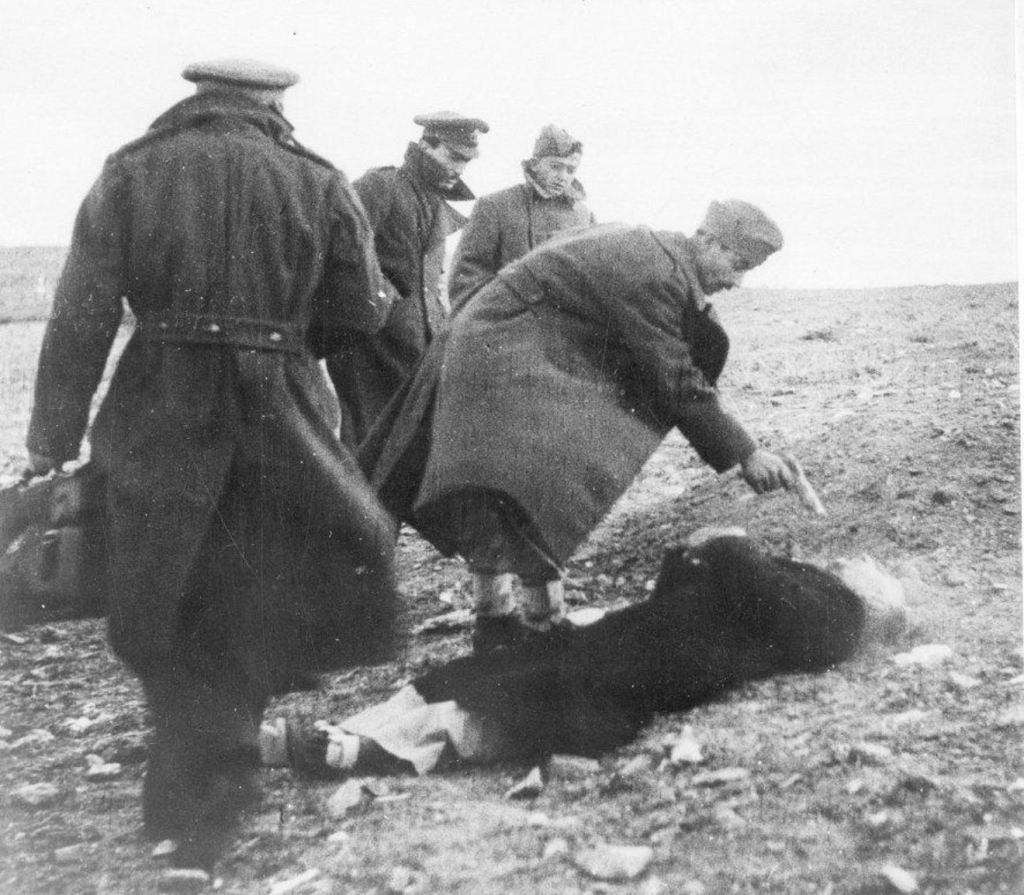
Fritz Schubert first appeared on Crete in the summer of 1941, only weeks after the island had fallen to the Germans. He was initially assigned as a military interpreter to the German Local Command (Ortskommandantur) in Chania, serving under General Alexander Andrae, the commander of occupied Crete.
In August 1941, Schubert was apparently transferred to the Regional German Command (Kreiskommandantur) in Rethymno. His career on the island, however, was only beginning. By the autumn of that year, he had been transferred again, this time to Heraklion, where he joined an Abwehr counter-intelligence detachment commanded by a Greek-speaking German officer, Major Hartmann, whose first name is unknown.
Schubert’s linguistic abilities would prove invaluable to the German occupation authorities. He spoke Turkish and Greek, although his Greek was marked by a pronounced Turkish accent. To the Cretans who encountered him, this became one of his most recognizable characteristics. They gave him a nickname that would follow him through the occupation: “the Turk.”
At first, Schubert was an interpreter and intelligence officer—a man who moved between languages and cultures on behalf of the occupying power. But his knowledge of Greek, his familiarity with the island, and his ability to communicate directly with Cretans would eventually make him far more dangerous than an ordinary military interpreter.
His execution closed the chapter on one of the occupation’s most brutal figures, but it could not erase the physical and psychological scars left in villages like Kali Sykia.
For decades after the war, the full extent of small-village atrocities like Kali Sykia was overshadowed in national history by larger urban events or major regional massacres. However, local efforts by historians and survivors ensured that the memory of the women who refused to betray their community endured. In June 2017, by Presidential Decree (Π.Δ. 49/1-6-2017), the Greek State officially recognized Kali Sykia as a Martyred Village (Μαρτυρικό Χωριό), cementing its place in the historical memory of the Greek resistance.
Sources:
https://en.wikipedia.org/wiki/Friedrich_Schubert
https://filmfestival.gr/en/films/burning-women-at-kali-sykia-by-german-nazis


Leave a Reply