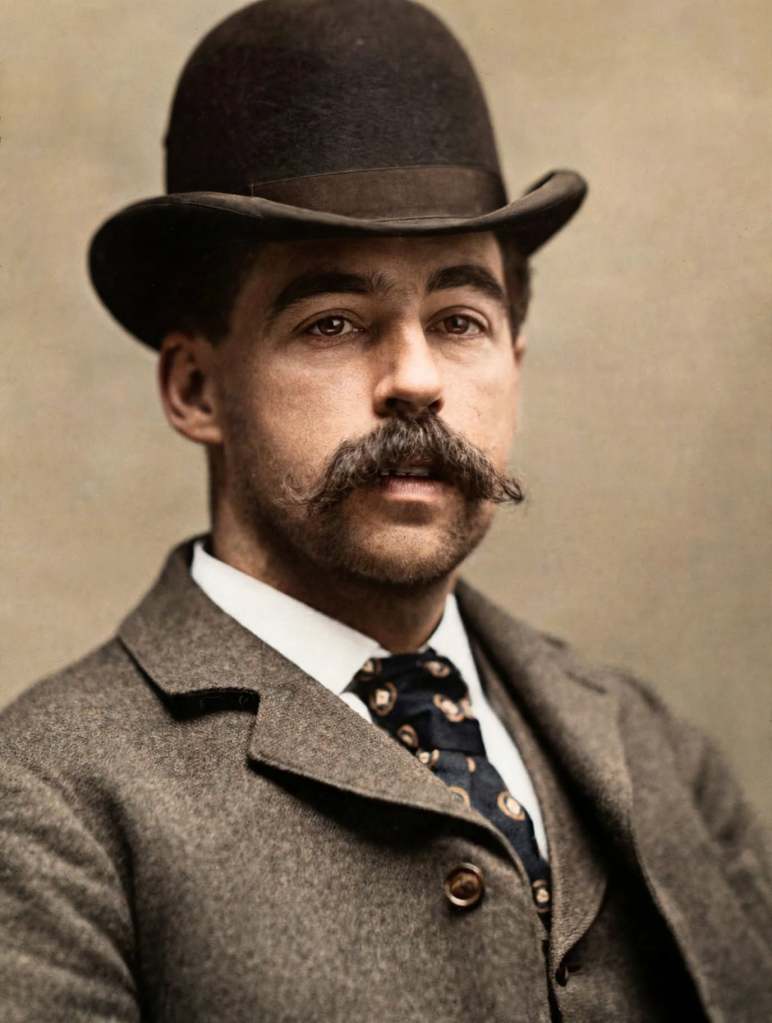
In the popular imagination, Herman Webster Mudgett—better known to history as Dr. Henry Howard Holmes—stands as America’s first serial killer, a Victorian gothic villain who constructed a labyrinthine “Murder Castle” in the shadow of the 1893 Chicago World’s Fair to slaughter as many as two hundred unsuspecting tourists. Yet, when the sensational headlines of the yellow press are stripped away, a more complex, chilling, and historically revealing figure emerges. Holmes was undoubtedly a cold-blooded murderer, a serial bigamist, and a pathological predator. Primarily, however, he was a consummate confidence man—a distinctly American product of the Gilded Age whose lethal career was driven less by an insatiable bloodlust than by an obsessive, systemic pursuit of financial fraud, insurance swindles, and total control.
From Gilmanton to the White City
Born on May 16, 1861, in Gilmanton, New Hampshire, Herman Webster Mudgett grew up in a devoutly Methodist household marked by strict discipline and emotional austerity. Early biographical accounts—many embellished by Mudgett himself in his later, wildly unreliable prison memoirs—describe a bright, socially isolated child fascinated by anatomy and skeletons. By the time he entered the University of Michigan’s Department of Medicine and Surgery in 1882, his true vocation had already taken shape: swindling. While in medical school, Mudgett stole cadavers from the university laboratories, disfigured them, and planted them to stage accidental deaths, collecting payouts on fraudulent life insurance policies taken out on fictitious or complicit individuals.
After graduating in 1884 and leaving behind a trail of unpaid debts, abandoned wives, and suspicious deaths across New York and Pennsylvania, Mudgett reinvented himself. Adopting the alias “Dr. H. H. Holmes,” he arrived in Chicago in August 1886—a city hurtling toward industrial and architectural dominance.
The Englewood “Castle” and the Machinery of Fraud
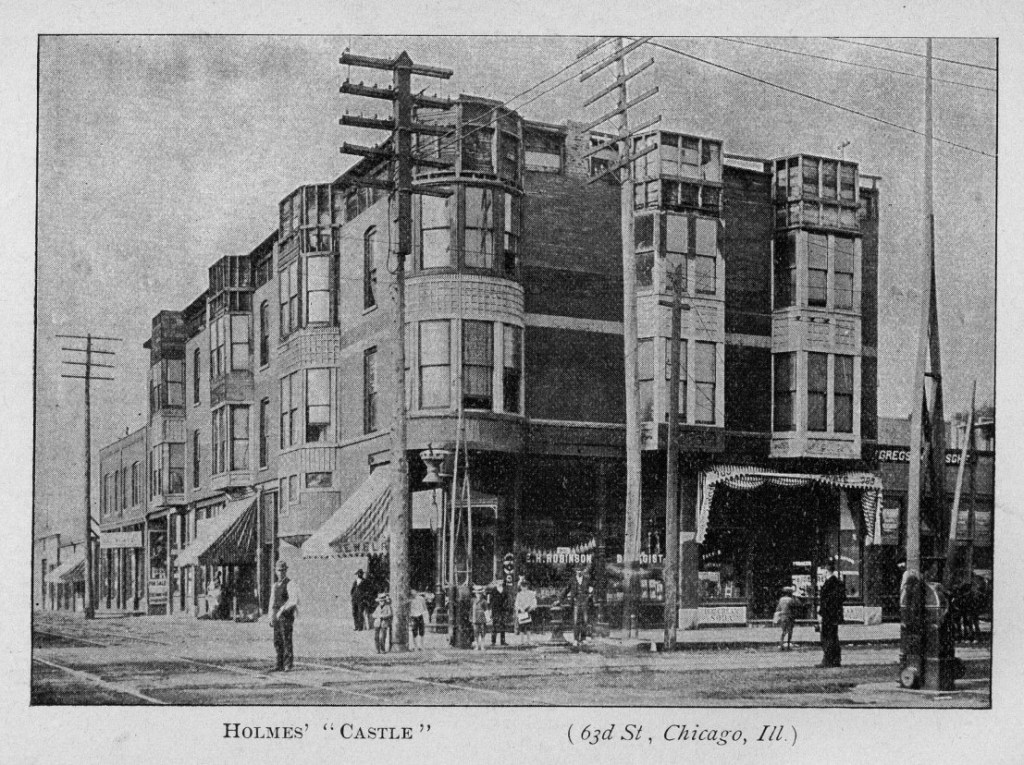
Holmes settled in Englewood, a rapidly growing South Side suburb located roughly three miles west of the future site of the 1893 World’s Columbian Exposition. There, he acquired a drugstore at the corner of Wallace and 63rd Streets from Elizabeth Holton, a widow whose husband had recently died. Soon after, Holton herself vanished; Holmes claimed she had moved to California, though she was never heard from again.
Using funds acquired through mortgaged properties, unpaid loans, and elaborate credit schemes, Holmes purchased the empty lot across the street and began constructing a massive, three-story, mixed-use building. Locals dubbed it “the Castle” due to its imposing, crenellated façade and sprawling footprint.
The building’s interior became the cornerstone of the Holmes mythos. Because Holmes routinely fired contractors mid-project—often to avoid paying them, while simultaneously keeping any single crew from grasping the entire blueprint—the upper floors developed into an erratic warren of dead-end hallways, windowless rooms, angled staircases, and doors that opened onto brick walls. When Chicago police finally searched the structure in July 1895, following a fire and a forensic investigation into Holmes’s crimes, the press eagerly transformed these architectural eccentricities into a custom-built slaughterhouse complete with grease chutes to the basement, soundproofed vaults rigged with gas lines, and vats of acid.
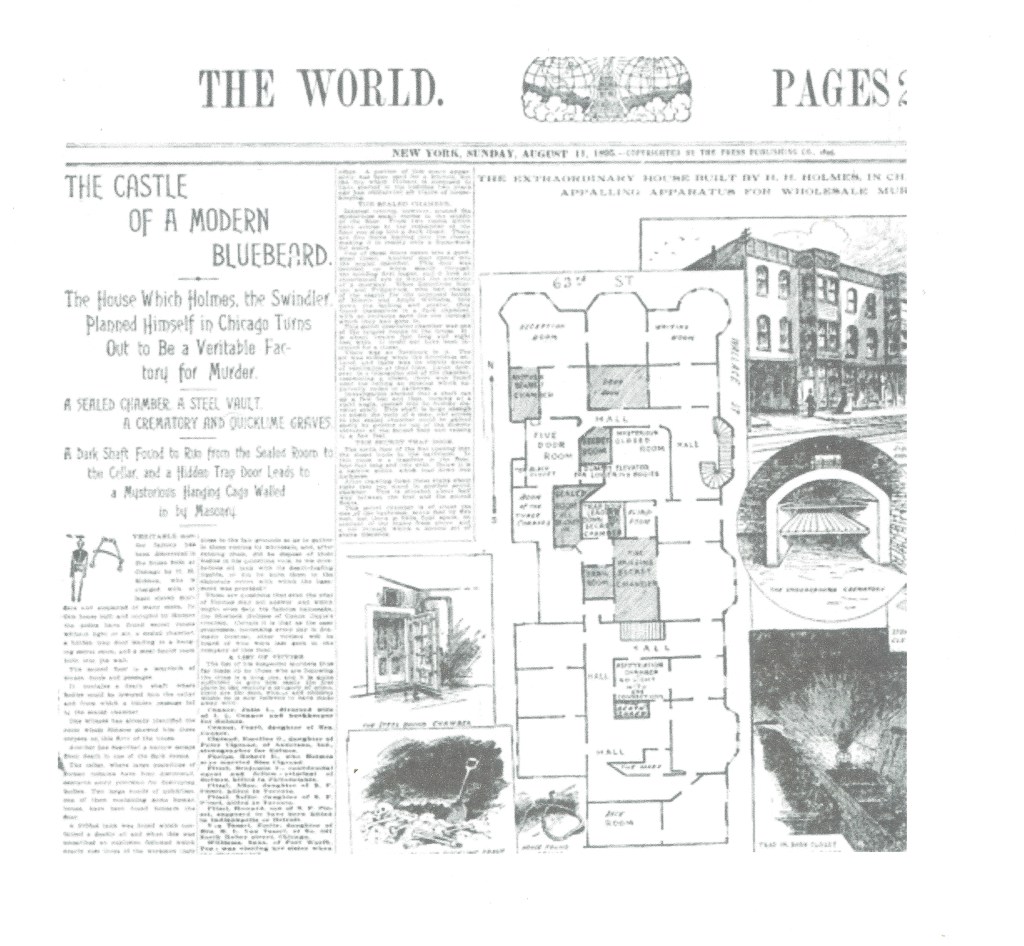
In reality, the Castle’s primary purpose was commercial fraud, not mass tourism murder. The ground floor housed legitimate storefronts—a pharmacy, a barber shop, a restaurant—designed to project respectability and secure credit from suppliers. The labyrinthine upper floors served as a shell game for stolen merchandise: Holmes routinely bought expensive goods, safes, and furniture on credit, hid them behind false walls or inside sealed rooms when creditors arrived to repossess them, and subsequently insured and liquidated the assets.
Murder, for Holmes, was an instrument of convenience and greed rather than random predation. His confirmed and most probable victims were not anonymous fairgoers lost in the crowds of the White City, but people entangled in his financial and personal webs:
- Julia Smythe and her daughter Pearl (1891): Julia was the wife of Ned Conner, an employee at Holmes’s pharmacy, and had become Holmes’s mistress. After Ned left Englewood, Julia and her six-year-old daughter vanished around Christmas 1891.
- Emeline Cigrand (1892): Holmes’s stenographer, who had become pregnant by him and knew too much about his fraudulent dealings; she disappeared in December 1892 after being lured into a sham marriage plot.
- Minnie and Nannie Williams (1893): Wealthy sisters from Texas whom Holmes charmed and manipulated. After persuading Minnie to transfer the deed to valuable Fort Worth real estate to him, Holmes invited her younger sister Nannie to Chicago. Both disappeared in the summer of 1893.
The Pitezel Conspiracy and the Unraveling
Irony defined Holmes’s downfall: the man who evaded detection while murdering vulnerable women in Chicago was ultimately caught because of an insurance scam gone wrong.
Following the close of the World’s Fair, mounting debts and arson investigations forced Holmes to flee Chicago. Accompanied by his longtime accomplice and fellow con man, Benjamin Pitezel, Holmes devised a $10,000 life insurance fraud in Philadelphia. The plan called for Pitezel to fake his own death using a cadaver procured by Holmes, allowing Pitezel’s wife, Carrie, to collect the payout and split it with Holmes. Instead, in September 1894, Holmes murdered Pitezel for real in a rented Philadelphia patent office, staging the scene to look like a fatal laboratory explosion.
To prevent Carrie Pitezel from realizing her husband was actually dead—and to keep her separated from the insurance money—Holmes convinced her that Benjamin was hiding out in South America. Under the guise of taking three of the Pitezel children (Alice, Nellie, and Howard) to reunite with their father, Holmes dragged them across the Midwest and into Canada. In October 1894, he murdered Alice and Nellie in Toronto, burying their bodies in the cellar of a rented house, and killed young Howard in a cottage in Irvington, Indiana, burning his remains in a stove.
Holmes’s web finally collapsed through the persistence of two investigators: Marion Hedgepeth, a jailed train robber whom Holmes had cheated out of a promised commission on the Pitezel tip-off, and Detective Frank Geyer of the Philadelphia Police Department. Hedgepeth alerted authorities to the insurance fraud, leading to Holmes’s arrest in Boston on 17 November 1894. Geyer then painstakingly traced Holmes’s route across the United States and Canada, uncovering the bodies of the three Pitezel children in July 1895.
Fact vs. Sensationalism: The Making of a Legend
Once Holmes was in custody, the nascent yellow journalism industry—led by William Randolph Hearst’s papers—seized upon the story. Lurid illustrations of trapdoors, asphyxiation chambers, and dissection tables flooded newspapers nationwide. Holmes leaned into the notoriety, selling a fabricated “confession” to the Hearst press for $7,500 in which he claimed responsibility for twenty-seven murders, even though several of the people he named were later proven to be alive.
Modern historians and criminologists—notably Adam Selzer, Harold Schechter, and Erik Larson—have worked to separate the historical record from nineteenth-century tabloid exaggeration:
- Victim Count: While popular lore routinely cites 100 to 200 victims, rigorous archival research confirms nine definite or highly probable murders (including the Pitezel family, the Williams sisters, Julia and Pearl Smythe, and Emeline Cigrand), with credible circumstantial links to perhaps a dozen more.
- The World’s Fair Connection: Although Holmes briefly rented rooms during the 1893 Exposition, there is no verifiable evidence that he systematically preyed upon transient tourists visiting the fair. Almost all of his known victims were employees, lovers, business associates, or their children.
- The “Murder Castle” Blueprint: The 1895 police search found evidence of human remains and suspicious subterranean spaces, including a large pit and bricked-over chambers, yet many of the gothic contraptions described in newspapers—such as greased body chutes and acid vats—were journalistic embellishments of standard building features or artifacts from Holmes’s illicit bone-articulation side business.
Legacy of a Gilded Age Predator
Herman Webster Mudgett was tried in Philadelphia solely for the murder of Benjamin Pitezel, convicted in November 1895, and hanged at Moyamensing Prison on May 7, 1896. Even on the gallows, he maintained a chilling composure, claiming he had killed only two people in his life and complaining that his neck did not snap cleanly, leaving him to strangle slowly for over fifteen minutes.
The enduring fascination with H. H. Holmes lies not in the exaggerated body counts of dime-novel lore, but in what his crimes reveal about late nineteenth-century America. Holmes weaponized the defining features of the Gilded Age: rapid urbanization, anonymous city crowds, weak regulatory oversight, the expansion of the life insurance industry, and the blind deference accorded to anyone bearing the title of “Doctor.” He was a mirror-image distortion of the self-made American entrepreneur—a man who turned human lives into balance-sheet liabilities and built a literal monument to deception in the heart of a booming metropolis.
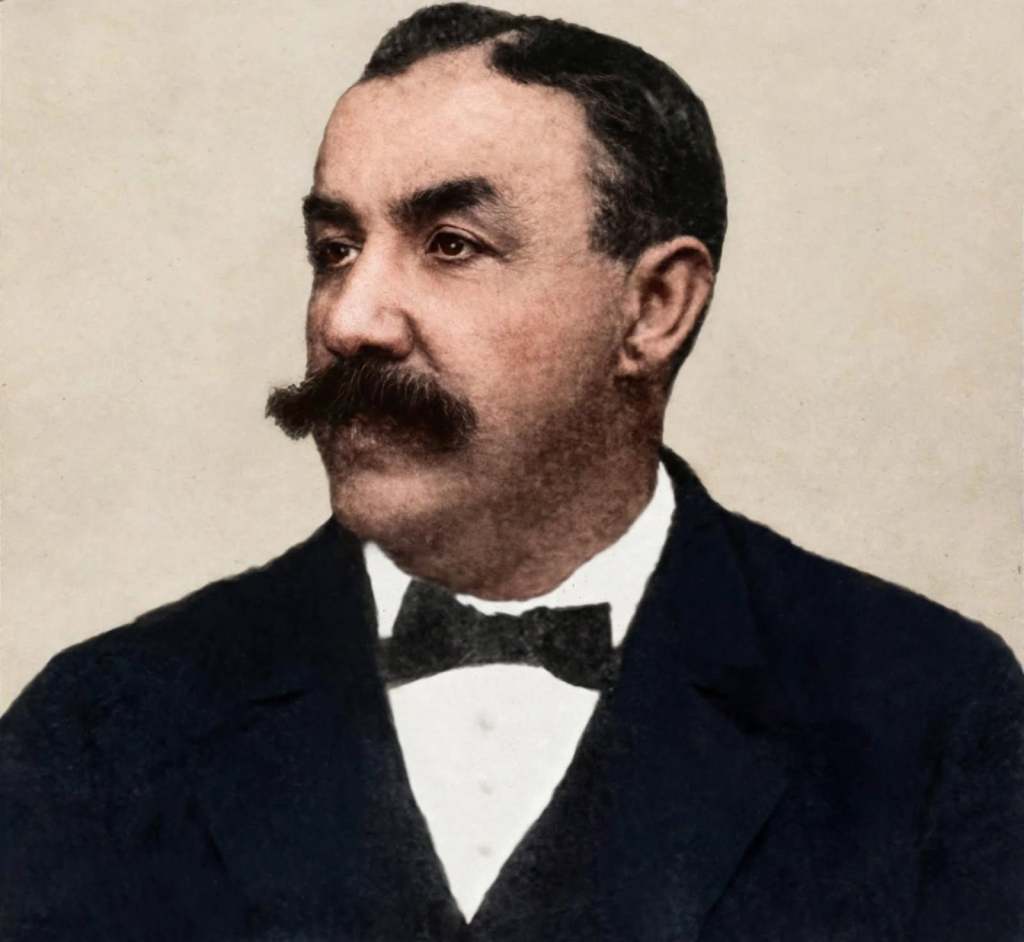
In June 1895, Philadelphia Police Detective Frank P. Geyer embarked on one of the most celebrated manhunts in nineteenth-century American criminology. While H. H. Holmes sat in Philadelphia’s Moyamensing Prison awaiting trial for the murder of Benjamin Pitezel, authorities realized they lacked a crucial piece of evidence: the whereabouts of three of Pitezel’s children—Alice (15), Nellie (11), and Howard (8)—whom Holmes had taken into his custody the previous autumn under the pretense of reuniting them with their father.
Armed with little more than photographs of the children, a single trunk, and a packet of letters written by Alice and Nellie while traveling with Holmes, Geyer spent six weeks piecing together a cold trail across the American Midwest and southern Ontario, exposing the full scope of Holmes’s cruelty.
The Setup: A Cruel Shell Game
In September 1894, after murdering Benjamin Pitezel in a staged laboratory explosion in Philadelphia, Holmes persuaded Pitezel’s grieving widow, Carrie, that her husband had merely faked his death to collect a $10,000 Fidelity Mutual Life Association payout and was hiding in South America.
To keep Carrie from discovering the truth—and to prevent her from keeping the insurance proceeds—Holmes orchestrated an elaborate shell game across North America. He split the Pitezel family into two groups:
- Group One: Carrie Pitezel and her remaining two children (Dessie and the baby, Wharton), whom Holmes moved from city to city under assumed names, promising they would soon join Benjamin.
- Group Two: Alice, Nellie, and Howard, whom Holmes claimed to be taking ahead to meet their father.
Throughout October 1894, Holmes deliberately moved both groups along overlapping routes—often staying in different hotels or rented houses just blocks apart in the same cities—so that neither Carrie nor the children ever crossed paths. Meanwhile, Holmes intercepted all correspondence, forcing Alice and Nellie to write cheerful letters to their mother that he either censored or never mailed.
Phase I: Cincinnati and the Indianapolis Lead
District Attorney George Graham assigned Detective Geyer—a seasoned investigator known for his methodical patience and personal familiarity with grief, having recently lost his own wife and daughter in a house fire—to trace the missing children. Geyer departed Philadelphia on June 26, 1895, accompanied by a Fidelity Mutual insurance investigator.
Geyer’s primary clues were postmarks on a handful of letters Alice and Nellie had managed to mail, dated from Cincinnati, Ohio, Indianapolis, Indiana, and Detroit, Michigan in late September and October 1894.
- Cincinnati (Late June 1895): Geyer began in Cincinnati, showing photographs of Holmes and the three children to hotel clerks, hack drivers, and real estate agents. He quickly confirmed that in late September 1894, Holmes had registered with the three children at a hotel before renting a house on Poplar Street. Neighbors recalled seeing the two girls and the young boy, noting that Holmes appeared brusque and secretive. However, all three children were seen leaving Cincinnati alive in early October, bound for Indianapolis.
- Indianapolis (Early July 1895): Following the trail west, Geyer discovered that Holmes had arrived in Indianapolis with the children around October 10, 1894, registering at the Circle House hotel. While the girls stayed at the hotel, Holmes arranged temporary boarding for eight-year-old Howard with a local family. Shortly thereafter, Holmes checked the girls out and took them north toward Detroit, leaving Howard behind for a brief period before returning alone to retrieve him. At this stage, Geyer noted an alarming shift in the timeline: after Indianapolis, Howard vanished entirely from hotel registers and letter descriptions.
Phase II: Detroit and the Trail to Toronto
Moving north to Detroit in mid-July, Geyer uncovered further proof of Holmes’s psychological manipulation. Hotel records confirmed that Holmes had arrived with Alice and Nellie on October 13, 1894—at the exact same time Carrie Pitezel and her other two children were staying at a separate Detroit boarding house just a few streets away.
In Detroit, Alice wrote a poignant letter to her mother—never delivered by Holmes—mentioning that Howard was not with them and expressing confusion over why they had not yet seen their father. Witnesses confirmed that Holmes and the two girls boarded a train heading east across the border into Canada. Geyer followed the rail line to Toronto, Ontario.
The Discovery at 16 St. Vincent Street
Arriving in Toronto in mid-July 1895, Geyer enlisted the assistance of the Toronto Police Department and published photographs of Holmes, Alice, and Nellie in the local newspapers, appealing to landlords who had rented properties to an American matching Holmes’s description in October 1894.
The breakthrough came quickly. A local landlord came forward, identifying Holmes (using the alias “A. C. Hayes”) as the man who had rented a modest brick house at 16 St. Vincent Street around October 18, 1894. Neighbors remembered the tenant distinctly: he had arrived with two young girls, had no furniture save for a single trunk, and had borrowed a spade from a neighbor, claiming he wanted to dig a bin in the cellar to store potatoes.
On July 15, 1895, Geyer, accompanied by Toronto detectives, entered the cellar of 16 St. Vincent Street. The floor was composed of hard-packed earth. Probing the soil in a back corner, Geyer noticed a section where the dirt felt noticeably softer. Grabbing a spade, Geyer began digging himself.
Roughly three feet beneath the cellar floor, Geyer’s shovel struck human remains. Gently clearing the dirt by hand, he uncovered the nude, decomposing bodies of Alice and Nellie Pitezel, lying side by side. Forensic examination indicated they had likely been locked in the large trunk and asphyxiated with illuminating gas via a rubber tube connected to a gas jet—a method consistent with Holmes’s preferred modus operandi.
Phase III: Returning to Irvington and Finding Howard
With the fates of Alice and Nellie confirmed, Geyer turned his attention back to Indiana to solve the disappearance of eight-year-old Howard. Reviewing the timeline from October 1894, Geyer realized Holmes had briefly returned to the Indianapolis area shortly after leaving Detroit and before arriving in Toronto.
Geyer returned to Indianapolis and expanded his search to the quiet suburban village of Irvington, four miles east of the city. Canvassing local real estate agents and hardware stores, Geyer discovered that around October 10, 1894, a man matching Holmes’s description—using the alias “G. Howell”—had rented a small cottage on Julian Avenue.
Crucially, local merchants remembered the tenant making two unusual purchases:
- A large, second-hand wood-burning stove, despite the cottage already having one.
- A quantity of quicklime and a set of carving knives.
On July 27, 1895, Geyer searched the Julian Avenue cottage. Inspecting the chimney flue, the outhouse, and the stove, he found the horrific answer. Inside the soot and ash of the stove—and buried in the backyard—Geyer recovered charred fragments of human bone, teeth, a section of a child’s skull, and a mass of unburned organic tissue, along with remnants of Howard’s clothing and toys. Holmes had dismembered and burned the eight-year-old boy’s body in the stove to dispose of the evidence before traveling back to Toronto to murder his sisters.
Historical Significance
Detective Frank Geyer’s six-week investigation—later chronicled in his 1896 book, The Holmes-Pitezel Case—transformed the legal and public understanding of H. H. Holmes.
Before Geyer’s journey, Holmes was viewed primarily as a slick insurance swindler whose accomplice had died in a suspicious fire. By patiently tracing the paper trail of postmarks, rental agreements, and eyewitness accounts across 1,500 miles, Geyer provided the irrefutable physical evidence that broke the case open. Although Holmes was formally tried and hanged only for the murder of Benjamin Pitezel, Geyer’s testimony regarding the discovery of the three children in Toronto and Irvington sealed Holmes’s conviction in November 1895 and exposed the cold, calculating brutality behind the myth.
Despite popular legend suggesting that H. H. Holmes’s “Murder Castle” burned to the ground in 1895, the structure actually survived for more than four decades after his arrest. Its post-1895 history is a strange mix of suspected arson, morbid tourism, and eventual urban redevelopment.
The August 1895 Fire and Failed “Horror Museum”
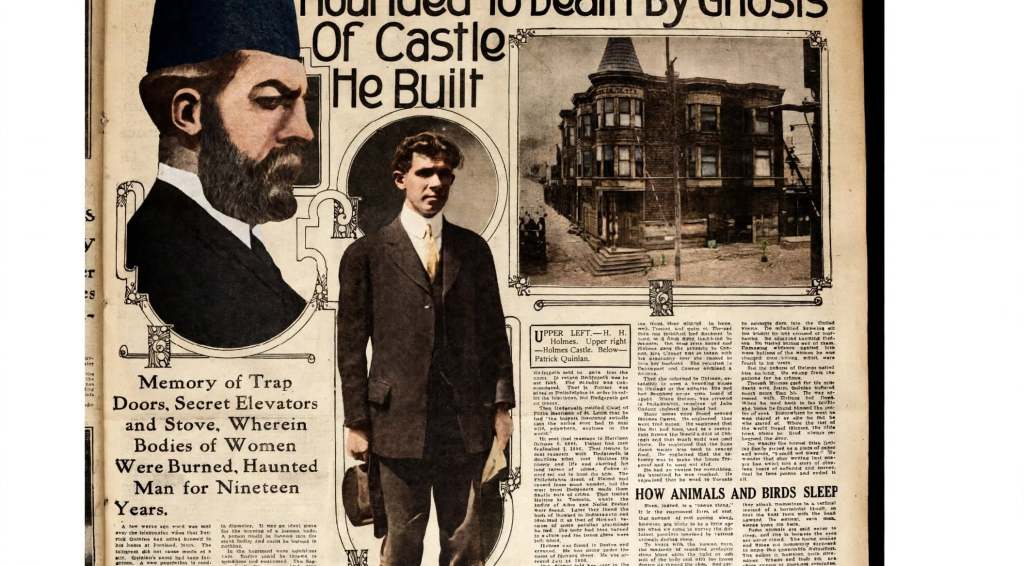
In mid-August 1895—just weeks after Chicago police wrapped up their publicized excavation of the building—a suspicious fire broke out inside the Castle. Flames tore through the upper stories, heavily damaging the third floor and roof, though the brick exterior and lower levels remained structurally intact.
Fire investigators immediately suspected arson. At the time, the property was tangled in competing mortgages, liens, and insurance disputes left behind by Holmes’s financial schemes. Even more intriguingly, just days before the blaze, an entrepreneur had reportedly leased or purchased the building with plans to convert it into a macabre “chamber of horrors” tourist attraction, charging visitors admission to tour the secret rooms and basement pit. Whether the fire was set to collect insurance money, destroy remaining evidence of Holmes’s crimes, or stop the building from becoming a lurid sideshow was never conclusively proven.
Forty Years as a Commercial Relic (1896–1938)
Rather than being demolished after the fire, the building was repaired, stripped of its damaged top floor, and returned to mundane commercial use. For the next forty-two years, the former “Castle” operated quietly on the corner of West 63rd and South Wallace Streets.
Over those decades, the ground-floor storefronts and upper levels housed a variety of ordinary businesses—including dry goods shops, storage warehouses, and neighborhood offices—while the Englewood district evolved around it. Although the building’s notorious past remained a staple of local Chicago lore, few of its later tenants paid much attention to its history until the late 1930s.
The 1938 Demolition and the Englewood Post Office
In 1938, the federal government acquired the corner lot as part of a New Deal-era public works expansion in Chicago, demolishing the remnants of Holmes’s building once and for all.
Today, the site at 611 West 63rd Street is occupied by the Englewood Station branch of the United States Postal Service, a sturdy, single-story red-brick post office built in the late 1930s.
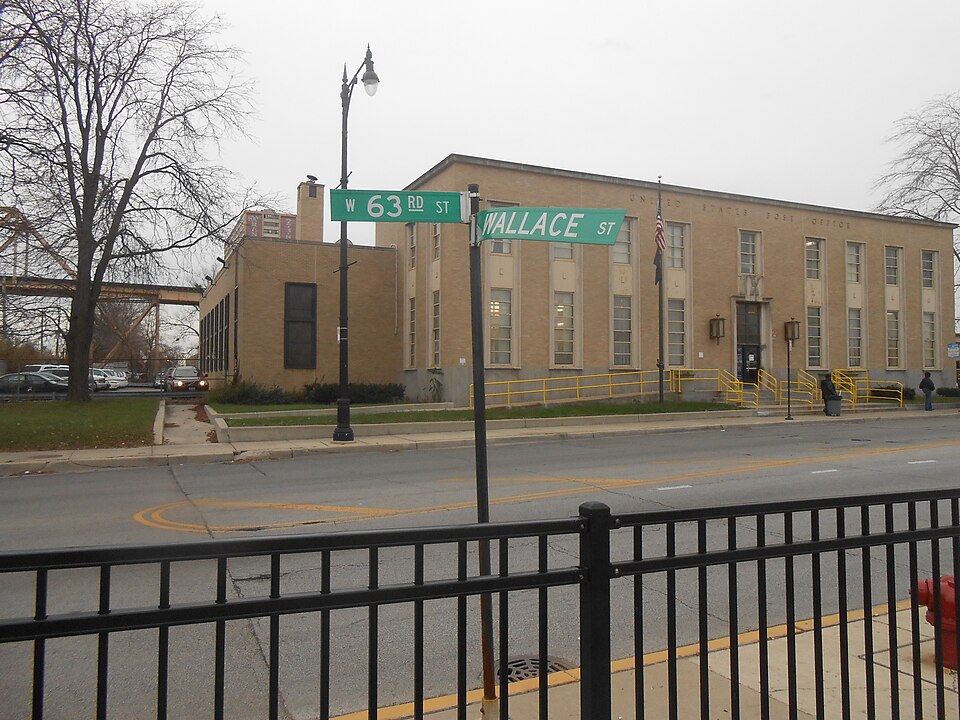
A few architectural details link the current site to its 1890s predecessor:
- The Exact Footprint: Holmes’s original building stood on the western portion of the current post office block, immediately adjacent to the corner of 63rd and Wallace Streets.
- The Subterranean Foundation: Because the 1938 demolition cleared the above-ground structure rather than excavating the entire deep foundation, portions of the original brick cellar walls and subterranean levels remained buried beneath the post office floor—a detail that has fueled decades of local ghost stories among postal workers and Chicago true-crime tour guides.
- Across the Street: Across Wallace Street—where Holmes originally acquired Elizabeth Holton’s drugstore in 1886—now sits a modern grocery store and parking lot, leaving no visible trace of the nineteenth-century storefronts where Holmes launched his career.
Sources:
https://guides.loc.gov/chronicling-america-h-h-holmes
https://en.wikipedia.org/wiki/H._H._Holmes


Leave a Reply