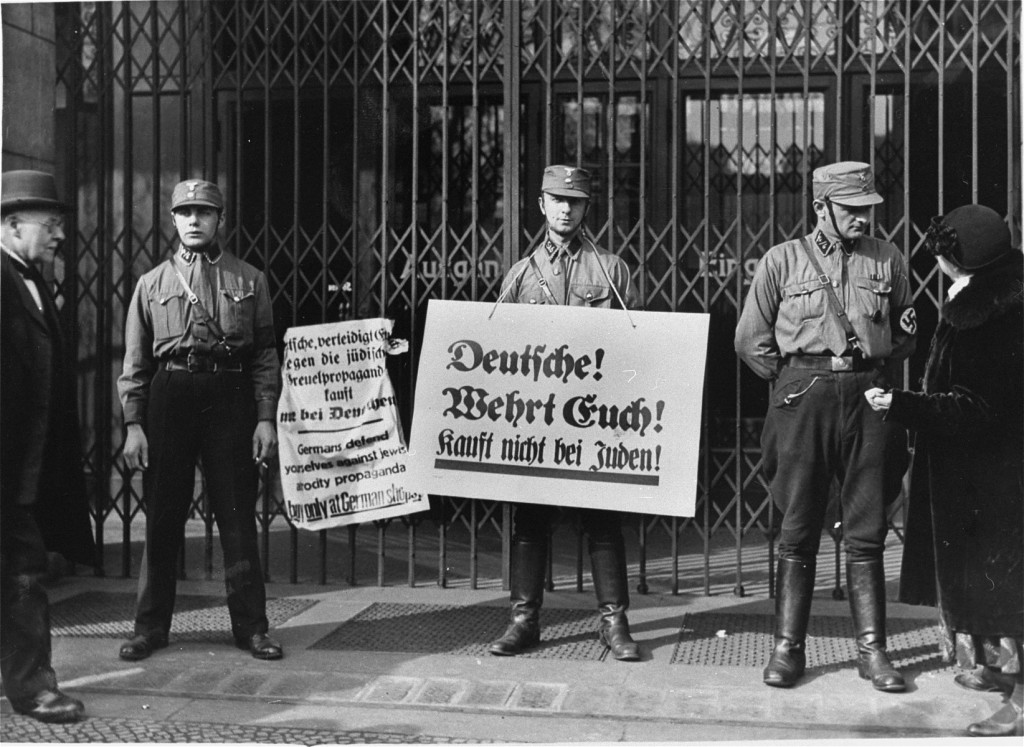
Never again is happening right now.
If there is one certainty in life, it is that history teaches us nothing. The same hatred that fuelled the Holocaust is once again visible today. Or perhaps the more uncomfortable question is whether it ever really disappeared.
Some argue that it is only Zionists they want to boycott. But those who make such arguments should be careful not to ignore the lessons of history. The systematic exclusion of one group rarely exists in isolation. Once discrimination and collective blame become normalised, the boundaries of hatred can expand. Yesterday it was the Jews; tomorrow it could be Asians, people with disabilities, or any other group that society decides to turn against. History has repeatedly demonstrated how easily prejudice can spread beyond its original targets.
Below is a brief timeline of the boycotts of Jewish-owned businesses and companies across Europe between 1933 and 1945. It is worth examining, because the parallels and differences with some of the rhetoric and boycott campaigns of the 2020s deserve serious consideration. Anyone familiar with the history of the 1930s should recognise why such developments warrant attention.
The Economic Persecution of European Jews, 1933–1945
The single official, nationwide Nazi boycott of Jewish businesses in Germany took place on Saturday, 1 April 1933. It was not a continuous twelve-year boycott, but rather the opening salvo in a much broader and increasingly systematic campaign of economic persecution that would eventually spread across Nazi-controlled and occupied Europe.
What began as street-level intimidation and organised picketing quickly evolved into something far more sinister. The Nazi regime gradually replaced public boycotts with discriminatory legislation, forced business transfers, compulsory liquidations and, ultimately, the wholesale confiscation of Jewish property. This process became known as Aryanization.
On 1 April 1933, SA (Sturmabteilung or Stormtrooper) members stationed themselves outside Jewish-owned shops, department stores, banks and professional offices throughout Germany. From 10 a.m. until 8 p.m., they intimidated customers, discouraged people from entering Jewish establishments and painted Stars of David and the word Jude on shop windows. The message was unmistakable: Jewish businesses were no longer welcome in German society.
Key Dates in the Economic Exclusion of European Jews (1933–1945)
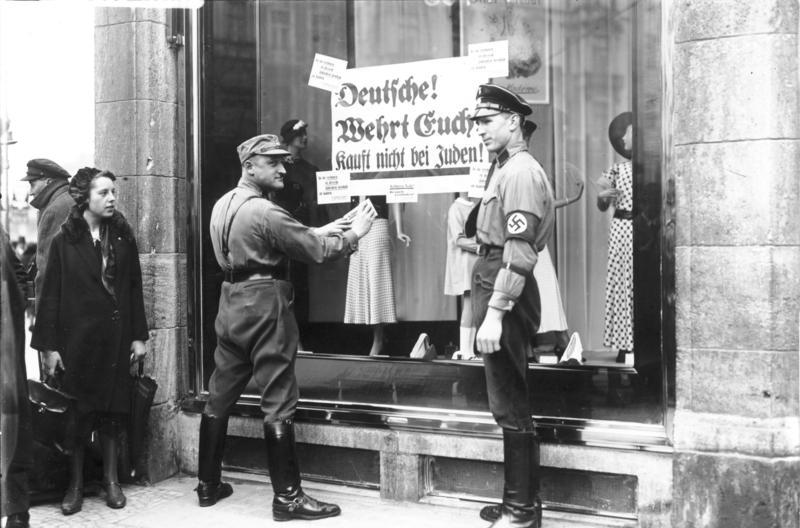
1 April 1933 – Nationwide Boycott of Jewish Businesses in Germany
The first coordinated, nationwide, state-sponsored boycott against Jewish businesses under the Nazi regime. Lasting just one day, it targeted Jewish-owned retail establishments, doctors, lawyers and other professionals throughout Germany. Although the central action was officially called off after twenty-four hours, local intimidation and economic discrimination continued. The boycott demonstrated how the Nazi regime could mobilise an entire political apparatus against a minority population.
7 April 1933 – Law for the Restoration of the Professional Civil Service
Just six days after the boycott, the Nazi government introduced legislation designed to remove Jews and political opponents from public employment. Jewish civil servants, judges, academics and other professionals were increasingly excluded from their positions. The persecution was moving beyond intimidation in the streets and becoming embedded in the machinery of the state.
1936–1939 – Polish Nationalist Boycotts
Germany was not the only European country where Jewish businesses faced organised economic hostility. In Poland, right-wing nationalist organisations, particularly the National Democratic movement known as Endecja, encouraged boycotts and organised picketing of Jewish-owned shops. In June 1936, Polish Prime Minister Felicjan Sławoj Składkowski publicly endorsed an economic struggle against Jewish businesses. Although Poland’s situation differed fundamentally from Nazi Germany’s state-sponsored programme, these campaigns contributed to an increasingly hostile economic environment for Polish Jews.
26 April 1938 – Compulsory Registration of Jewish Property
Following the Anschluss, the annexation of Austria in March 1938, the Nazi regime expanded its campaign of economic dispossession. Jews in Germany were required to register domestic and foreign assets exceeding 5,000 Reichsmarks. The information provided enabled the authorities to identify, monitor and ultimately confiscate Jewish wealth. What had begun with boycotts and intimidation was becoming an organised system of state-sponsored robbery.
9–12 November 1938 – Kristallnacht and the Elimination of Jews from Economic Life
During the November pogroms, commonly known as Kristallnacht, Nazi organisations and their supporters attacked Jewish communities throughout Germany, Austria and the recently annexed Sudetenland. Thousands of Jewish businesses were vandalised or destroyed, synagogues were burned, homes were ransacked and Jewish men were arrested and sent to concentration camps.
On 12 November 1938, Hermann Göring chaired a meeting at which the regime formalised the exclusion of Jews from German economic life. The subsequent decree prohibited Jews from operating retail businesses and independent trades from 1 January 1939. Jewish businesses were effectively forced out of existence or transferred into non-Jewish ownership.
1939–1944 – Aryanization and Confiscation Across Occupied Europe
With the outbreak of the Second World War in September 1939, the persecution of Jewish businesses expanded across Europe. Following the invasion of Poland, and subsequently Western Europe in 1940 and the Balkans and Soviet territories in 1941, Nazi authorities extended their economic policies into occupied territories.
Jewish businesses were registered, seized, liquidated or transferred to non-Jewish owners. In countries such as France, Hungary and Romania, local authorities and collaborationist administrations also participated in varying forms of economic persecution and dispossession. In the occupied Netherlands, Belgium and elsewhere, Jewish property was systematically confiscated through increasingly elaborate administrative mechanisms.
Economic exclusion was no longer simply about preventing Jews from buying or selling goods. It was about stripping an entire population of its livelihoods, independence, possessions and ability to survive. It formed part of the wider machinery of persecution that culminated in deportation and genocide.
8 May 1945 – The End of the Second World War in Europe
With Nazi Germany’s unconditional surrender, the regime responsible for these policies collapsed. However, the end of the war did not automatically restore what had been stolen. Thousands of survivors returned to find their businesses, homes and possessions gone. Many never recovered their property, and restitution remained an unresolved issue for decades.
A historical point worth emphasising: The progression from the April 1933 boycott to compulsory registration, Aryanization and confiscation is particularly important. It demonstrates that economic persecution was not an isolated event but part of a steadily escalating system of discrimination and dispossession. This makes the timeline a powerful historical companion to your introductory passage.
Sources
https://en.wikipedia.org/wiki/The_Holocaust_in_Germany
https://encyclopedia.ushmm.org/content/en/article/boycott-of-jewish-businesses


Leave a Reply