Yet the history repeats again, be it in an alternate configuration
In the autumn of 1348, an invisible dread crept northward through the Alpine passes into Bavaria long before the first bubo appeared on a human neck. Merchants arriving in the Free Imperial City of Augsburg brought tales of a pestilence wiping out entire Mediterranean ports, accompanied by a darker, more convenient rumor: that Europe’s Jewish communities had conspired to poison the wells. By late November 1348—and continuing into the violent winter of 1349 across neighboring German cities—that rumor became a death sentence. The destruction of Augsburg’s Jewish community was not a random spasm of medieval superstition, nor merely a localized tragedy. Rather, it exemplified how existential terror, religious fanaticism, and cold municipal greed fused together to annihilate over two hundred Jewish communities across Western and Central Europe during the Black Death.
To understand how a thriving civic minority could be wiped out in a matter of days, one must look at the anatomy of the well-poisoning libel. In the absence of germ theory, medieval Europeans struggled to comprehend a pathogen—Yersinia pestis—capable of killing up to half a continent’s population within four years. The accusation of deliberate poisoning originated in the spring of 1348 in southern France and Savoy, where Jewish physicians and travelers were tortured at Chillon on Lake Geneva until they confessed to receiving powders made of spiders, frogs, lizards, and human hearts from conspirators in Toledo. Municipal councils across the Rhine and Danube copied these forced confessions and circulated them by courier. In Augsburg, as in Basel and Strasbourg, panic outpaced the bacillus itself; the community was attacked before the plague had even breached the city walls.
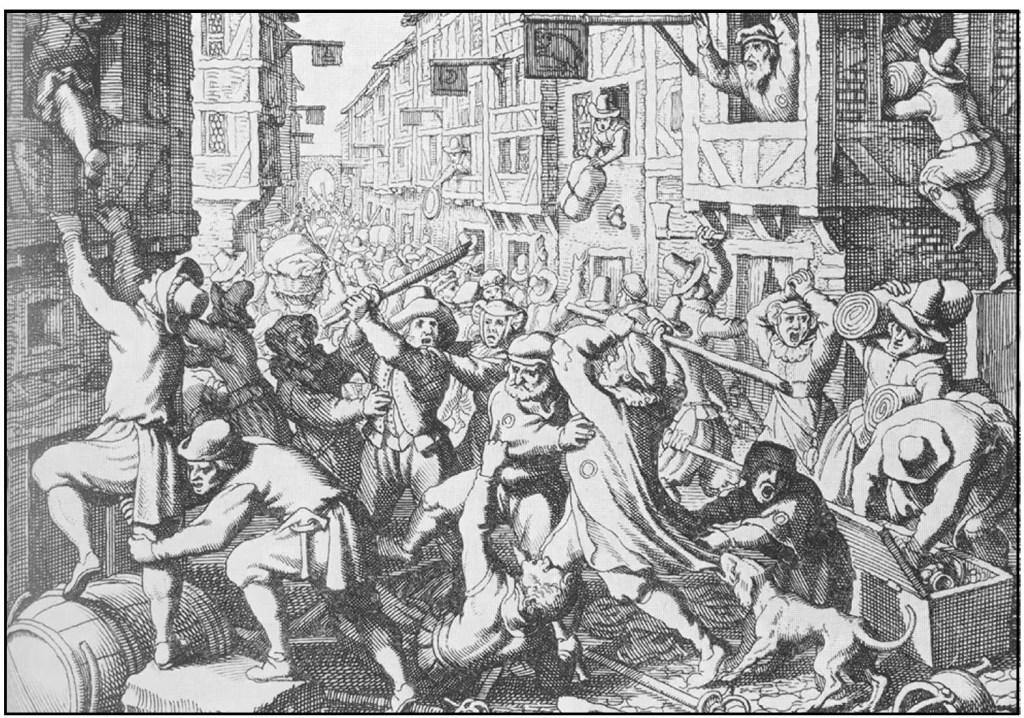
Yet fear alone rarely burned a medieval ghetto without the quiet blessing of civic authority. Across the Holy Roman Empire, Free Imperial Cities enjoyed substantial autonomy, and their ruling patrician families and craft guilds were frequently deeply indebted to Jewish moneylenders—the very people restricted by Christian canon law and guild statutes to finance and pawnbroking. In Augsburg, the violence bore the unmistakable fingerprints of financial opportunism. Burgomaster Heinrich Portner, heavily in debt to Jewish creditors, actively facilitated the assault by ordering the city gates opened to a hostile mob. When the Jewish quarter was stormed, the rioters did not merely loot valuables; they systematically targeted chests containing bonds, pledges, and promissory notes. Burning the lenders alongside their ledgers offered an instant, irreversible cancellation of municipal and private debt.
This pattern repeated with chilling precision from the Rhineland to Thuringia between late 1348 and the end of 1349. In Basel in January 1349, city fathers yielded to guild pressure by constructing a wooden barn on an island in the Rhine, locking hundreds of Jews inside, and setting it ablaze. On February 14, 1349—St. Valentine’s Day—Strasbourg’s craft guilds deposed their mayor, Peter Schwarber, precisely because he sought to uphold imperial law and protect the city’s Jews. Within days, roughly two thousand Jews were burned to death on a wooden scaffolding erected in their own cemetery, and the city council promptly divided their confiscated wealth and canceled all outstanding debts. Where communities resisted, as in Mainz in August 1349, where armed Jewish defenders initially killed two hundred attackers, superior numbers and civic militias eventually overwhelmed them, culminating in mass martyrdom and the destruction of Europe’s oldest Ashkenazi centers.
The tragedy was compounded by the failure of traditional medieval protections. Theoretically, Jews in the Holy Roman Empire held the status of Kammerknechte—”servants of the imperial chamber”—placing their lives and property under the direct protection of the emperor in exchange for heavy taxation. In practice, Emperor Charles IV treated Jewish lives as liquid political capital. Cash-strapped and eager to secure the loyalty of imperial cities and territorial princes, Charles repeatedly bargained away his legal duty, granting cities advance pardons for the murder of their Jewish populations or negotiating his share of the confiscated real estate and canceled debts before the ashes had cooled. Conversely, the papacy took a remarkably clear stand against the hysteria. In 1348, Pope Clement VI issued two papal bulls, Quamvis Perfidiam, explicitly forbidding Christians from harming Jews or forcing their conversion. Clement pointed out two plain facts that reason alone should have made obvious: the plague struck regions where no Jews lived, and Jews themselves were dying of the pestilence at the exact same rate as their Christian neighbors. His warnings, however, went largely unheeded against the fervor of the itinerant flagellant brotherhoods (Geissler), whose bloody penitential processions whipped townspeople into apocalyptic fury wherever they marched.
The massacre at Augsburg and its sister cities permanently altered the map of European Jewry. While small numbers of Jews were gradually permitted to return to German cities in the 1350s and 1360s—often because local economies stalled without credit networks—they returned under harsher restrictions, higher taxes, and precarious short-term residence permits. Thousands of survivors abandoned Western Europe altogether, migrating eastward into the Kingdom of Poland and the Grand Duchy of Lithuania, where King Casimir III the Great offered royal charters of protection and economic opportunity. Out of the smoke of Augsburg, Strasbourg, and Mainz emerged a profound demographic shift, transferring the heartland of Ashkenazi civilization from the Rhine and Danube valleys to Eastern Europe for the next six centuries.
Sources:
https://www.steelsnowflake.org/post/the-dark-history-of-anti-semitic-violence-during-the-black-death


Leave a Reply