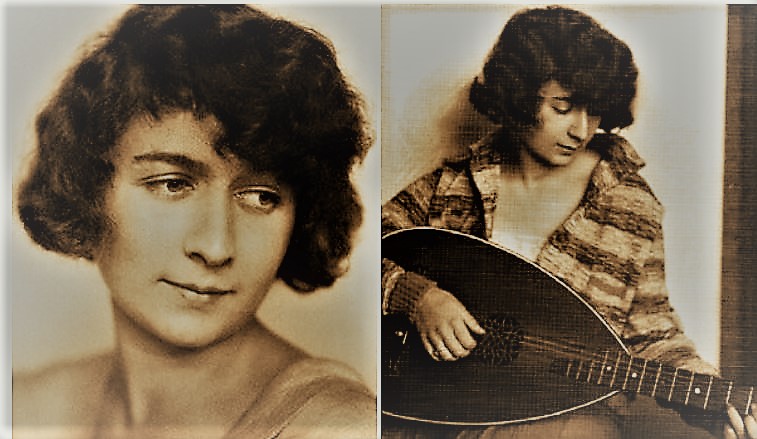
Ilse Weber (January 11, 1903 – October 6, 1944) née Herlinger, was born in Witkowitz near Mährisch-Ostrau. A Jewish poet, she wrote in German, most notably songs and theater pieces for Jewish children. She married Willi Weber in 1930. She was transported to Auschwitz with the children of Theresienstadt and killed in the gas chambers, along with her son, Tommy.
Ilse Weber was a Czech author and songwriter. She wrote children’s fiction, and her most popular book was “Mendel Rosenbusch: Tales for Jewish Children” (1929). She had learned to sing and play guitar, lute, mandolin and balalaika, but she had never sought a career as a musician. When the Nazis occupied Czechoslovakia in 1939, the Webers were able to get their eldest son,Hanuš, to safety in Sweden through Kindertransport.

Hanuš was sent first to the U.K. to live with a friend of his mother who was the daughter of a Swedish diplomat, and he may well be the Hans Weber listed as No. 1292 in the records of the kindertransports to the U.K. organised by Nicholas Winton.

He survived the war in Sweden, and lives in Stockholm in retirement. His son, Tommy, born in 1977, is named in honor of his younger brother, murdered with his mother in Auschwitz.
Unfortunately, Ilse, her husband, and their younger son Tommy were sent to Theresienstadt in February 1942. She worked in the camp’s children’s hospital at night, doing all she could for the patients without the help of medicine, as it was forbidden for Jewish prisoners. She wrote many poems while she was there and set a good number of them to music. She would accompany herself on guitar while she sang her lullaby-like songs to children and the elderly of the ghetto. When her husband was deported to Auschwitz two years later, she and Tommy went with him so as not to break up their family.
She wrote around 60 poems during her imprisonment and set many of them to music, employing deceptively simple tunes and imagery to describe the horror of her surroundings. In performance she accompanied herself on guitar.
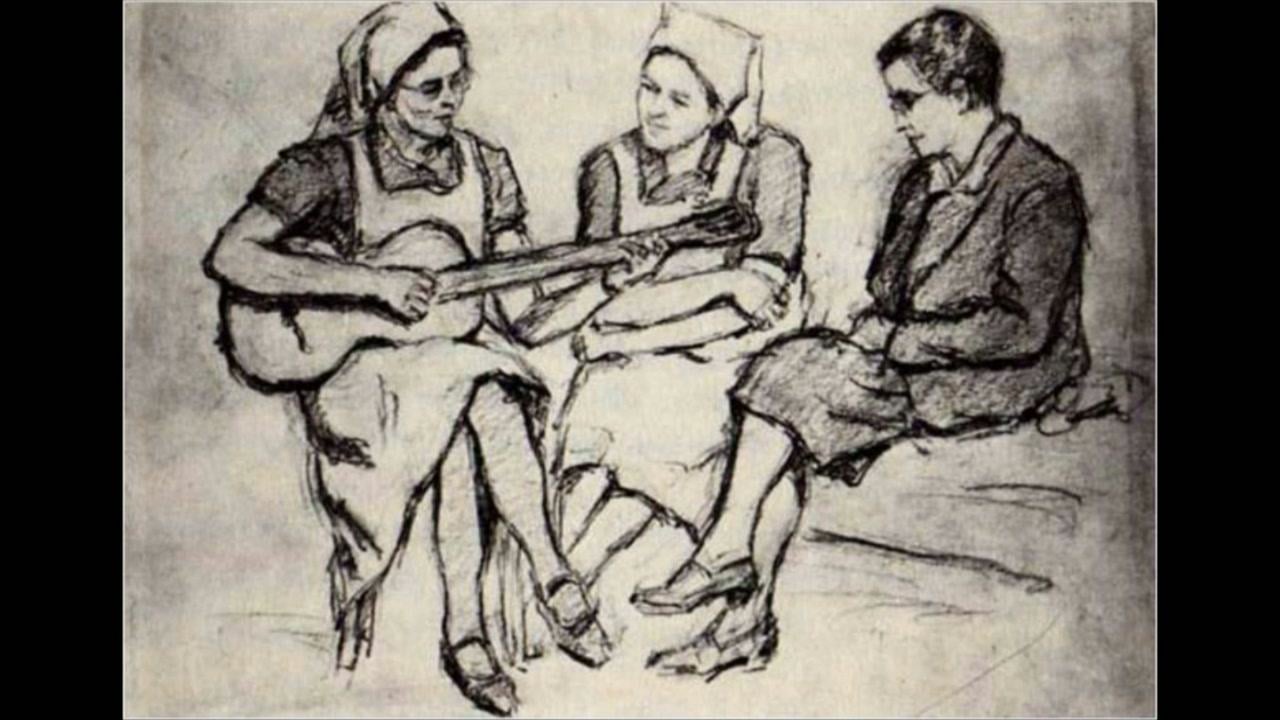
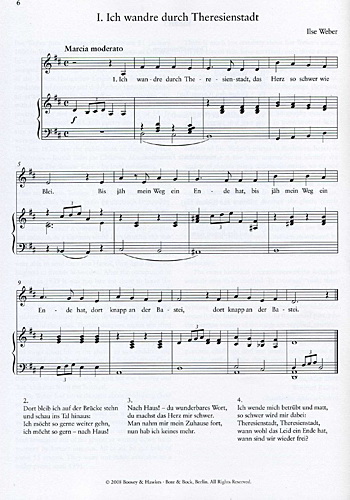
Her songs include “Lullaby,” “I Wandered Through Theresienstadt,” “The Lidice Sheep,” “And the Rain Falls,” and “Avowal of Belief.”
When her husband was deported to Auschwitz in October 1944, Ilse Weber volunteered to join him with their son Tommy because she didn’t want to break up the family. She and the boy were sent to the gas chamber on arrival. Willi Weber survived them by 30 years.
Her most popular book was “Mendel Rosenbusch: Tales for Jewish Children” (1929).

The title character, a kind elderly man, mysteriously receives a magic coin that enables him to become invisible at will. He uses this power to perform anonymous good deeds for his neighbors. Weber’s sharp observations and gentle humor make these stories appealing for all ages.
Below a song written by Ilse Weber, it is such a beautiful and haunting song.
|
“Wiegala” by Ilse Weber Wiegala, wiegala, weier, Wiegala, wiegala, werne, Wiegala, wiegala, wille, |
English Translation: Wiegala, wiegala, weier, Wiegala, wiegala, werne, Wiegala, weigala, wille, |

Donation
Your readership is what makes my site a success, and I am truly passionate about providing you with valuable content. I have been doing this at no cost and will continue to do so. Your voluntary donation of $2 or more, if you are able, would be a significant contribution to the continuation of my work. However, I fully understand if you’re not in a position to do so. Your support, in any form, is greatly appreciated. Thank you. To donate, click on the credit/debit card icon of the card you will use. If you want to donate more than $2, just add a higher number in the box left from the PayPal link. Your generosity is greatly appreciated. Many thanks.
$2.00


 History of Sorts
Leave a reply to Deborah Wells Cancel reply