In this blog, I will address the actions of some so-called “Jewhunters” in the Netherlands during World War II. The main reason behind their actions wasn’t driven by political ideology; it was something much simpler—greed.
Johannes Hendrik Feldmeijer was a Dutch Nazi politician and a member of the NSB (Nationaal-Socialistische Beweging). He was tasked with establishing and commanding the Nederlandsche SS.
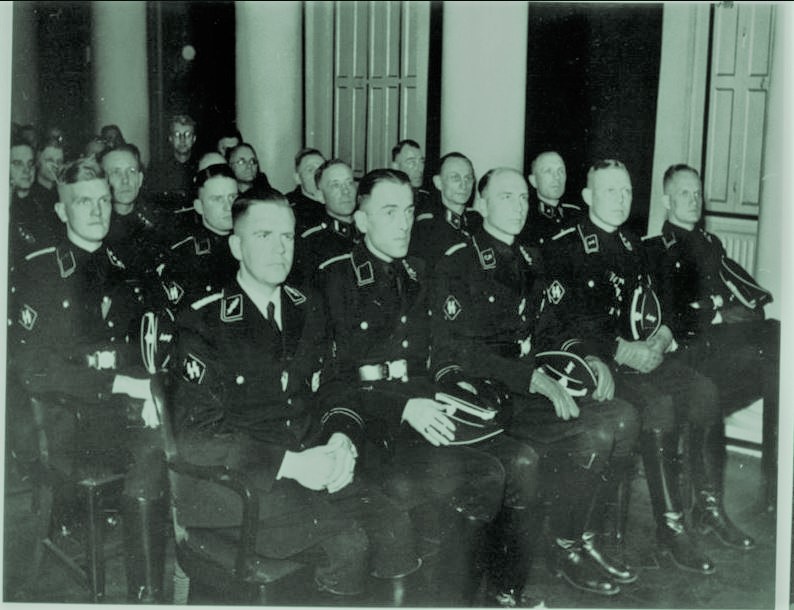
The picture above shows a meeting of the Germanic SS in the Netherlands, also known as the Nederlandsche SS. Feldmeijer, seated at the far left in the front row, and some other members are listening to a speech by Rauter, the highest-ranking SS and Police Leader in the Netherlands. To Feldmeijer’s right are Jan Jansonius, Peter Kooymans, Jan van Efferen, and Leo Broersen. In the second row, next to Wim Heubel, are several notorious Jewhunters, including Kees Kaptein, an unidentified individual, Johan Meijer, and Abraham Kaper, Head of the Jewish Affairs Bureau in Amsterdam.

Although the man pictured above may have had a somewhat comical appearance (ironically, his hairstyle resembled that of a contemporary Dutch politician), there was nothing amusing about him. He was pure evil, driven solely by greed.
Wim Henneicke was part of a group of bounty hunters called the Colonne Henneicke. He betrayed and robbed Jews; between 8,000 and 9,000 Jews were betrayed by this group in 1943. Towards the end of the war, Henneicke began passing the names of other collaborators and infiltrators to members of the resistance, likely in an attempt to build connections with them. However, he did not live to see the end of the war. On December 8, 1944, he left his home in Amsterdam and was shot dead by an unidentified member of the Amsterdam resistance.
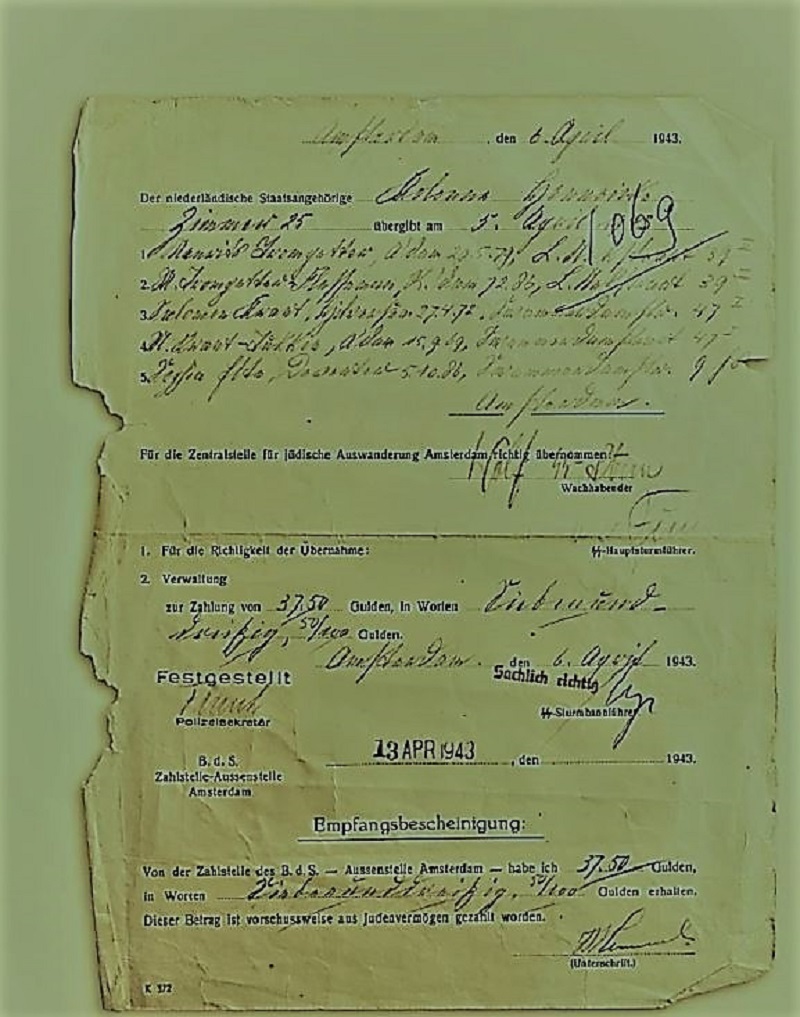
Henneicke and his team were paid a bounty of 7.5 Dutch guilders for each Jewish person they betrayed, which translates to approximately €42 or $50 in today’s currency. Below is a receipt for a reward earned from betraying five Dutch Jews.
I came across a film made by Harry Swaab. The film chronicles the daily life of fourteen Jewish people in hiding (the Swaab, Robinski, and Hess families) on the third floor above the Alcazar nightclub at 5 Thorbeckeplein in Amsterdam. They were helped by Dirk Vreeswijk, the owner of Alcazar, and his family. The movie was filmed in 1942-1943. Harry Swaab, one of the people in hiding and the film’s initiator, later explained that the film was made to combat boredom. It captures the daily life of the people in hiding, including how they concealed themselves in moments of danger. Their time in hiding lasted from mid-1942 until April 1943, when they were betrayed. At the end of April 1943, the Nazis raided the building with the assistance of Dutch Jewhunters from the Colonne Henneicke. All those in hiding were arrested, except for Leo Hess and Harry Swaab.
It is fascinating to see how they dealt with daily life, even managing intimate moments, despite the constant threat of discovery.
After the war, Harry Swaab created a version of the film with subtitles explaining its context. A “prologue” was added with exterior shots of Rembrandtplein. The Jewish Historical Museum currently holds the film.
The following people appear in the film:
Greenheart, Bep (1922)
Gunther, Klara (1912-2005)
Hess, [First name unknown]
Hess, Gerda
Hess, Leo
Robinski, Henric
Robinski, Jacob (1881-1943)
Robinski, Katjac
Robinski-Joseph, Ida Hedwig (1884-1943)
Swaab, Harry (1914-2005)
Swaab, Milly (1912-1994)
Swaab, Sophia (1908-1974)
Swaab, Truus (1912-1971)
Vreeswijk, Dirk (1891-1965)
Vreeswijk-van Schaik, Marie (1898-1979)
Period: mid-1942 – April 1943
Sources
https://collections.ushmm.org/search/catalog/irn1004588
https://www.oorlogsbronnen.nl/thema/Jodenjagers?Foto%27s=1
Donation
Your readership is what makes my site a success, and I am truly passionate about providing you with valuable content. I have been doing this at no cost and will continue to do so. Your voluntary donation of $2 or more, if you are able, would be a significant contribution to the continuation of my work. However, I fully understand if you’re not in a position to do so. Your support, in any form, is greatly appreciated. Thank you. To donate, click on the credit/debit card icon of the card you will use. If you want to donate more than $2, just add a higher number in the box left from the PayPal link. Your generosity is greatly appreciated. Many thanks.
$2.00
 History of Sorts
Leave a comment