
Anyone who has seen the movie “Schindler’s List,” will know about Amon Göth, whom Ralph Fiennes played.
Göth was the son of a prosperous publisher in Vienna. In 1931, he became a member of the Austrian Nazi Party at the age of 23. He was granted full party membership on May 31, 1931. His decision to join the party at this early stage meant that he was considered an Alter Kämpfer (Old Fighter), i.e., one who had joined the party before Adolf Hitler’s rise to the position of Chancellor of Germany.
Göth rose steadily through the SS ranks, earning a promotion to untersturmführer (equivalent to second lieutenant) in 1941 and joining Operation Reinhard, the Nazi campaign to kill the Jews of occupied Poland, in 1942. He was made commandant of Plaszów in February 1943. Still, he remained active elsewhere, supervising the violent closings of the Kraków ghetto (March 1943), the Tarnów ghetto, and the Szebnie concentration camp (both in September 1943). His performance so pleased his superiors that he was promoted two ranks to Hauptsturmführer (equivalent to army captain) in the summer of 1943.
In Plaszów, Göth had many prisoners killed as punishment for infractions, but he also killed randomly and capriciously. From the balcony of his villa, he took target practice with his rifle on prisoners as they moved about the camp.
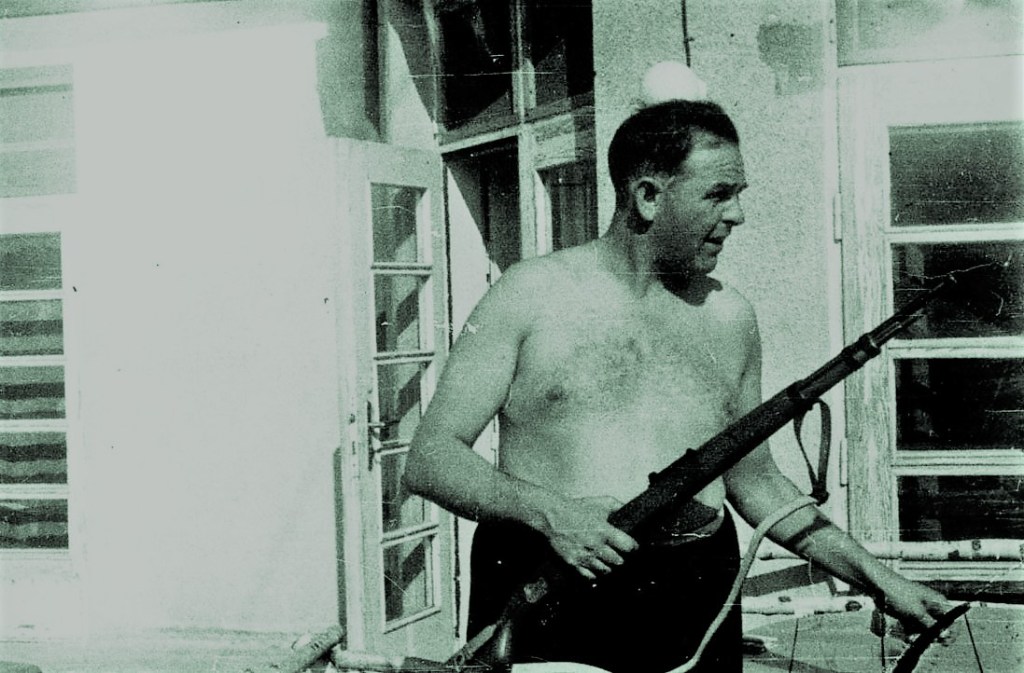
Joseph Bau, a Polish-born Israeli artist, philosopher, inventor, animator, comedian, commercial creator, copy-writer, poet, and survivor of the Płaszów concentration camp, said about Göth.
“A hideous and terrible monster that reached a height of more than two meters. He [Göth] set the fear of death in people, terrified masses, and accounted for much chattering of teeth.
He ran the camp through extremes of cruelty that are beyond the comprehension of a compassionate mind – employing tortures which dispatched his victims to hell.
For even the slightest infraction of the rules, he would rain blow after blow upon the face of the helpless offender and would observe with satisfaction born of sadism, how the cheek of his victim would swell and turn blue, how the teeth would fall out and the eyes would fill with tears.
Anyone he was whipping was forced to count aloud, with each stroke of the whip, and if he made a mistake, he was required to start counting over again.
During interrogations, which were conducted in his [Göth] office, he would set his dog on the accused, who was strung by his legs from a specially placed hook in the ceiling.
In the event of an escape from the camp, he would order the entire group from which the escapee had come to form a row, would give the order to count ten, and would personally kill every tenth person.
At one morning parade, in the presence of all the prisoners, he shot a Jew, because, as he complained, the man was too tall. Then, as the man lay dying, he urinated on him.
Once, he caught a boy who was sick with diarrhea and was unable to restrain himself. Göth forced him to eat all the excrement and then shot him.”

Göth was even too evil for Nazi standards. On September 13, 1944, Göth was relieved of his position and charged by the SS with theft of Jewish property (which belonged to the state, according to Nazi regulations), failure to provide adequate food to the prisoners under his charge, violation of concentration camp regulations regarding the treatment and punishment of prisoners, and allowing unauthorised access to camp personnel records by prisoners and non-commissioned officers. The SS turned over the camp’s administration at Płaszów to SS-Obersturmführer Arnold Büscher. The camp was closed on January 15, 1945. Göth had been scheduled for an appearance before SS Judge Georg Konrad Morgen, but due to the progress of World War II and Germany’s looming defeat, the charges against him were dropped in early 1945.
All those charges against him may appear to suggest that the Nazis actually cared for the well-being of prisoners, but that wasn’t the case. It only meant that Göth’s crimes were against the ‘greater good’ of the Third Reich. He enriched himself and used prisoners for his own benefit.
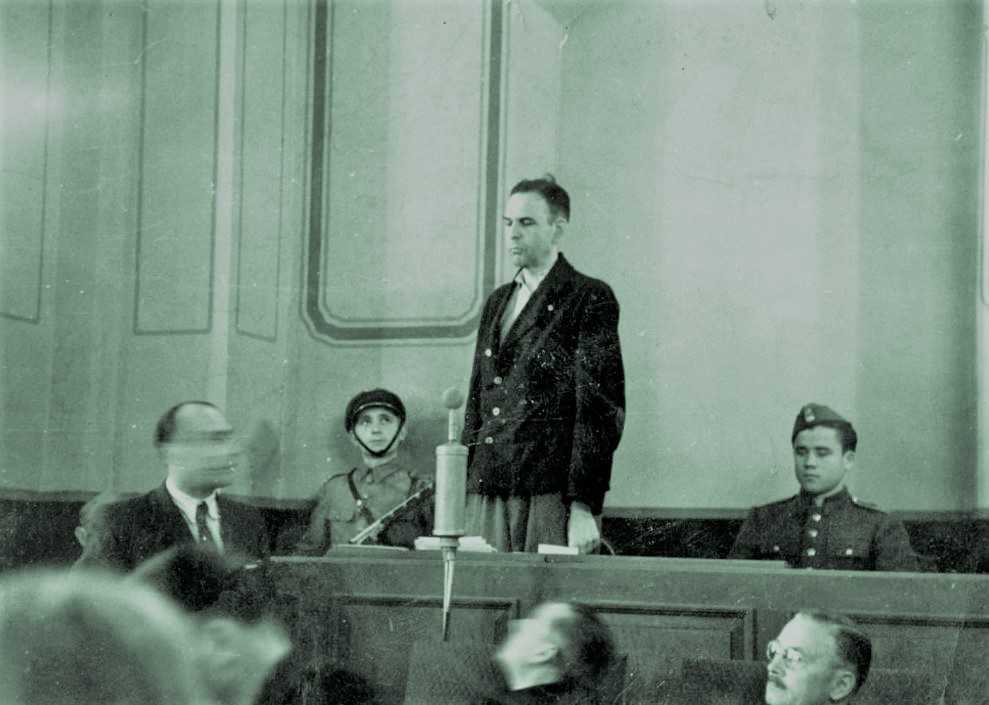
After being diagnosed with diabetes, Göth was sent to an SS sanitarium in Bad Tölz, Germany, where U.S. troops arrested him in early 1945. The Americans turned him over to the restored Polish government, which then tried him for war crimes, most notably the killing of more than 10,000 people in the Plaszów and Szebnie camps and in the Kraków and Tarnów ghettos. Göth’s defense was that he was only following orders. After the brief trial, he was convicted on September 5, 1946, and hanged eight days later. He was sentenced to death and was hanged on September 13, 1946, at the Montelupich Prison in Kraków, not far from the site of the Płaszów camp. His remains were cremated and the ashes thrown in the Vistula River. Allegedly, his last words were “Heil Hitler.”
In addition to his two marriages, Göth had a two-year relationship with Ruth Irene Kalder, a beautician and aspiring actress originally from Breslau (or Gleiwitz; sources vary). Kalder first met Göth in 1942 or early 1943 when she worked as a secretary at Oskar Schindler’s enamelware factory in Kraków. She met Göth when Schindler brought her to dinner at the villa at Płaszów; she said it was love at first sight. She soon moved in with Göth, and the two had an affair; however, she stated that she never visited the camp itself. Göth’s second wife, Anna, still living in Vienna with their two children, filed for divorce upon learning of Göth’s affair with Kalder. Kalder left for Bad Tölz to be with her mother for the birth of her daughter, Monika Hertwig, on 7 November 1945. She was Göth’s last child. Kalder was devastated by Göth’s execution in 1946, and she took Göth’s name shortly after his death.
In 2002, Hertwig published her memoirs under the title Ich muß doch meinen Vater lieben, oder? (“I do have to love my father, don’t I?”). Hertwig described her mother as unconditionally glorifying Göth until confronted with his role in the Holocaust. Kalder suffered from emphysema and committed suicide in 1983 shortly after giving an interview in Jon Blair’s documentary Schindler. Hertwig’s experiences in dealing with her father’s detailed crimes are in Inheritance, a 2006 documentary directed by James Moll. Helen Jonas-Rosenzweig, one of Göth’s Jewish former housemaids, appears in the documentary. The documentary details the meeting of the two women at the Płaszów memorial site in Poland. Hertwig had requested the meeting, but Jonas-Rosenzweig was hesitant because her memories of Göth and the concentration camp were so traumatic. She eventually agreed after Hertwig wrote to her, “We have to do it for the murdered people.” Jonas felt touched by this sentiment and agreed to meet her.
Monika’s daughter, Jennifer Teege, is a German writer. Her Grandfather was Amon Göth. Her 2015 book ‘My Grandfather Would Have Shot Me: A Black Woman Discovers Her Family’s Nazi Past’ was a New York Times bestseller. I disagree with that because if it were up to her Grandfather, she wouldn’t even have been born, because of her Father’s Nigerian background.

Sources
https://www.britannica.com/biography/Amon-Goth
https://www.bbc.com/news/magazine-24347798
https://www.bbc.com/news/magazine-24347798
Inheritance: Beyond the Film With James, Monika and Helen

 History of Sorts
Leave a comment