
I have been doing posts about World War II and the Holocaust since 2016. When I started, I reckoned I’d have enough material to last for a year, two years tops. Seven years on, I am still finding new stories daily. Stories like that of Waldemar Hugh Nods.
Waldemar Hugh Nods was born on 1 September 1908 in Surinam, South America, a Dutch colony. His parents were some of the first Surinamese people born free from slavery. Slavery was abolished in 1863 in Surinam.
In 1928, 20-year-old Waldemar came to study in the Netherlands. His dark skin color caused attention and discrimination.
In October 1928, Waldemar met Rika van der Lans: white, 17 years his senior, and already married with four children. When they began their relationship, it caused a scandal.
Rika had already upset her Catholic parents by marrying a Protestant, Willem Hagenaar, in 1913. However, by the time she met Waldemar, she was separated from Willem and took their children to live in The Hague. She supported the children by renting out rooms, which is how she met Waldemar.
When she found herself pregnant by Waldemar, it led to alienation from her
children and their family. Their son Waldy was born on 17 November 1929. he was nicknamed “Sonny Boy,” after the Al Jolson song, popular at the time.
Rika Waldemar and their son were evicted from their home. They met an elderly Jewish man named Sam, who offered them shelter.
Waldemar completed his studies in 1931 and secured a job as an accountant. His new family moved with him to Scheveningen, a seaside district of The Hague, where they opened a guesthouse, with financial help from Sam, in 1934: Pension Walda.
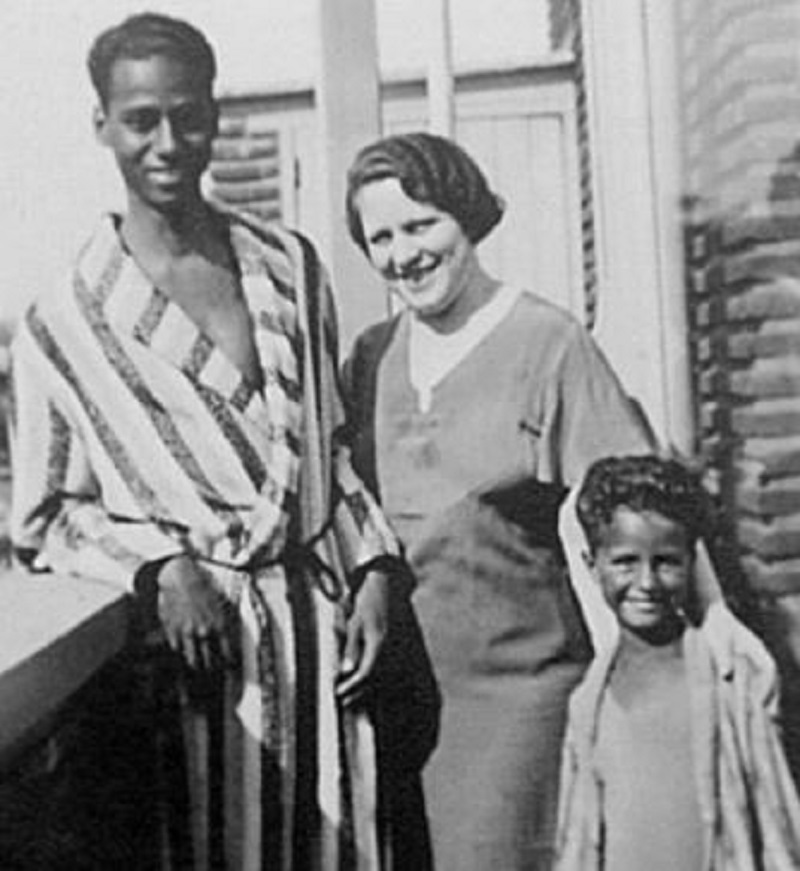
Despite the Great Depression, the guesthouse was remarkably successful, especially with German tourists. This was mainly thanks to Waldemar’s perfect German, acquired by studying for his diploma in business correspondence in German.
Finally, Waldemar and Rika were married on 17 May 1937.
Right at the time, Rika’s affairs with her own children seem to normalize again when the Germans invade the country. Rika and Waldemar were forced to shelter German soldiers. After a while, the family had to leave because the area was being cleared for the Atlantic Wall. Because Rika mentions that she has five children, they are assigned a larger house. Then in November 1942, the couple began to hide Jews from the Nazis at the request of a young resistance fighter. They were seen by the Dutch resistance as ideal candidates as they were a small family with spare rooms in their home and were also free of the antisemitism that occurred among the resistance, which made Jews harder to hide than other Dutch fugitives.
Their son, Waldy, was unaware of the hidden guests until the day he was brought home by the police after getting in a fight with a boy who had racially abused him. This panicked his mother, who told him about the Jews and insisted that nobody must ever find out.
In August 1943, the family moved to a house on Pijnboomstraat where they continued to hide Jews and others. The resistance sent them fugitives others were unwilling to accommodate. Among them were Dobbe Franken, the daughter of a leading member of the Jewish Council in Rotterdam, and Gerard van Haringen, a Dutch SS deserter, who now regretted running away from home aged 17 to sign up. Just before dawn on 18 January 1944, the house was raided. Everyone, including Waldy and the hidden fugitives, was interrogated. Waldemar admitted to hiding Jews.
Rika took all the blame and was sentenced to life imprisonment. She was first imprisoned in Scheveningen, and from there, she went to Vught concentration camp (near ‘s-Hertogenbosch) and was eventually taken to Ravensbrück, where she was murdered in February 1945.

Waldemar was given a lenient sentence compared to his wife, whom he last saw at Scheveningen prison. He was deported via Vught concentration camp to Neuengamme Concentration Camp on 23 February 1944 and was given prisoner number 32180.
Waldemar’s dark skin stood out at Neuengamme. The SS guards remarked, “He was a chimpanzee who surprisingly turned out to be able to understand and perform complicated instructions to the letter in German.” Thanks to his language skills he was put to work in the camp post office and was able to communicate with his family.
Waldemar wrote his last letter to his relatives on 7 January 1945 in German as prescribed.
“[ … ] and Waldie my boy, how are you? Work hard and also do your best with football.”
He knew that the war would soon be over and hoped to return home soon:
“[ … ] back as soon as possible. [ … ] I am waiting for that now.”
In April 1945, due to the evacuation of the Neuengamme main camp, Waldemar Nods, like many other prisoners, was put on the passenger ship Cap Arcona, which was moored in the Lübecker Bay, the stretch of sea Northeast of Hamburg. On 3 May 1945, the ship was accidentally bombed by British aircraft. The vast majority of prisoners on board the Cap Arcona died.

Waldemar initially survives the attack. He jumped into the sea and swam to the coast (he was a good swimmer in Surinam—he already swam long distances in the river), made it to shore only to be gunned down by SS child soldiers, with orders to shoot any survivors.
Waldemar and Rika’s son, Waldy, grew up in a foster home. He worked as a financial and economic journalist at Het Parool and later at Bruynzeel in Suriname.
Waldemar died at the age of 85 in 2015.
Sources
https://www.kz-gedenkstaette-neuengamme.de/vorbereitung/biografie_waldemar_nods.html
https://olc.chocochaos.com/dosn15z.htm
https://www.oorlogsbronnen.nl/tijdlijn/Waldemar-Hugh-Nods/02/110382

Donation
Your readership is what makes my site a success, and I am truly passionate about providing you with valuable content. I have been doing this at no cost and will continue to do so. Your voluntary donation of $2 or more, if you are able, would be a significant contribution to the continuation of my work. However, I fully understand if you’re not in a position to do so. Your support, in any form, is greatly appreciated. Thank you. To donate, click on the credit/debit card icon of the card you will use. If you want to donate more than $2, just add a higher number in the box left from the PayPal link. Your generosity is greatly appreciated. Many thanks.
$2.00
.
 History of Sorts
Leave a comment