
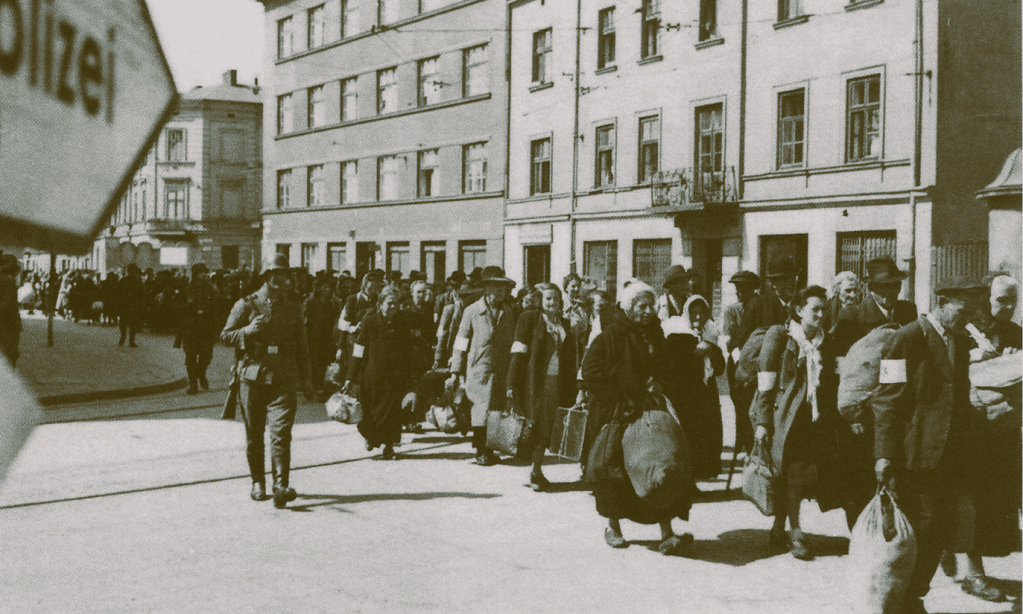
Today marks the 81st anniversary of the liquidation of the Krakow ghetto. Rather than posting photographs, I thought it would be better to read the testimonies of two who survived.
On March 13-14, 1943, the SS and police carried out the operation, shooting some 2,000 Jews in the ghetto. The SS transferred another 2,000 Jews, those capable of work and the surviving members of the Jewish Council and the Jewish police force (Ordnungsdienst), to the Plaszow forced-labor camp. The rest of the Jews, approximately 3,000, were deported to the Auschwitz-Birkenau killing center in two transports,
Willie Sterner:
“Then, my father, my brothers, and I were pushed into another cattle car, which soon began to move. We too were pressed in like sardines in a can; there was no room at all to move. After spending many terrible hours in the cattle car, our train arrived in Krakow. Tired and hungry, we were pushed into military trucks and driven to the Krakow ghetto.
The Krakow ghetto was yet another place of horror, an ugly, dirty place. During the month that we were there, we were terrorized by the Nazis and by many of the OD, the Jewish police. We had little food or medical help, so many people died from illness and starvation. There were so many corpses lying on the streets that nobody paid any attention — we just walked over them. Our people died so fast that it was impossible to take care of them all. The burial squad was overworked, tired, hungry, and stressed. We were homeless and dressed like beggars, wearing old, dirty, torn clothing, and most of us had no shoes. Little children had no shoes for their small feet and wore rags. Hungry, dirty, and lonely, they asked passersby for food, but it was impossible to find a helping hand. There was so little food. Many of the children couldn’t even walk anymore and lay on the sidewalks. It was heartbreaking.
We were the lost people. We were nobodies. We had so little strength that we felt we couldn’t even think anymore; our minds felt shut down. We lived with indescribable brutality. We didn’t know where our loved ones were. We were no longer a proud Jewish people.”
Tauba Biber:
“This one morning, orders – ‘get out, get out’ – and whatever. By then we only had a few bits belongings – you, we grabbed the belongings and lined up to march to Plaszow. Plaszow is the outskirts of Krakow, and it, in Plaszow children were not allowed, older people were not allowed and there were shot on the spot. But some people took a chance and smuggled in some children in the bag, in the rucksack, whatever way the could. Plaszow was a Jewish cemetery. When we got to Plaszow, as we arrived through the gates and it wasn’t even ready – it was no huts even built for us – we saw already three men hanging. Frightened, I, I just don’t know, and when I think back, we must have been completely already numb, without no feeling, we just obeyed and did what we had to do. There were inspections by the Gestapo. So the children had no right to be there, so for some, something happened that they decided, they knew that, they found out that there are children in the camp, so they decided to set up a nursery. So of course the parents were glad, the children would be able, will be looked after in the nursery, so of course the children were put there. And it didn’t take long, maybe two weeks after, we were standing on the appell, and the music was blaring – always in the most terrifying moments there was music. We see from a distance a lorry, an open lorry, with the children. Next to me was standing a mother with twins, two little girls, if there were 10, on the appell and they were going around looking – the Gestapo – if there was any children, or anybody that shouldn’t be there, and these two children clinging to their mother, ‘mother they’re coming, they’re going to take us away’. And so they did. And this lorry, while we were standing there on the appell, this lorry with the children drove off and never seen again. And that’s how those parents lost their children, with a trick that the children will be looked after. Well when I think back today – I don’t know – how can anybody survive? The first two years when we were still at home, with family, and knowing the peasants in our town, it wasn’t so bad, because the peasants were always helping, bringing us food, in exchange for other goods, but in the camps, that was impossible. And how we survived on this black water in the morning that was supposed to be coffee, or the grey soup at lunchtime with the little square of black bread that was like lime, and when we ate it, we didn’t feel any different. It didn’t satisfy in any way, and we were forever hungry…If you’re tired, you’re scared, you’re hungry, lack of sleep and always in fear from one minute to the next, we didn’t know what’s going to happen to us.”
Sources:
https://www.iwm.org.uk/history/concentration-camp-survivors-share-their-stories

Donation
Your readership is what makes my site a success, and I am truly passionate about providing you with valuable content. I have been doing this at no cost and will continue to do so. Your voluntary donation of $2 or more, if you are able, would be a significant contribution to the continuation of my work. However, I fully understand if you’re not in a position to do so. Your support, in any form, is greatly appreciated. Thank you. To donate, click on the credit/debit card icon of the card you will use. If you want to donate more than $2, just add a higher number in the box left from the PayPal link. Your generosity is greatly appreciated. Many thanks.
$2.00
 History of Sorts
Leave a comment