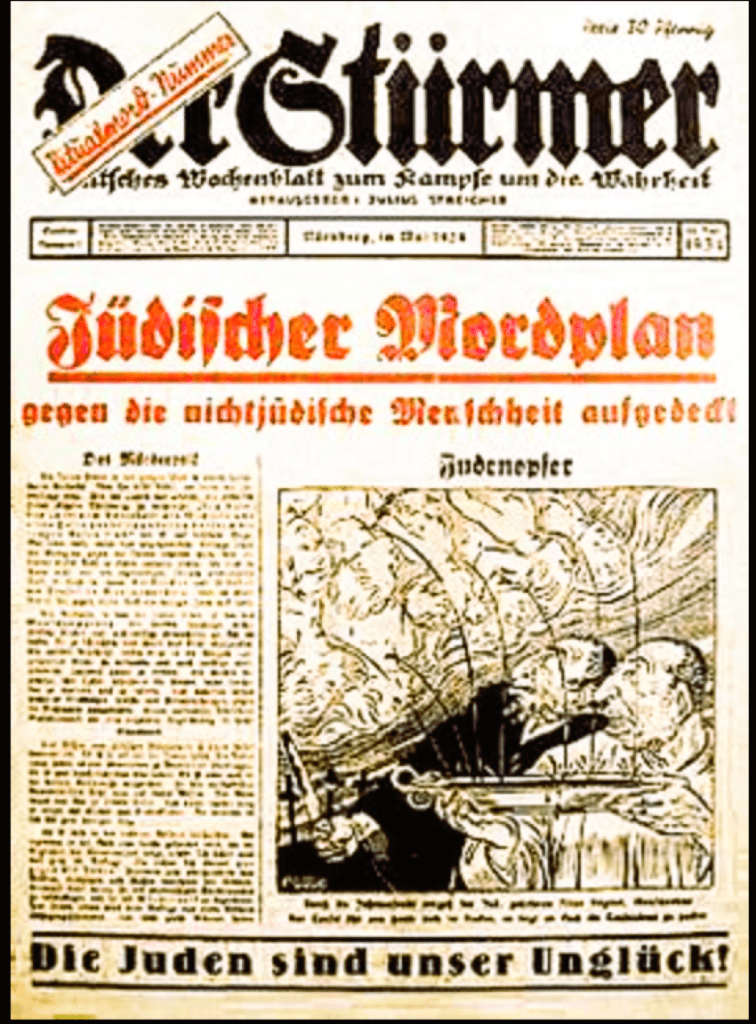
Blood libel—the false accusation that Jews kidnapped and murdered Christian children to use their blood for ritual purposes—was a centuries-old anti-Semitic myth. Though it originated in medieval Europe, this pernicious belief persisted into modern times. It was revived during the Third Reich by the Nazi regime.
Medieval Origins of Blood Libel
The blood libel first appeared in the 12th century, with one of the most infamous early cases being that of William of Norwich in 1144. Jews were accused of ritual murder, and despite being utterly baseless, these charges often led to violent pogroms and massacres against Jewish communities. Over the centuries, similar accusations resurfaced, leading to further persecution and mass killings.
Blood Libel in the Nazi Era
The Nazi regime under Adolf Hitler weaponized age-old myths like blood libel to further demonize Jews. However, the Nazi anti-Semitic propaganda primarily focused on more modern themes, such as Jews being part of a global conspiracy or causing economic hardship. However, Nazi propaganda drew heavily on medieval stereotypes, including the blood libel, to create a sense of ancient enmity between Jews and the Christian majority.
- Julius Streicher and Der Stürmer:
The Nazi newspaper Der Stürmer, led by the vehement anti-Semite Julius Streicher, regularly featured grotesque illustrations and articles accusing Jews of unspeakable crimes, including blood libel. Streicher often invoked the blood libel myth in his efforts to inflame hatred against Jews. The most infamous issue of Der Stürmer featured a front-page cartoon in 1934 showing Jews engaged in ritual murder with the caption “Ritual Murder of Non-Jewish Children Revealed.” - Blood Libel in Nazi Propaganda:
Although the blood libel was not the central focus of Nazi anti-Semitic ideology (which emphasized political, racial, and economic aspects of Jewish “threats”), it was still an effective tool in reviving ancient Christian fears of Jews. By invoking these medieval myths, the Nazis sought to create continuity between historical anti-Semitism and their own. For instance, in Nazi Germany, blood libel tales were used to justify violence against Jews, presenting the Jewish people as inherently cruel and dangerous to German society. - Cultural Impact:
The blood libel myth resonated particularly with rural populations, where deeply ingrained superstitions and older religious beliefs persisted. While Nazi racial theories focused more on pseudo-scientific ideas of racial purity and Aryan superiority, traditional anti-Semitic beliefs, such as blood libel, helped the regime appeal to long-standing fears and prejudices, particularly among the more religious segments of society. - Nazi Education and Indoctrination:
Nazi schools, youth groups (like the Hitler Youth), and other organizations also helped perpetuate myths like blood libel. Children were taught anti-Semitic tropes, and Nazi-controlled textbooks sometimes referenced or alluded to Jewish crimes and ritual murder myths as part of a broader curriculum of indoctrination.
Post-War Legacy
After the fall of the Third Reich, blood libel myths faded in prominence in Western Europe, largely discredited and delegitimized in the aftermath of the Holocaust. However, the myth has continued to persist in other parts of the world, including in parts of the Middle East, where it is sometimes invoked in anti-Israel and anti-Jewish rhetoric.
Conclusion
In the Third Reich, the blood libel myth was less central than other anti-Semitic ideologies. Still, it was nonetheless a key part of the broader Nazi strategy to demonize Jews. The Nazis revived this medieval superstition as part of a long tradition of Jewish scapegoating, tying their modern racial propaganda to a history of Christian-Jewish conflict. This reinforced public support for the regime’s increasingly violent actions against Jews, including the Holocaust.
Sources
https://encyclopedia.ushmm.org/content/en/article/blood-libel
https://www.bbc.com/news/world-us-canada-12176503
https://www.ajc.org/translatehate/blood-libel
Donation
Your readership is what makes my site a success, and I am truly passionate about providing you with valuable content. I have been doing this at no cost and will continue to do so. Your voluntary donation of $2 or more, if you are able, would be a significant contribution to the continuation of my work. However, I fully understand if you’re not in a position to do so. Your support, in any form, is greatly appreciated. Thank you. To donate, click on the credit/debit card icon of the card you will use. If you want to donate more than $2, just add a higher number in the box left from the PayPal link. Your generosity is greatly appreciated. Many thanks.
$2.00
 History of Sorts
Leave a comment