
The concept of the “Aryan Jesus” played a significant role in the Third Reich’s effort to align Christianity with its racist, anti-Semitic ideology. The notion that Jesus was not Jewish but rather Aryan, represents one of the most grotesque distortions of religious history during the Nazi era. This manipulation of Christianity was part of a broader attempt to reshape German society and culture in line with the tenets of National Socialism, which exalted the Aryan race as superior and sought to remove all traces of Jewish influence from German life. This blog explores the origins of the Aryan Jesus myth, its theological and ideological function in Nazi propaganda, and its broader implications within the Third Reich’s effort to establish a racially pure, ideologically consistent state.
1. Historical Origins of the Aryan Jesus Myth
1.1. 19th-Century Racial Theories
The roots of the Aryan Jesus myth can be traced back to 19th-century European racial theories, which classified people into hierarchical categories based on perceived ethnic and racial differences. Influential writers like Houston Stewart Chamberlain and other proponents of “scientific” racism argued that the “Aryan” race, particularly its Germanic branch, was superior in both intellect and morality.

This theory found fertile ground in Germany, where nationalism and romanticism increasingly intertwined with racial ideologies. Chamberlain’s book, The Foundations of the Nineteenth Century (1899), became a critical text that promoted the idea of the Germans as the true inheritors of Western civilization and characterized Jews as culturally and racially inferior.
Chamberlain and others argued that the figure of Jesus must be reclaimed from Judaism. Since Jesus was seen as the savior of Western civilization, they claimed he could not have been Jewish but rather an Aryan, thus “purifying” the origins of Christianity. This anti-Semitic reframing of Jesus set the stage for its later exploitation by the Nazi regime, which sought to co-opt Christianity for its purposes.
Hitler was introduced to Chamberlain’s work early in his political career, and he found in Chamberlain’s racial theories a justification for his own beliefs about Aryan supremacy and Jewish inferiority. Hitler’s admiration for Chamberlain was not only intellectual but also personal. Chamberlain, who had settled in Germany and became a naturalized citizen, became closely associated with the German nationalist movement and even married into the family of the famous composer Richard Wagner, whose work also influenced Hitler. Chamberlain and Hitler met in person in 1923, and Hitler regarded him as a spiritual mentor, praising him for laying the intellectual groundwork for Nazi ideology. Hitler’s nephew, William Patrick Hitler, would later take Houston as his surname.
1.2. Pre-Nazi Religious Nationalism
Prior to the rise of Nazism, various nationalist movements in Germany explored the idea of a distinct “German Christianity” that emphasized the nation’s cultural and racial identity. These movements aimed to reject the “Jewish” aspects of Christianity, including the Old Testament and Jesus’ historical identity as a Jew. This version of Christianity was tailored to fit with the Volkisch movement—a nationalist and racist ideology—that glorified German heritage and the purity of the Aryan race.
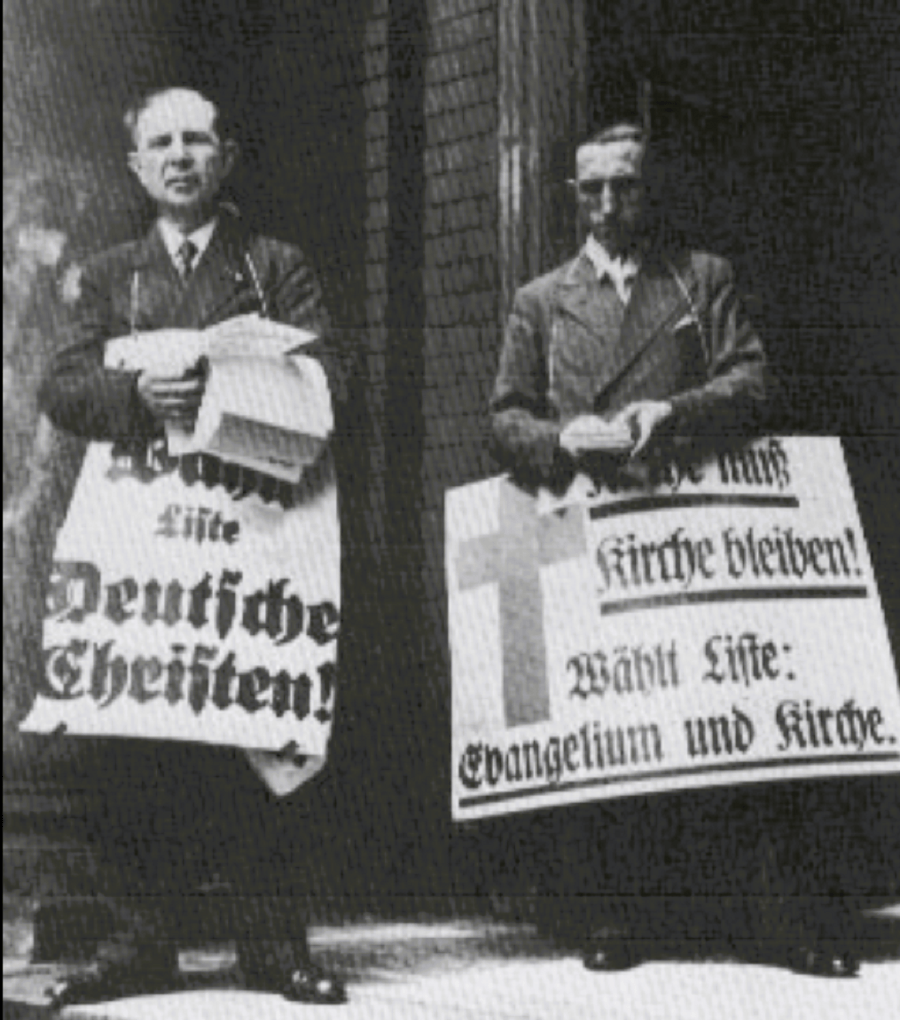
The German Christian Movement (Deutsche Christen), which would later become an instrument of Nazi religious policy, began to take shape in these circles. It sought to create a German form of Protestantism that was aligned with nationalist and racial ideologies.
2. Nazi Ideology and the Use of the Aryan Jesus
2.1. Hitler’s Vision of Religion
Adolf Hitler and the Nazi leadership viewed Christianity with a mixture of pragmatism and contempt. While many in the Nazi elite, including Heinrich Himmler, were more sympathetic to neo-paganism or saw Christianity as fundamentally incompatible with Nazi ideology, Hitler himself recognized the potential power of religion in shaping public opinion and maintaining social order. He expressed disdain for Christianity’s perceived Jewish origins but also saw its strategic value.
In Mein Kampf, Hitler suggested that Jesus had opposed the Jews of his time, not as one of them, but as a fighter against the “Jewish spirit.” Hitler and the Nazi leadership thus saw Jesus as a symbol who could be repurposed to fit Nazi ideology. This involved severing Jesus from his Jewish roots and making him an Aryan figurehead, a model for the German people to emulate.
2.2. Positive Christianity and the German Christian Movement
One of the most significant ways in which the Aryan Jesus myth was institutionalized during the Third Reich was through the doctrine of “Positive Christianity” and the German Christian Movement. Positive Christianity was a loosely defined religious concept that was supported by the Nazi Party. It claimed to align Christianity with Nazi racial ideology, emphasizing racial purity and the rejection of Jewish elements from the faith. This version of Christianity was stripped of its Jewish components—including the Old Testament—and depicted Jesus as a figure in opposition to Judaism.
The German Christians (Deutsche Christen), a Protestant group within the German Evangelical Church, became the principal advocates of this racially redefined Christianity. Under the leadership of pro-Nazi pastors such as Ludwig Müller, the movement promoted the idea that Jesus was an Aryan hero fighting against Jewish corruption. The German Christian Movement worked to “de-Judaize” the church, advocating for the removal of the Old Testament from Christian worship and eliminating any vestiges of Jewish culture from Christian doctrine.
2.3. Theological Manipulation: Jesus as Aryan
The Nazi version of Jesus was constructed to align with the broader goals of National Socialism, which sought to create a unified, racially pure Volksgemeinschaft (people’s community). In this vision, Jesus was not a Jewish rabbi from first-century Palestine but rather a heroic Aryan who fought against the Jews. Nazi theologians, such as Walter Grundmann, were instrumental in propagating this distortion of Jesus’ identity. Grundmann led the Institute for the Study and Eradication of Jewish Influence on German Church Life, which sought to remove all Jewish traces from Christian doctrine.
These efforts included reinterpretations of the New Testament that portrayed Jesus as the enemy of Judaism rather than a figure within it. The Pharisees, who are frequently depicted in the Gospels as opposing Jesus, were reimagined as representatives of a corrupt Jewish race, with Jesus standing as the noble Aryan fighting for truth and righteousness.
3. Broader Implications in the Third Reich
3.1. Anti-Semitism and the Aryanization of Christianity
The Aryan Jesus myth was central to the Nazi regime’s attempt to justify its anti-Semitic policies on religious grounds. By portraying Jesus as an Aryan, the Nazis were able to construct a theological basis for their persecution of Jews. This distortion of Christianity lent a veneer of religious legitimacy to the regime’s brutal treatment of Jewish people, including the Nuremberg Laws, the Kristallnacht pogrom, and ultimately the Holocaust.
By claiming that Jesus had fought against Jewish influences, the Nazis sought to present their racial policies as a continuation of his work. Thus, the Aryan Jesus became a symbol of the “struggle” against Jewish influence, allowing the regime to manipulate the Christian faith to support its genocidal policies.
3.2. Resistance and Rejection by Traditional Churches
Not all Christians in Germany accepted the Nazi reinterpretation of Jesus. The Confessing Church (Bekennende Kirche), led by theologians like Karl Barth and Dietrich Bonhoeffer, actively resisted the efforts of the Nazi regime to distort Christian teachings. They rejected the de-Judaization of Christianity and opposed the idea of an Aryan Jesus. In the Barmen Declaration of 1934, the Confessing Church condemned the Nazi attempts to subordinate Christianity to political ideology.
However, the resistance of the Confessing Church was the exception rather than the rule. Many mainstream Christian denominations in Germany either acquiesced to or actively supported the Nazi regime. The silence of many church leaders during the Holocaust remains a subject of moral reckoning.
4. Post-War Legacy and Rejection of the Aryan Jesus
4.1. Discrediting the Aryan Jesus Myth
After the defeat of Nazi Germany in 1945, the Aryan Jesus myth was thoroughly discredited. The racial and pseudo-theological distortions it represented were rejected by theologians, historians, and scholars. The post-war reckoning with the Holocaust led to a broader re-examination of Christian anti-Semitism and its role in the Nazi genocide, culminating in efforts to rebuild Christian-Jewish relations.
4.2. Long-Lasting Impact
Despite its discrediting, the legacy of the Aryan Jesus myth has lingered on in certain fringe groups, including neo-Nazi movements and white supremacist organizations. These groups continue to propagate a racially exclusive version of Christianity that aligns with their racist ideologies. However, mainstream Christianity, both Catholic and Protestant, has broadly repudiated these distortions and re-emphasized the Jewish identity of Jesus and the universality of his message.
The concept of an Aryan Jesus represents one of the most extreme and dangerous distortions of religious history, born out of the Nazi regime’s efforts to align Christianity with its racist, anti-Semitic ideology. By constructing a Jesus who was Aryan rather than Jewish, the Nazis sought to provide religious justification for their racial policies and the persecution of Jews. The Aryan Jesus myth played a significant role in Nazi propaganda, allowing the regime to manipulate Christian faith to support its broader ideological goals. However, this distortion of Christian doctrine was ultimately rejected by many within the Christian community, and today, it stands as a symbol of the destructive power of ideological manipulation of religion. The legacy of the Aryan Jesus myth serves as a reminder of the importance of resisting the politicization and racialization of religious beliefs.
Sources
https://en.futuroprossimo.it/2021/08/i-nazisti-crearono-una-bibbia-antisemita-e-un-gesu-ariano/
https://www.jstor.org/stable/j.ctv2175r65
https://press.princeton.edu/books/paperback/9780691148052/the-aryan-jesus
Donation
Your readership is what makes my site a success, and I am truly passionate about providing you with valuable content. I have been doing this at no cost and will continue to do so. Your voluntary donation of $2 or more, if you are able, would be a significant contribution to the continuation of my work. However, I fully understand if you’re not in a position to do so. Your support, in any form, is greatly appreciated. Thank you. To donate, click on the credit/debit card icon of the card you will use. If you want to donate more than $2, just add a higher number in the box left from the PayPal link. Your generosity is greatly appreciated. Many thanks.
$2.00

 History of Sorts
Leave a comment