
On October 5, 1942, the small Dutch town of Geleen, located in the province of Limburg, experienced a devastating bombing raid during World War II. This event is significant not only for the destruction it caused but also for the tragic error that led to the bombing of a civilian area instead of its intended military target. What should have been a strategic strike against German war assets became a moment of horror for the residents of Geleen, leading to the loss of many innocent lives and widespread damage to the town.
Monday, October 5, 1942. It seems like an ordinary day in Geleen. The threat of war is palpable, but people have grown accustomed to it. No one in Geleen suspects that, within 24 hours, the mining town will be shrouded in mourning.
For several weeks, the British Royal Air Force Bomber Command had been targeting mining and industrial complexes in the Rhineland. The success of an attack largely depended on weather conditions. On October 5, the weather seemed favorable for an attack on Aachen. Between 19:09 and 19:40, 257 aircraft took off from various English airfields, headed for Aachen. Leading the squadron were pathfinders who were to mark the target with flares. However, bad weather complicated the flight, and some of the pathfinders failed to reach their destination. The aircraft dispersed over a wide area.
At 21:42, the command post of the Staatsmijn Maurits received an air raid warning from the Luftschutz central command: aircraft approaching! A warning signal was issued, and total darkness was ordered.

No coke ovens were to be emptied to prevent glowing embers from emitting light. At 22:10, dozens of flares suddenly appeared in the sky west and northwest of Geleen. Shortly after the 22:15 air raid alarm, the first high-explosive bombs began to whistle down. The explosions became more numerous and intense. Fires broke out in several places. Planes circled over Geleen repeatedly, dropping more bombs. English bombs on Geleen! What a terrible mistake! They thought they were flying over the Ruhr area!
Geleen turned into a hellscape. Houses collapsed. Debris was flung around, and clouds of dust hung like a dense mist over the burning city. Finally, around 23:10, the air raid subsided. The planes withdrew, leaving a trail of death and destruction. Miners were trapped underground in the Maurits. Due to a power outage, the lifts were no longer operational. The miners were forced to begin a long climb to the surface. Miraculously, they made it without incident. By 10:30 the next morning, the last miner saw daylight again.
Around thirty planes were involved in the bombing of Geleen. Thirty-six high-explosive bombs were dropped; five were direct hits, landing in Eindstraat, Vuling, Minister Ruysstraat, Nachtegaalstraat, and Romaniestraat. The other bombs fell in open fields, and a few did not detonate. In addition, about 12,000 incendiary bombs and 300 phosphorus bombs of varying weights were scattered across the entire municipality.

Fire brigades from all the major municipalities in Limburg, and even from outside the province (Den Bosch, Tilburg, Breda, Nijmegen, and Rotterdam) and Aachen, provided assistance in Geleen and at Staatsmijn Maurits. Due to the poor visibility, the attackers had spread so widely that casualties were reported throughout South Limburg. One of the pathfinders stated upon returning to base: “We had no idea where we were.” The “mistaken bombing” claimed about a hundred lives in South Limburg, including 83 in Geleen. A twelve-year-old boy, likely Jewish, was buried as an unknown victim; no death certificate could be issued for him. Fatalities were also reported in Beek (1), Schimmert (3), Heerlen (7), and the hamlet of Aalbeek (2).
Geleen counted 22 seriously injured individuals. Fifty-nine homes were reduced to rubble, and 227 houses were heavily damaged—103 of which had to be demolished. Another 528 houses sustained moderate damage, while 1,728 homes had roof and glass damage. In addition to the aforementioned streets, Groenstraat, Rijksweg-Zuid, Geenstraat, and Annastraat were heavily affected. Three thousand residents were left homeless, approximately 20 percent of the population.
Only one aircraft managed to drop its bombs on Aachen, the intended target of the attack. A Wellington bomber crashed near Maastricht, killing five crew members. During a firefight over Brunssum, another bomber exploded. Wreckage and the remains of its crew were scattered across the municipality. Throughout South Limburg, there was damage from high-explosive and incendiary bombs.
What became known as the bombing of Geleen was a night of horror for all of South Limburg. “A night that will haunt you like a nightmare,” said one resident of Geleen. The municipality experienced the darkest day in its history.
The bombing of Geleen on October 5, 1942 stands as a somber reminder of the tragic consequences of war, particularly the vulnerability of civilians in conflict zones. While the raid was part of a broader Allied strategy to weaken Nazi Germany’s war effort, the miscalculation that led to the destruction of a civilian area instead of an industrial target underscores the complexity and brutality of aerial warfare during World War II.
For the people of Geleen, the bombing was a catastrophe that changed their lives forever. In an instant, a peaceful town became a site of destruction and loss. Though the Allied forces were seen as liberators by much of the Dutch population, incidents like the Geleen bombing served as a reminder that the road to liberation would be fraught with danger and sacrifice.
Today, the bombing is remembered as one of the key events in Geleen’s wartime history. It serves as a reminder of both the hardships endured by civilians under occupation and the indiscriminate nature of modern warfare. The victims of the bombing are honored in local memorials, ensuring that the memory of the tragedy continues to be preserved for future generations.
Report
England, October 5, 1942:

Weather report:
- 9:15 AM: Rain and low-hanging clouds
- 12:15 PM: Clearings expanding towards the south
- 4:10 PM: Further expansion of clear skies to the line Felixtowe-Lizard.
North of this line, the Allied air force expects clear skies well past midnight, crucial for returning aircraft. A decision is made to carry out a bombing mission on Aachen. Due to expected cloud cover over the target area, the attack is moved up slightly. Between 7:09 PM and 7:40 PM, 257 aircraft take off from various airfields for the mission. The pathfinders lead, tasked with marking the target with flares. However, bad weather hampers the flight, and several pathfinders do not reach the target area. The aircraft spread out over a large area.
Geleen:
At 9:42 PM, the command post of Staatsmijn Maurits receives an air raid warning from the air surveillance center / Luftschutzcentrale. An alert is issued: planes are approaching. No more coke ovens are to be emptied to prevent glowing embers from emitting light.
At 10:10 PM, dozens of flares suddenly light up the sky west and northwest of Geleen. Right after the air raid warning at 10:15 PM, bombs begin to whistle down. The explosions become more frequent and intense. Fires break out in several places. Planes keep circling over Geleen, dropping new loads of bombs.
Geleen turns into a hellscape. Houses collapse. Debris is scattered, and clouds of dust hang over the burning city like thick fog. Finally, around 11:10 PM, the violence subsides. The planes fly away, leaving death and destruction behind. Underground in the Maurits mine, miners are trapped. The shaft lifts no longer work. Forced by circumstances, they begin a long climb to the surface. Miraculously, they make it without any accidents. It’s not until 10:30 the next morning that the last miner sees daylight again.
The bombing of Geleen involved about thirty aircraft. Thirty-six high-explosive bombs fell. Five of them were direct hits in Eindstraat, Vuling, Minister Ruysstraat, Nachtegaalstraat, and Romaniestraat. The other bombs fell in open fields, and some failed to explode. Around 12,000 incendiary bombs and 300 phosphorus bombs were also scattered across the entire municipality.
Fire brigades from all major cities in Limburg, as well as from Den Bosch, Tilburg, Breda, Nijmegen, Rotterdam, and Aachen, assisted in Geleen and at Staatsmijn Maurits. Due to poor visibility, the attackers were so scattered that casualties were reported throughout South Limburg. One of the pathfinders remarked upon returning to base: “We had no idea where we were.”
The attack claimed about a hundred lives in South Limburg, 83 of them in Geleen. Among the victims was a 12-year-old boy, probably Jewish, buried as an unknown victim. No death certificate was issued for him. Fatalities were also reported in Beek (1), Schimmert (3), Heerlen (7), and the hamlet of Aalbeek (2).
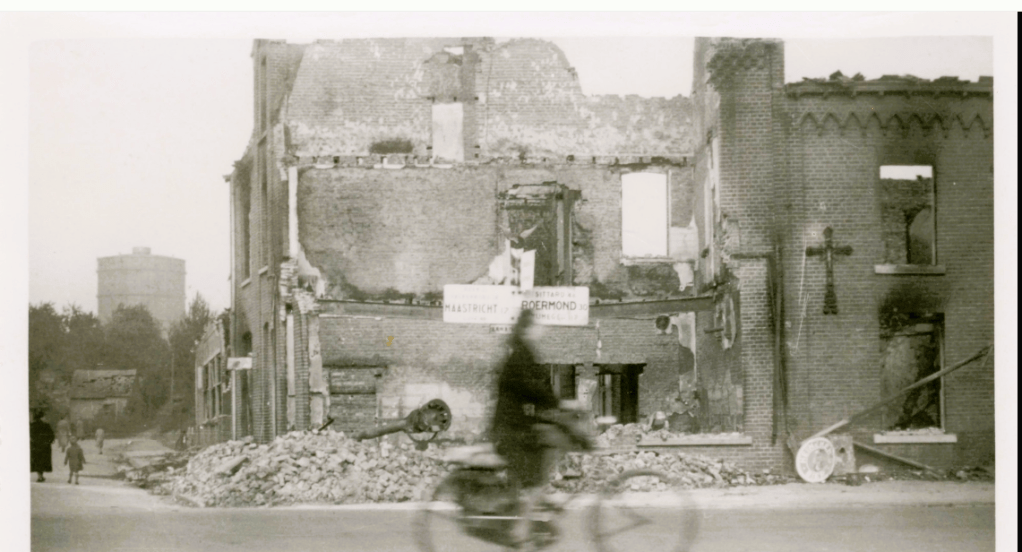
Geleen had 22 severely injured people. Fifty-nine houses were completely destroyed, 227 were severely damaged, and 103 of them had to be demolished. A further 528 houses sustained heavy or moderate damage, and 1,728 had roof and window damage. In addition to the already mentioned streets, Groenstraat, Rijksweg-Zuid, Geenstraat, and Annastraat were heavily hit. Three thousand residents were left homeless, about 20 percent of the population. Only one aircraft dropped its bombs over Aachen, the actual target of the raid. A Wellington bomber crashed near Maastricht, killing five crew members, with one wounded crewman taken prisoner. A bomber exploded during an air battle over Brunssum, scattering wreckage and the bodies of the crew across the municipality. Throughout South Limburg, there was damage from high-explosive and incendiary bombs. What became known as the “Bombing of Geleen” was a night of terror for all of South Limburg. “A night that haunts you like a nightmare,” one Geleen resident later recorded. Geleen experienced the darkest day in its history.
Sources
https://historiesittardgeleenborn.nl/verhaal/19/het-bombardement-van-geleen
https://www.limburger.nl/cnt/dmf20201007_00179010
Donation
Your readership is what makes my site a success, and I am truly passionate about providing you with valuable content. I have been doing this at no cost and will continue to do so. Your voluntary donation of $2 or more, if you are able, would be a significant contribution to the continuation of my work. However, I fully understand if you’re not in a position to do so. Your support, in any form, is greatly appreciated. Thank you. To donate, click on the credit/debit card icon of the card you will use. If you want to donate more than $2, just add a higher number in the box left from the PayPal link. Your generosity is greatly appreciated. Many thanks.
$2.00
 History of Sorts
Leave a comment