There is a common misconception that Nazi war crimes were committed only by the SS. Still, the Wehrmacht was also responsible for numerous atrocities.
The massacre at Chozum is part of a broader history of the Wehrmacht’s involvement in war crimes during the invasion of the Soviet Union, a topic long shrouded in controversy. While the SS and Einsatzgruppen were primarily responsible for mass killings, the Wehrmacht was also profoundly complicit in atrocities, as shown by events like this massacre. After the war, many such incidents were downplayed or went unpunished due to the chaotic nature of the Eastern Front and the sheer scale of the crimes committed across the Soviet territories.
Below are translated transcripts and the original documents by Wehrmacht officers referring to the massacre.
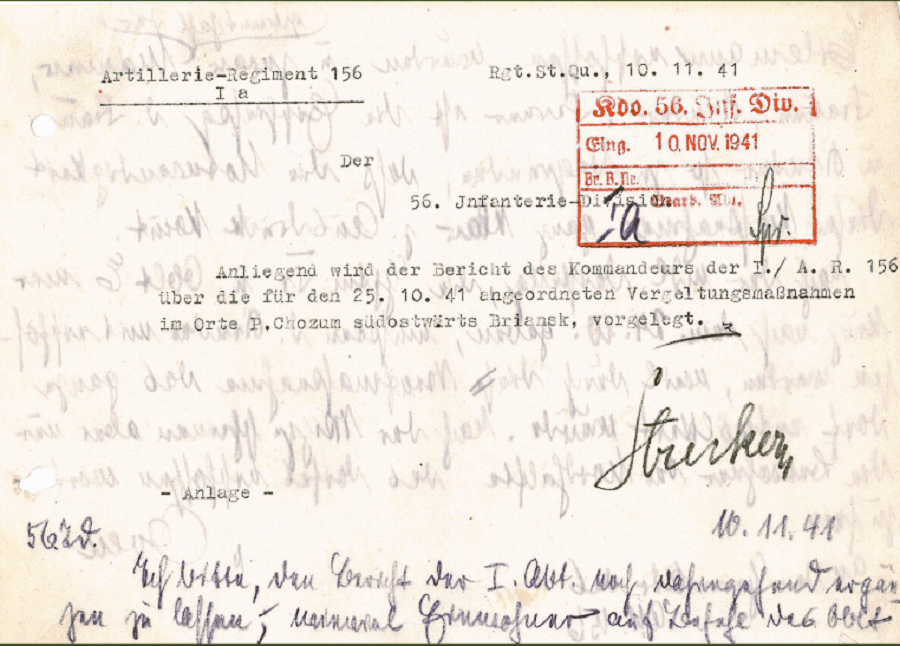
————“Rgt. St. Qu., November 10, 1941
[Stamp: Rdo. 56. Inf. Div.
Entry 10. November 1941
Br. B. No. [Omission]
Arb. No. [Handwritten addition: Ia [Abbreviation: Lpr.]]]
The 56th Infantry Division
Enclosed is the report of the commander of I./AR 156 on the retaliatory measures ordered for 25.10.1941 in the town of P. Chozum, southeast of Briansk. [Abbreviation: [illegible]]
[Signature: Strecker]
Attachment
[Handwritten addition: 56. Id. 10.11.1941
I request that the report of the I. Division be supplemented to indicate how many inhabitants were expelled on the orders of the First Lieutenant]”

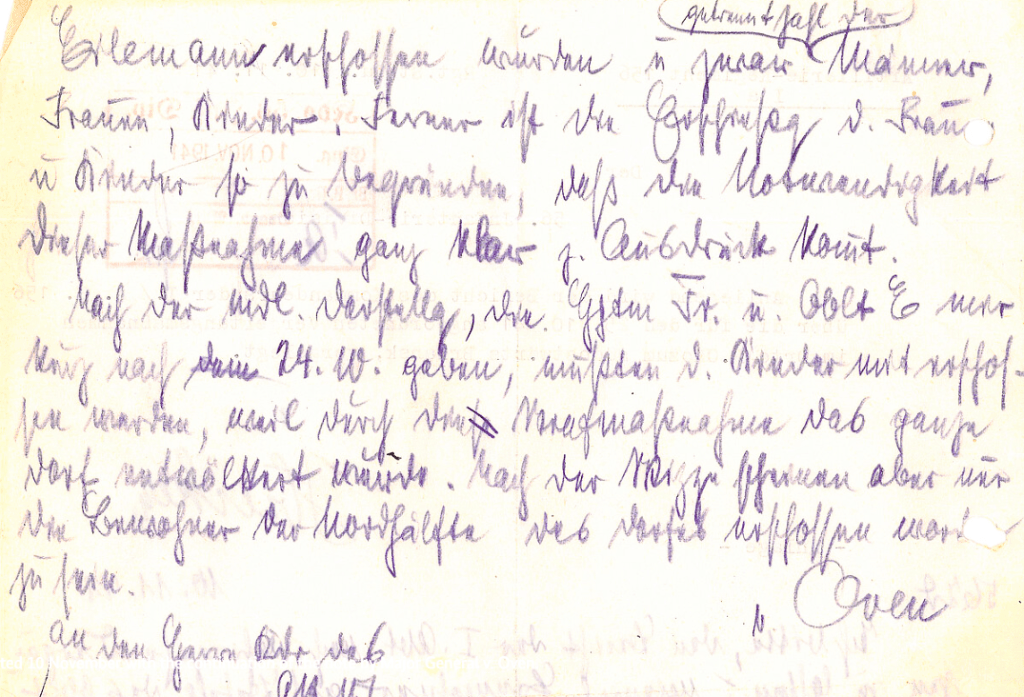
[Handwritten note: Eilemann were shot separately, namely men, women and children. Furthermore, the shooting of women and children must be justified in such a way that the necessity of this measure is clearly expressed. According to the oral description that Captain Fr. and Oblt . E gave me shortly after October 24, 1941, the children had to be shot too, because the entire village was depopulated by the [crossed out: ß] punitive measure. According to the sketch, however, only the inhabitants of the northern half of the village seem to have been shot.
[Signature: v. Oven]
To the Commander of the
Att. [illegible, abbreviation expanded to: Artillery Regiment]
Handwritten addition: Div. Kmor
Tub. 177]
Artillery Regiment 156
Ia
Rgt. St. Qu., November 19, 1941
[Stamp: Rdo. 56. Inf. Div.
Entry 19 November 1941
Br. B. No. [omission] Annex [omission]
Arb. No. [Handwritten addition: Ia [Abbreviation: L.]]]
The 56th Infantry Division
Enclosed is the report of the commander of I./AR 156 on the retaliatory measures ordered for October 25, 1941 in the town of P. Chozum, southeast of Briansk. [Abbreviation: [illegible]]
[Signature: Strecker]
2 plants
I ./ AR156
OU, 15.11.1941
The 156th
Artillery Regiment
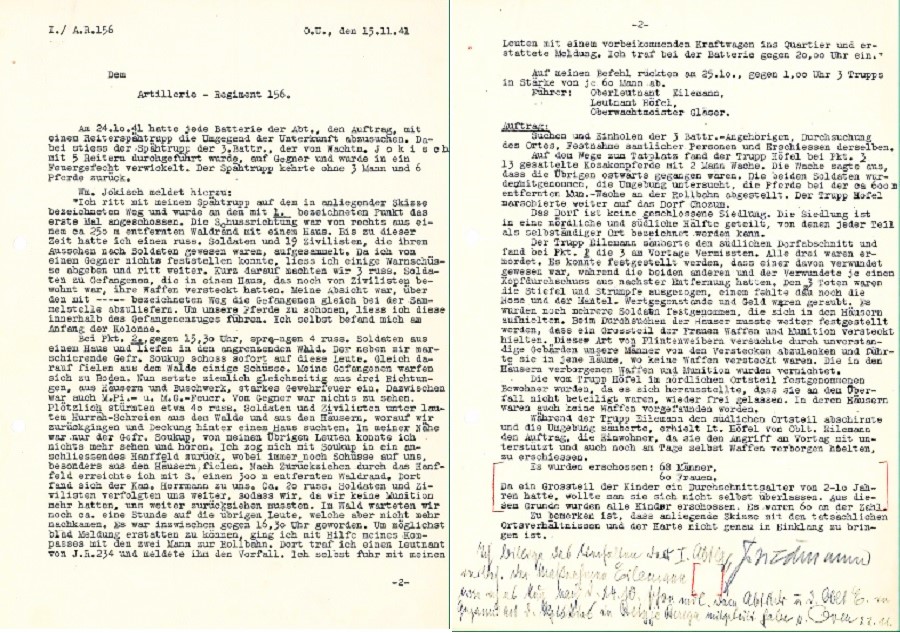
On October 24, 1941, each battery of the detachment was tasked with searching the area around the accommodation with a mounted patrol. The patrol of the 3rd Battalion, led by Sergeant Jokisch with 5 riders, encountered enemies and became involved in a firefight. The patrol returned without 3 men and 6 horses.
Wm. Jokisch reports:
“I rode with my reconnaissance troop on the path marked in the attached sketch and was shot at for the first time at the point marked 1. The direction of the fire was from the right, from a house on the edge of a forest about 250 m away. By this time, I had picked up a Russian soldier and 19 civilians who looked like soldiers. As I could not see any enemy, I fired a few warning shots and rode on. Shortly afterward, we took three Russian soldiers prisoner who had hidden their weapons in a house that was still inhabited by civilians. My intention was to take the prisoners to the collection point via the path marked [formatting: dashed line]. To protect our horses, I had them led within the prisoner train. I was at the front of the column.
At point 2, at around 3.30 p.m., four Russian soldiers jumped out of a house and ran into the adjacent forest. Private Soukup, who was marching next to me, immediately shot at these people. Immediately afterward, several shots were fired from the forest. My prisoners threw themselves to the ground. Now heavy rifle fire began almost simultaneously from three directions, from houses and bushes. In between, there was also a machine gun and MG fire. There was no sign of the enemy. Suddenly, about 40 Russian soldiers and civilians stormed out of the forest and the houses, shouting loudly; after that, we retreated and sought cover behind a house. Only Private Soukup was near me; I could no longer see or hear any of my other men. I retreated with Soukup into an adjacent hemp field, where shots were still being fired at us, especially from the houses. After retreating through the hemp field, I reached the edge of the forest 300 m away with S. There, Chancellor Herrmann joined us.
About 20 Russian soldiers and civilians continued to pursue us, so we had to retreat further as we had no more ammunition. We waited in the forest for about an hour for the rest of the people, but they did not follow. It was now around 4:30 p.m. In order to be able to report as soon as possible, I went with the two men to the runway with the help of my compass. There, I met a lieutenant from JR234 and reported the incident to him. I drove with my People in a passing car, went into the area, and reported. I arrived at the battery around 8:00 p.m.”
On my orders, on October 25, 1941, at around 1:00 a.m., three squads of 60 men each moved out.
Leaders: First Lieutenant Eilemann,
Lieutenant Höfel,
Sergeant Gläser.
Mission:
Find and catch up with the 3 battalion members, search the place, arrest all persons, and shoot them.
On the way to the crime scene, the Höfel squad found 13 saddled Cossack horses with 2 men on guard at point 3. The guard stated that the rest had gone east. The two soldiers were taken away, the area was examined, and the horses were left at the ammunition guard on the runway about 600 m
away. The Höfel squad marched on to the village of Chozum. The village is not a closed settlement. The settlement is divided into a northern and southern half, each of which can be described as an independent place.
Eilemann’s squad cleared the southern part of the village and found the three men who had gone missing the day before at point 2. All three had been murdered. It was determined that one of them had been wounded, while the other two and the wounded man had each been shot through the head at close range. The three dead men had their boots and socks removed, and one was also missing his trousers and coat. Valuables and money had been stolen. Several soldiers who were staying in the houses were arrested. When the houses were searched, it was also determined that most of the women were hiding weapons and ammunition. These gun-wielding women tried to distract our men from their hiding places with incomprehensible gestures. They led them into rooms where no weapons were hidden. The weapons and ammunition hidden in the houses were destroyed.
The residents arrested by Höfel’s squad in the northern part of the town were released because it turned out that they had not been involved in the attack. No weapons were found in their houses either.
While Eilemann’s squad cordoned off the southern part of the town and cleared the area, Lt. Höfel received orders from Lt. Eilemann to shoot the residents because they had supported the attack the day before and had concealed weapons that day.
Those shot were: 68 men,
60 women.
Since the majority of the children had an average age of 2-10 years, they did not want to leave them to their own devices. For this reason, all of the children were shot. There were 60 of them. It should be noted that the attached sketch does not exactly match the actual local conditions and the map.
[Signature: Friedmann]

[Handwritten addition:
I approve of the conduct of the 1st Division of the Commander of the Eilemann measures, as I had already verbally communicated to the Division and Lieutenant E. in the presence of the Regiment Kms in Belyie Berega shortly after October 24, 1941.
[Signature: v. Oven] November 22, 1941]
Copy!
33
[Handwritten addition: hr 31/3
ha]
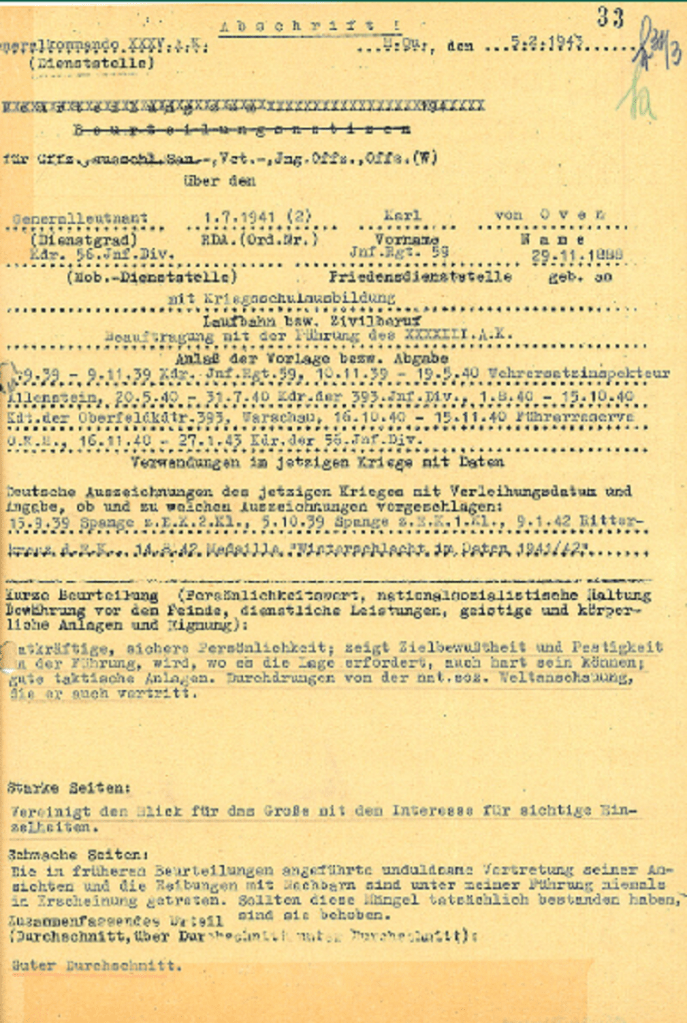
General Command XXXV.AK; H.Qu., 05.02.1943
(office)
[crossed out: assessment on [omission] 194 [omission]
assessment notes]
for officers excluding medical, veterinary, junior officers, officers 
via the
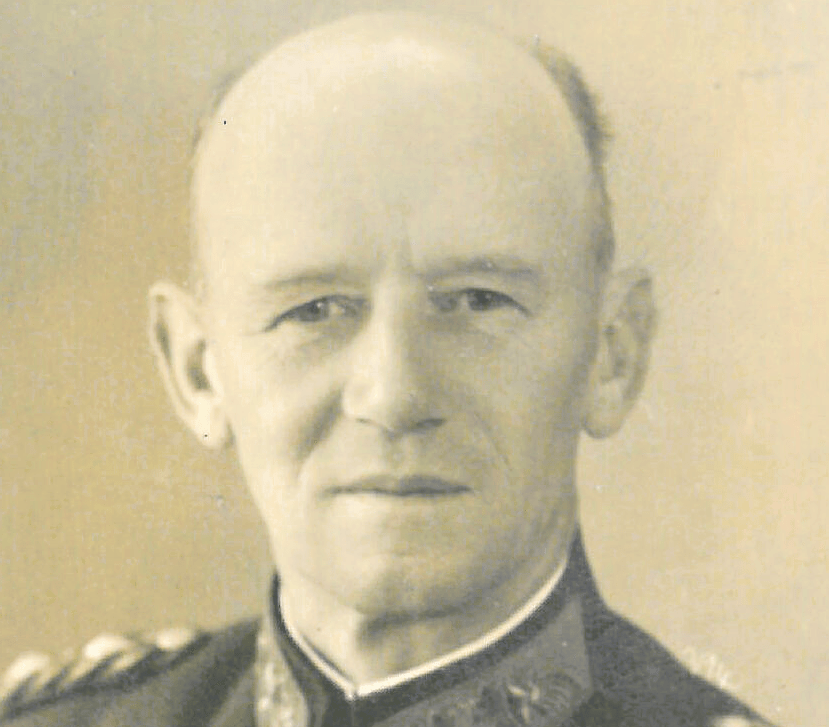
(Rank): Lieutenant General
RDA.(Ord.No.): 01.07.1941 (2)
First name: Karl
Name: von Oven
(Mobile Department): Commander 56.Inf.Div.
Peace Service Office: Inf.Rgt. 59
born on: November 29, 1888
Career or civilian profession: with military school education
Reason for submission or handover: Assignment to lead the XXXXIII.AK
Assignments in the current war with dates: 09.1939-09.11.1939 Commander of Inf.Rgt.59, 10.11.1939-19.05.1940 Defense Replacement Inspector Allenstein, 20.05.1940-31.07.1940 Commander of the 393rd Inf. Div., 01.08.1940-15.10.1940 Commander of the Oberfeldkdtr. 393, Warsaw, 16.10.1940-15.11.1940 Commander’s Reserve OKH, 16.11.1940-27.01.1943 Commander of the 56th Inf. Div.
German awards of the current war with award date and
information on whether and for which awards proposed:
15.09.1939 Clasp zEK 2.K1., 05.10.1939 Clasp ZEK 1.K1., 09.01.1942 Knight’s Cross dEK, 14.08.1942 Medal “Winter Battle in the East 1941/1942”
Brief assessment (personality, National Socialist attitude, ability to stand up to the enemy, performance in the service, mental and physical abilities and suitability):
Energetic, confident personality; shows a sense of purpose and firmness in leadership, can be tough when the situation requires it; good tactical abilities. Imbued with the National Socialist worldview, which he also represents.
Strengths:
Combines an eye for the big picture with an interest in visible details.
Weak points:
The intolerant representation of his views and the friction with neighbors mentioned in previous assessments have never come to light under my leadership. If these deficiencies actually existed, they have been remedied.
Summary judgment
(average, above average, below average):
Good average.”————–
What is particularly notable about this specific case—the annihilation of an entire village by the 156th Artillery Regiment, and the indiscriminate shooting of men, women, and children as a “measure of atonement” in an unequal conflict—is not just the cold brutality of the perpetrators, but the early timing in autumn 1941. Based on what is known, the Wehrmacht only fully adopted such practices as the partisan war intensified in 1942. However, the indiscriminate murder of civilians had already become common in the “Jewish actions” carried out by the Einsatzgruppen of the Security Police and SD, as well as Waffen-SS brigades, starting in late summer 1941.
It remains unclear whether the members of the 156th Artillery Regiment were directly influenced by these precedents or whether they initiated this radicalization on their own. Either way, with the crime at Chozum, the 156th Artillery Regiment represents the early stages of the Wehrmacht’s partial alignment with the brutal tactics of the Waffen-SS and Einsatzgruppen.
Source
Donation
Your readership is what makes my site a success, and I am truly passionate about providing you with valuable content. I have been doing this at no cost and will continue to do so. Your voluntary donation of $2 or more, if you are able, would be a significant contribution to the continuation of my work. However, I fully understand if you’re not in a position to do so. Your support, in any form, is greatly appreciated. Thank you. To donate, click on the credit/debit card icon of the card you will use. If you want to donate more than $2, just add a higher number in the box left from the PayPal link. Your generosity is greatly appreciated. Many thanks.
$2.00

 History of Sorts
Leave a comment