
Nowadays, it is easy to blame social media for the widespread distribution of fake news through memes and other formats. However, this phenomenon is far from new. About 100 years ago, propaganda postcards and cartoons served the same purpose (after all, a meme is essentially a digital version of a propaganda or satirical postcard or cartoon) and were spread through mail or newspapers.
Long before Hitler rose to power, German politicians like Friedrich Ebert were already blaming communists, socialists, and particularly Jews for Germany’s defeat in World War I by promoting the “stab-in-the-back” myth.
After World War I, German military leaders attempted to shift the blame for the country’s defeat away from themselves. Throughout the war, they had concealed the deteriorating military situation from the public. Moreover, many Germans were reluctant to believe that their military had truly been defeated. This led to the spread of a myth suggesting that German forces could have won the war if they had not been “stabbed in the back” by disloyal German citizens who allegedly undermined the war effort.
Despite being entirely false, the stab-in-the-back myth gained widespread belief. German Jews had loyally and bravely served in the German army during WWI, with their numbers proportionally higher than their representation in the general population.
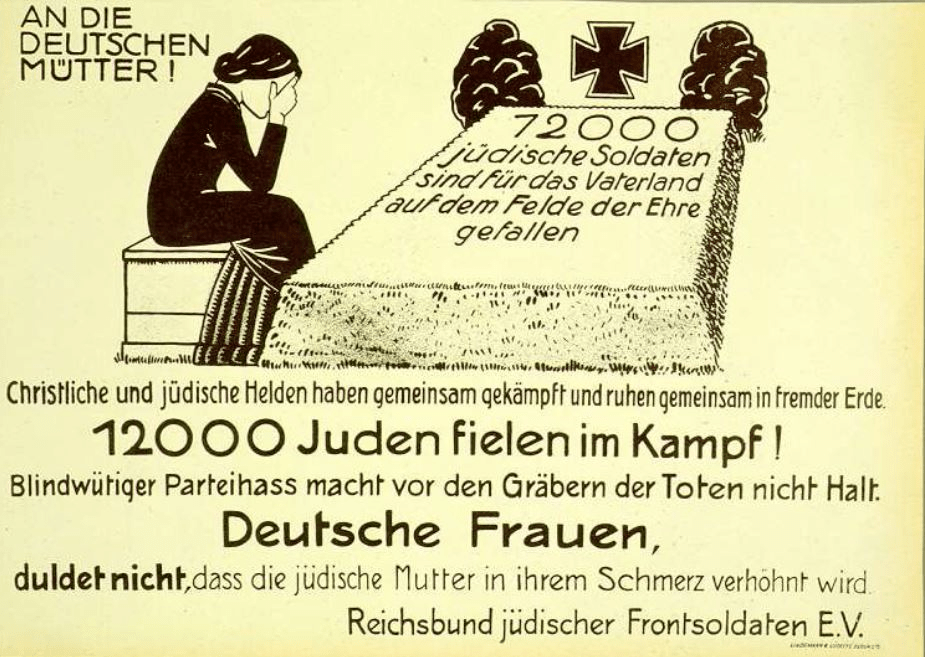
The “Reich Federation of Jewish Front Soldiers” emphasized this fact. Nonetheless, several damaging myths were deliberately spread alongside older prejudices, such as:
- Jews had instigated the war to bring Europe to financial ruin and under Jewish control.
- Jews exploited wartime misery to enrich themselves and prolong the conflict to lead the Bolshevik Revolution in advancing world revolution.
These myths were further reinforced by propaganda postcards and cartoons. The term “stab-in-the-back” itself likely originated from General Erich Ludendorff and dates back to the autumn of 1919. During a dinner with General Sir Neill Malcolm, head of the British Military Mission in Berlin, Malcolm asked Ludendorff why he thought Germany lost the war. After Ludendorff listed his reasons, including that the home front had failed the army, Malcolm asked, “Do you mean, General, that you were stabbed in the back?” Ludendorff seized on the phrase, repeating, “Yes, that’s it, exactly—we were stabbed in the back.”

This narrative was taken up by conservatives, nationalists, and former military leaders, who began to speak critically of the peace, the Weimar politicians, socialists, communists, and especially Jews. They suggested that these groups had not supported the war effort and had betrayed Germany to its enemies. By the time the Nazis rose to power, the groundwork for these harmful myths was already in place.

Sources
https://www.annefrank.org/en/timeline/193/the-stab-in-the-back-legend/
Donation
Your readership is what makes my site a success, and I am truly passionate about providing you with valuable content. I have been doing this at no cost and will continue to do so. Your voluntary donation of $2 or more, if you are able, would be a significant contribution to the continuation of my work. However, I fully understand if you’re not in a position to do so. Your support, in any form, is greatly appreciated. Thank you. To donate, click on the credit/debit card icon of the card you will use. If you want to donate more than $2, just add a higher number in the box left from the PayPal link. Your generosity is greatly appreciated. Many thanks.
$2.00

 History of Sorts
Leave a comment