
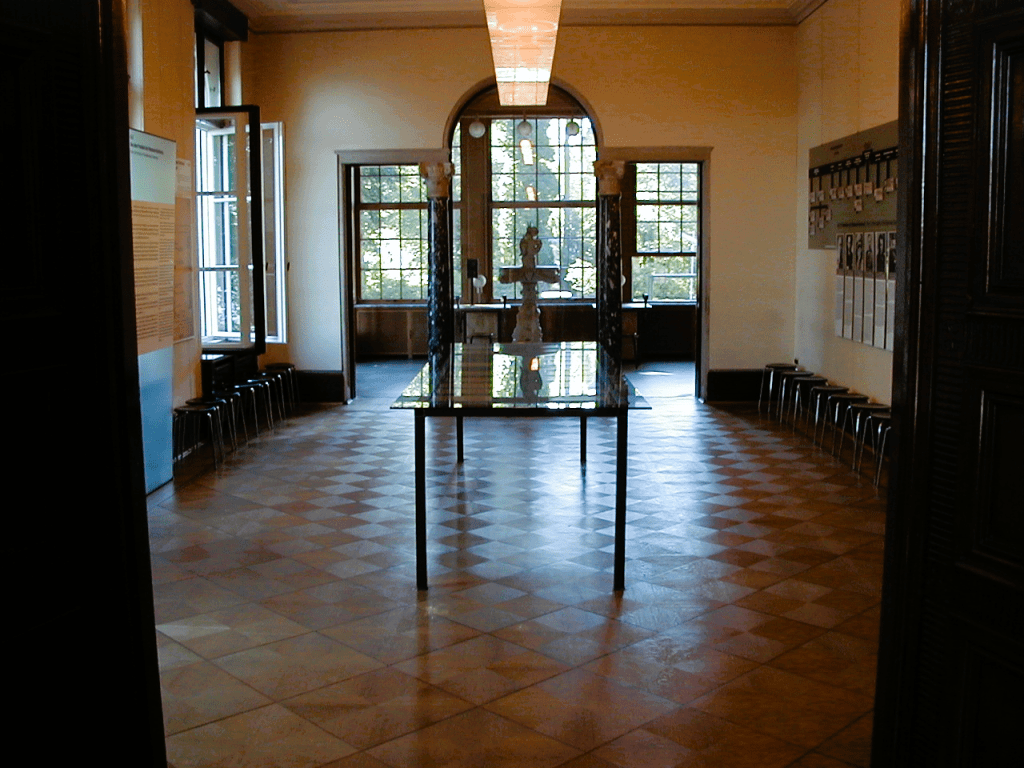
The German word “Wahnsinn,” meaning “insanity” or “madness,” bears a slight phonetic resemblance to “Wannsee.” The image above depicts the villa located at Am Großen Wannsee 56–58 in Berlin. On January 20, 1942, this villa became the site where 15 high-ranking Nazi officials convened to devise the horrifying plans for the Holocaust.
Although the Holocaust had begun nine years earlier, the meeting at the villa on January 20, 1942, focused on accelerating the systematic eradication of European Jews.
The Wannsee Conference, held on January 20, 1942, in the Berlin suburb of Wannsee, was a meeting of senior Nazi officials to discuss and coordinate the implementation of the “Final Solution to the Jewish Question,” which involved the mass extermination of European Jews.
Here are the key attendees of the Wannsee Conference, along with their positions at the time:
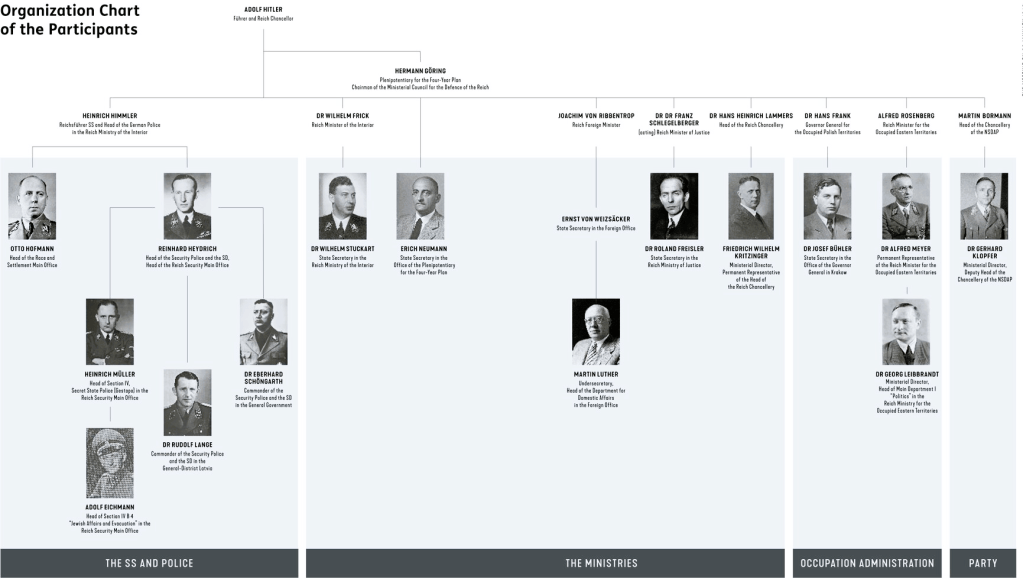
Organizers and Chair:
- Reinhard Heydrich
- Position: Chief of the Reich Security Main Office (RSHA) and Acting Reich Protector of Bohemia and Moravia.
- Role: Chaired the meeting and outlined the plans for the Final Solution.
- Adolf Eichmann
- Position: Head of Section IV B4 of the RSHA, responsible for Jewish affairs and emigration.
- Role: Prepared the conference agenda and minutes.
Other Attendees:
- Heinrich Müller
- Position: Chief of the Gestapo (Secret State Police), a department within the RSHA.
- Dr. Josef Bühler
- Position: State Secretary of the General Government (occupied Poland).
- Dr. Roland Freisler
- Position: State Secretary in the Reich Ministry of Justice.
- Dr. Georg Leibbrandt
- Position: Head of the Eastern Affairs Department in the Reich Ministry for the Occupied Eastern Territories.
- Dr. Alfred Meyer
- Position: Deputy Reich Minister for the Occupied Eastern Territories.
- Wilhelm Stuckart
- Position: State Secretary in the Reich Ministry of the Interior.
- Erich Neumann
- Position: Director of the Office of the Four-Year Plan.
- Martin Luther
- Position: Undersecretary at the Foreign Office.
- Otto Hofmann
- Position: Chief of the SS Race and Settlement Main Office.
- Dr. Gerhard Klopfer
- Position: State Secretary in the Party Chancellery.
- Friedrich Wilhelm Kritzinger
- Position: Deputy Head of the Reich Chancellery.
Purpose:
The meeting focused on coordinating efforts across various branches of the Nazi government to deport and systematically murder Jews in occupied Europe. Detailed population figures of Jews in various countries were discussed, and mechanisms of extermination, including the use of death camps, were outlined.
While the Wannsee Conference itself did not initiate the Holocaust (mass killings were already underway), it served to formalize and organize the genocidal policy across Nazi-occupied territories.
Here’s an extensive blog about the Wannsee Conference and its planning:
The Wannsee Conference: Planning the “Final Solution”
The Wannsee Conference, held on January 20, 1942, in a quiet Berlin suburb, stands as one of the most chilling milestones in the history of the Holocaust. Convened by senior Nazi officials, the meeting solidified plans for the systemic extermination of Europe’s Jewish population, euphemistically referred to as the “Final Solution to the Jewish Question.” Though the Holocaust was already underway by this point, the Wannsee Conference marked the formalization of genocide as state policy. This article delves into the background, planning, key participants, and implications of this fateful meeting.
Background: The Road to Wannsee
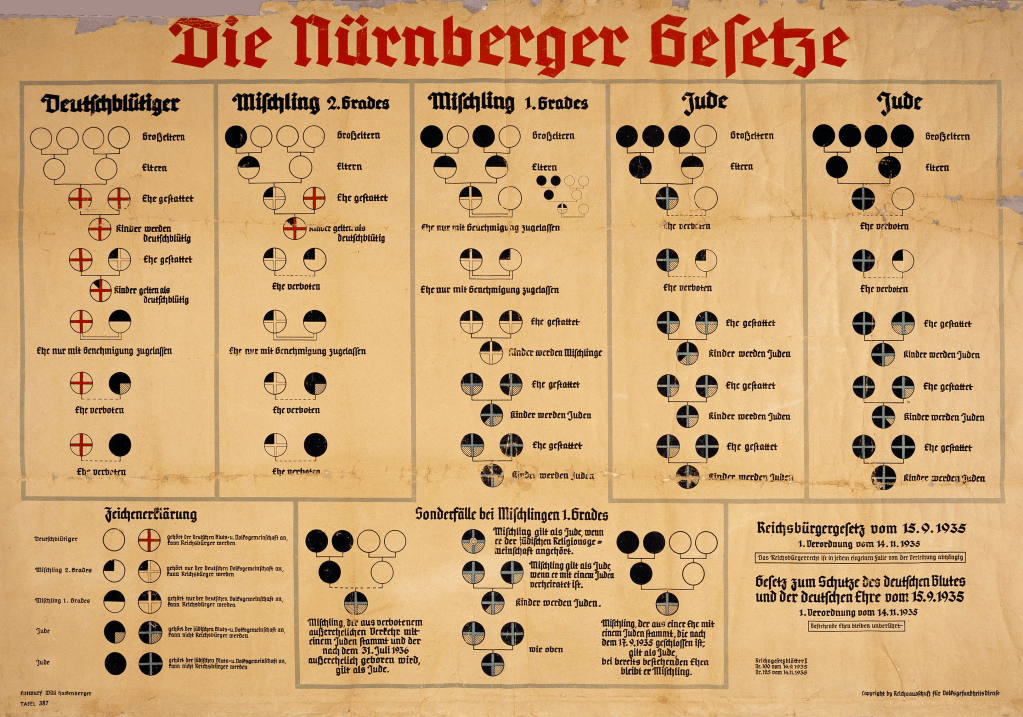
The Nazis’ persecution of Jews began long before the Wannsee Conference. Adolf Hitler’s rise to power in 1933 ushered in an era of escalating antisemitic policies. Jews were stripped of their rights through the Nuremberg Laws (1935), which deprived them of German citizenship and prohibited intermarriage between Jews and non-Jews. State-sponsored violence reached a terrifying crescendo during Kristallnacht (1938), when Jewish homes, businesses, and synagogues were attacked across Germany and Austria.
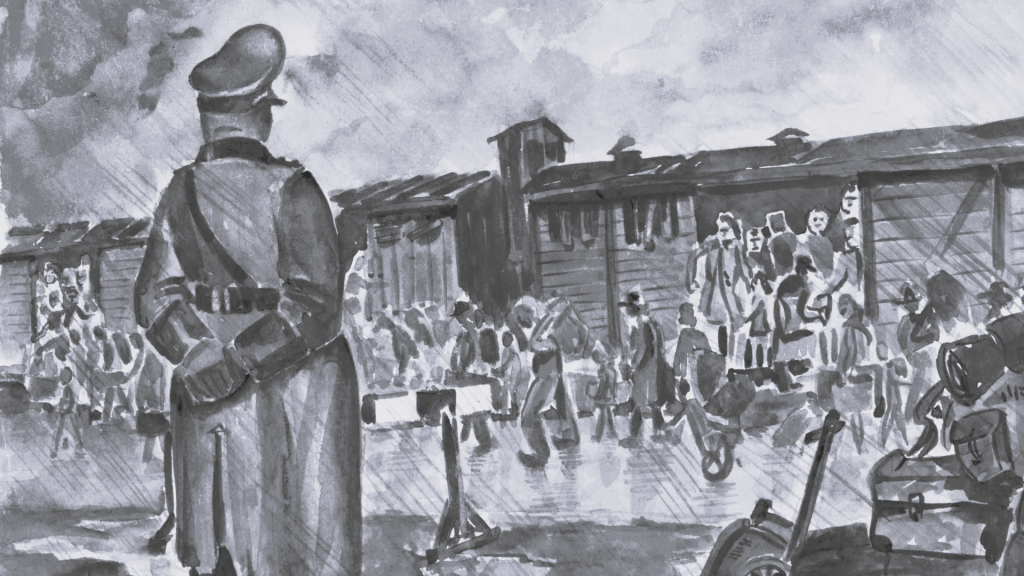
By the onset of World War II in 1939, the Nazis’ policy toward Jews had shifted from persecution to forced displacement. Millions of Jews were deported to ghettos in Eastern Europe under horrific conditions. However, as the war expanded, the Nazi leadership sought a more “efficient” method to address what they saw as the “Jewish problem.” The invasion of the Soviet Union in 1941 and subsequent massacres by Einsatzgruppen (mobile killing units) foreshadowed the industrialized genocide to come. It was against this backdrop that the Wannsee Conference was conceived.
Planning the Wannsee Conference
Purpose of the Meeting
By late 1941, senior Nazi officials had decided to coordinate and streamline the mass murder of Jews across occupied Europe. The conference was not called to debate whether the “Final Solution” would occur—that decision had already been made—but rather to organize its implementation. SS-Obergruppenführer Reinhard Heydrich, head of the Reich Security Main Office (RSHA) and one of the architects of the Holocaust, issued invitations for the meeting. The attendees included representatives from key government ministries, the SS, and other Nazi organizations.
Location
The conference took place in a villa in Wannsee, an affluent lakeside suburb of Berlin. The villa, confiscated from a Jewish owner, was chosen for its secluded and serene setting—an ironic contrast to the grim agenda.
Preparation
Heydrich meticulously prepared for the meeting, which was intended to ensure cooperation among the various branches of the Nazi regime. The primary document for discussion was a report summarizing the number of Jews in Europe and the logistical framework for their extermination. Bureaucratic efficiency and consensus-building were paramount, as the success of the “Final Solution” depended on the participation of numerous agencies.
The Conference
Attendees
Fifteen high-ranking officials attended the meeting, representing organizations such as the RSHA, the Ministry of the Interior, the Ministry of Justice, and the Foreign Office. Among them were Adolf Eichmann, tasked with managing the logistics of deportations, and Dr. Wilhelm Stuckart, co-author of the Nuremberg Laws.
Agenda
The meeting, chaired by Heydrich, lasted approximately 90 minutes. Key points of discussion included:
- Defining Jewish Identity: Attendees discussed who would be classified as Jewish under Nazi racial laws, including individuals of mixed ancestry (Mischlinge).
- Scope of the “Final Solution”: Heydrich presented a list estimating the Jewish population in Europe at over 11 million, including Jews in neutral and enemy countries.
- Methods of Extermination: Although specific methods like gas chambers were not detailed, the conference confirmed that mass murder would be the primary strategy. Deportation to extermination camps was emphasized as a key element.
- Coordination Among Agencies: Each participant’s role in the “Final Solution” was outlined, ensuring seamless cooperation between the SS, government ministries, and local authorities.
Tone of the Meeting
The minutes of the conference, recorded by Eichmann, reveal the bureaucratic and detached language used to discuss genocide. Terms like “evacuation” and “resettlement” masked the reality of mass murder. Despite the horrifying subject matter, attendees discussed the logistics with cold efficiency.
Aftermath
The Wannsee Conference did not mark the beginning of the Holocaust but rather its institutionalization. Following the meeting, the extermination of Jews intensified. Death camps such as Auschwitz-Birkenau, Treblinka, and Sobibor became central to the Nazis’ genocidal apparatus, using gas chambers to murder millions.
The bureaucratic precision and coordination facilitated by the conference highlight the industrial-scale efficiency of the Holocaust. The meeting also underscored the complicity of various branches of the Nazi government, beyond the SS, in the implementation of genocide.
Legacy
The Wannsee Conference remains a stark reminder of the dangers of state-sanctioned hatred and the capacity for ordinary bureaucrats to become instruments of atrocity. The villa where the meeting took place is now a memorial and educational site, preserving the memory of the victims and teaching future generations about the Holocaust.
In the words of Primo Levi, a Holocaust survivor, “It happened, therefore it can happen again.” Understanding events like the Wannsee Conference is crucial to preventing such horrors from recurring.
This meeting exemplifies the fusion of ideology and bureaucracy in the Third Reich, demonstrating how genocide was facilitated not just by fanatics but also by functionaries who saw themselves as “following orders.” The Wannsee Conference stands as a harrowing chapter in history, urging humanity to remain vigilant against the forces of hatred and authoritarianism.
Below are the ‘minutes’ of that meeting.
The English text of the Wannsee protocol is based on the official U.S. government translation and was prepared for evidence in trials at Nuremberg, as reproduced in John Mendelsohn, ed., The Holocaust: Selected Documents in Eighteen Volumes. Vol. 11: The Wannsee Protocol and a 1944 Report on Auschwitz by the Office of Strategic Services (New York: Garland, 1982), 18-32. Substantial revisions to the Nuremberg text have been made to add clarity and, in some cases, to correct mistakes in an obviously hasty translation.
Stamp: Top Secret
30 copies
16th copy
Minutes of discussion.
I. The following persons took part in the discussion about the
final solution of the Jewish question which took place in Berlin,
am Grossen Wannsee No. 56/58 on 20 January 1942.
Gauleiter Dr. Meyer and Reichsamt- Reich Ministry for
leiter Dr. Leibbrandt the Occupied Eastern
territories
Secretary of State Dr. Stuckart Reich Ministry for
the Interior
Secretary of State Neumann Plenipotentiary for
the Four Year Plan
Secretary of State Dr. Freisler Reich Ministry of
Justice
Secretary of State Dr. Buehler Office of the Govern-
ment General
Under Secretary of State Dr. Luther Foreign Office
SS-Oberfuehrer Klopfer Party Chancellery
Ministerialdirektor Kritzinger Reich Chancellery
SS-Gruppenfuehrer Hofmann Race and Settlement
Main Office
SS-Gruppenfuehrer Mueller Reich Main Security
SS-Obersturmbannfuehrer Eichmann Office
SS-Oberfuehrer Dr. Schoengarth Security Police and SD
Chief of the Security Police and
the SD in the Government General
SS-Sturmbannfuehrer Dr. Lange Security Police and SD
Commander of the Security Police
and the SD for the General-District
Latvia, as deputy of the Commander
of the Security Police and the SD
for the Reich Commissariat “Eastland”.
II. At the beginning of the discussion Chief of the Security
Police and of the SD, SS-Obergruppenfuehrer Heydrich, reported
that the Reich Marshal had appointed him delegate for the
preparations for the final solution of the Jewish question in
Europe and pointed out that this discussion had been called for
the purpose of clarifying fundamental questions. The wish of the
Reich Marshal to have a draft sent to him concerning
organizational, factual and material interests in relation to the
final solution of the Jewish question in Europe makes necessary
an initial common action of all central offices immediately
concerned with these questions in order to bring their general
activities into line.
The Reichsfuehrer-SS and the Chief of the German Police
(Chief of the Security Police and the SD) was entrusted with the
official central handling of the final solution of the Jewish
question without regard to geographic borders.
The Chief of the Security Police and the SD then gave a
short report of the struggle which has been carried on thus far
against this enemy, the essential points being the following:
 a)   the expulsion of the Jews from every sphere of life of
      the German people,

 b)   the expulsion of the Jews from the living space of the
      German people.

 In carrying out these efforts, an increased and planned
acceleration of the emigration of the Jews from Reich territory
was started, as the only possible present solution.
By order of the Reich Marshal, a Reich Central Office for
Jewish Emigration was set up in January 1939 and the Chief of the
Security Police and SD was entrusted with the management. Its
most important tasks were
 a)   to make all necessary arrangements for the preparation
      for an increased emigration of the Jews,

 b)   to direct the flow of emigration,

 c)   to speed the procedure of emigration in each individual
      case.

 The aim of all this was to cleanse German living space of
Jews in a legal manner.
All the offices realized the drawbacks of such enforced
accelerated emigration. For the time being they had, however,
tolerated it on account of the lack of other possible solutions
of the problem.
The work concerned with emigration was, later on, not only a
German problem, but also a problem with which the authorities of
the countries to which the flow of emigrants was being directed
would have to deal. Financial difficulties, such as the demand
by various foreign governments for increasing sums of money to be
presented at the time of the landing, the lack of shipping space,
increasing restriction of entry permits, or the cancelling of
such, increased extraordinarily the difficulties of emigration.
In spite of these difficulties, 537,000 Jews were sent out of the
country between the takeover of power and the deadline of 31
October 1941. Of these
 approximately 360,000 were in Germany proper on 30 January
 1933

 approximately 147,000 were in Austria (Ostmark) on 15 March
 1939

 approximately 30,000 were in the Protectorate of Bohemia and
 Moravia on 15 March 1939.

 The Jews themselves, or their Jewish political
organizations, financed the emigration. In order to avoid
impoverished Jews’ remaining behind, the principle was followed
that wealthy Jews have to finance the emigration of poor Jews;
this was arranged by imposing a suitable tax, i.e., an emigration
tax, which was used for financial arrangements in connection with
the emigration of poor Jews and was imposed according to income.
Apart from the necessary Reichsmark exchange, foreign
currency had to presented at the time of landing. In order to
save foreign exchange held by Germany, the foreign Jewish
financial organizations were – with the help of Jewish
organizations in Germany – made responsible for arranging an
adequate amount of foreign currency. Up to 30 October 1941,
these foreign Jews donated a total of around 9,500,000 dollars.
In the meantime the Reichsfuehrer-SS and Chief of the German
Police had prohibited emigration of Jews due to the dangers of an
emigration in wartime and due to the possibilities of the East.
III. Another possible solution of the problem has now taken the
place of emigration, i.e. the evacuation of the Jews to the East,
provided that the Fuehrer gives the appropriate approval in
advance.
These actions are, however, only to be considered
provisional, but practical experience is already being collected
which is of the greatest importance in relation to the future
final solution of the Jewish question.
Approximately 11 million Jews will be involved in the final
solution of the European Jewish question, distributed as follows
among the individual countries:
Country Number
A. Germany proper 131,800
Austria 43,700
Eastern territories 420,000
General Government 2,284,000
Bialystok 400,000
Protectorate Bohemia and Moravia 74,200
Estonia – free of Jews –
Latvia 3,500
Lithuania 34,000
Belgium 43,000
Denmark 5,600
France / occupied territory 165,000
unoccupied territory 700,000
Greece 69,600
Netherlands 160,800
Norway 1,300
B. Bulgaria 48,000
England 330,000
Finland 2,300
Ireland 4,000
Italy including Sardinia 58,000
Albania 200
Croatia 40,000
Portugal 3,000
Rumania including Bessarabia 342,000
Sweden 8,000
Switzerland 18,000
Serbia 10,000
Slovakia 88,000
Spain 6,000
Turkey (European portion) 55,500
Hungary 742,800
USSR 5,000,000
Ukraine 2,994,684
White Russia
excluding Bialystok 446,484
                          Total     over                     11,000,000


 The number of Jews given here for foreign countries
includes, however, only those Jews who still adhere to the Jewish
faith, since some countries still do not have a definition of the
term “Jew” according to racial principles.
The handling of the problem in the individual countries will
meet with difficulties due to the attitude and outlook of the
people there, especially in Hungary and Rumania. Thus, for
example, even today the Jew can buy documents in Rumania that
will officially prove his foreign citizenship.
The influence of the Jews in all walks of life in the USSR
is well known. Approximately five million Jews live in the
European part of the USSR, in the Asian part scarcely 1/4
million.
The breakdown of Jews residing in the European part of the
USSR according to trades was approximately as follows:
 Agriculture                                                      9.1 %
 Urban workers                                                   14.8 %
 In trade                                                        20.0 %
 Employed by the state                                           23.4 %
 In private occupations such as
 medical profession, press, theater, etc.                        32. 7%

 Under proper guidance, in the course of the final solution
the Jews are to be allocated for appropriate labor in the East.
Able-bodied Jews, separated according to sex, will be taken in
large work columns to these areas for work on roads, in the
course of which action doubtless a large portion will be
eliminated by natural causes.
The possible final remnant will, since it will undoubtedly
consist of the most resistant portion, have to be treated
accordingly, because it is the product of natural selection and
would, if released, act as a the seed of a new Jewish revival
(see the experience of history.)
In the course of the practical execution of the final
solution, Europe will be combed through from west to east.
Germany proper, including the Protectorate of Bohemia and
Moravia, will have to be handled first due to the housing problem
and additional social and political necessities.
The evacuated Jews will first be sent, group by group, to
so-called transit ghettos, from which they will be transported to
the East.
SS-Obergruppenfuehrer Heydrich went on to say that an
important prerequisite for the evacuation as such is the exact
definition of the persons involved.
It is not intended to evacuate Jews over 65 years old, but
to send them to an old-age ghetto – Theresienstadt is being
considered for this purpose.
In addition to these age groups - of the approximately
280,000 Jews in Germany proper and Austria on 31 October 1941,
approximately 30% are over 65 years old – severely wounded
veterans and Jews with war decorations (Iron Cross I) will be
accepted in the old-age ghettos. With this expedient solution,
in one fell swoop many interventions will be prevented.
The beginning of the individual larger evacuation actions
will largely depend on military developments. Regarding the
handling of the final solution in those European countries
occupied and influenced by us, it was proposed that the
appropriate expert of the Foreign Office discuss the matter with
the responsible official of the Security Police and SD.
In Slovakia and Croatia the matter is no longer so
difficult, since the most substantial problems in this respect
have already been brought near a solution. In Rumania the
government has in the meantime also appointed a commissioner for
Jewish affairs. In order to settle the question in Hungary, it
will soon be necessary to force an adviser for Jewish questions
onto the Hungarian government.
With regard to taking up preparations for dealing with the
problem in Italy, SS-Obergruppenfuehrer Heydrich considers it
opportune to contact the chief of police with a view to these
problems.
In occupied and unoccupied France, the registration of Jews
for evacuation will in all probability proceed without great
difficulty.
Under Secretary of State Luther calls attention in this
matter to the fact that in some countries, such as the
Scandinavian states, difficulties will arise if this problem is
dealt with thoroughly and that it will therefore be advisable to
defer actions in these countries. Besides, in view of the small
numbers of Jews affected, this deferral will not cause any
substantial limitation.
The Foreign Office sees no great difficulties for southeast
and western Europe.
SS-Gruppenfuehrer Hofmann plans to send an expert to Hungary
from the Race and Settlement Main Office for general orientation
at the time when the Chief of the Security Police and SD takes up
the matter there. It was decided to assign this expert from the
Race and Settlement Main Office, who will not work actively, as
an assistant to the police attache.
IV. In the course of the final solution plans, the Nuremberg
Laws should provide a certain foundation, in which a prerequisite
for the absolute solution of the problem is also the solution to
the problem of mixed marriages and persons of mixed blood.
The Chief of the Security Police and the SD discusses the
following points, at first theoretically, in regard to a letter
from the chief of the Reich chancellery:
1) Treatment of Persons of Mixed Blood of the First Degree
Persons of mixed blood of the first degree will, as regards
the final solution of the Jewish question, be treated as Jews.
 From this treatment the following exceptions will be made:

 a)   Persons of mixed blood of the first degree married to
      persons of German blood if their marriage has resulted
      in children (persons of mixed blood of the second
      degree).  These persons of mixed blood of the second
      degree are to be treated essentially as Germans.

 b)   Persons of mixed blood of the first degree, for whom
      the highest offices of the Party and State have already
      issued exemption permits in any sphere of life.
      Each individual case must be examined, and it is not
      ruled out that the decision may be made to the
      detriment of the person of mixed blood.

 The prerequisite for any exemption must always be the
personal merit of the person of mixed blood. (Not the merit of
the parent or spouse of German blood.)
Persons of mixed blood of the first degree who are exempted
from evacuation will be sterilized in order to prevent any
offspring and to eliminate the problem of persons of mixed blood
once and for all. Such sterilization will be voluntary. But it
is required to remain in the Reich. The sterilized “person of
mixed blood” is thereafter free of all restrictions to which he
was previously subjected.
2) Treatment of Persons of Mixed Blood of the Second Degree
Persons of mixed blood of the second degree will be treated
fundamentally as persons of German blood, with the exception of
the following cases, in which the persons of mixed blood of the
second degree will be considered as Jews:
 a)   The person of mixed blood of the second degree was born
      of a marriage in which both parents are persons of
      mixed blood.

 b)   The person of mixed blood of the second degree has a
      racially especially undesirable appearance that marks
      him outwardly as a Jew.

 c)   The person of mixed blood of the second degree has a
      particularly bad police and political record that shows
      that he feels and behaves like a Jew.

 Also in these cases exemptions should not be made if the
person of mixed blood of the second degree has married a person
of German blood.
3) Marriages between Full Jews and Persons of German Blood.
Here it must be decided from case to case whether the Jewish
partner will be evacuated or whether, with regard to the effects
of such a step on the German relatives, [this mixed marriage]
should be sent to an old-age ghetto.
4) Marriages between Persons of Mixed Blood of the First Degree
and Persons of German Blood.
 a)   Without Children.

      If no children have resulted from the marriage, the
      person of mixed blood of the first degree will be
      evacuated or sent to an old-age ghetto (same treatment
      as in the case of marriages between full Jews and
      persons of German blood, point 3.)

 b)   With Children.

      If children have resulted from the marriage (persons of
      mixed blood of the second degree), they will, if they
      are to be treated as Jews, be evacuated or sent to a
      ghetto along with the parent of mixed blood of the
      first degree.  If these children are to be treated as
      Germans (regular cases), they are exempted from
      evacuation as is therefore the parent of mixed blood of
      the first degree.
5) Marriages between Persons of Mixed Blood of the First Degree
and Persons of Mixed Blood of the First Degree or Jews.
In these marriages (including the children) all members of
the family will be treated as Jews and therefore be evacuated or
sent to an old-age ghetto.
6) Marriages between Persons of Mixed Blood of the First Degree
and Persons of Mixed Blood of the Second Degree.
In these marriages both partners will be evacuated or sent
to an old-age ghetto without consideration of whether the
marriage has produced children, since possible children will as a
rule have stronger Jewish blood than the Jewish person of mixed
blood of the second degree.
SS-Gruppenfuehrer Hofmann advocates the opinion that
sterilization will have to be widely used, since the person of
mixed blood who is given the choice whether he will be evacuated
or sterilized would rather undergo sterilization.
State Secretary Dr. Stuckart maintains that carrying out in
practice of the just mentioned possibilities for solving the
problem of mixed marriages and persons of mixed blood will create
endless administrative work. In the second place, as the
biological facts cannot be disregarded in any case, State
Secretary Dr. Stuckart proposed proceeding to forced
sterilization.
Furthermore, to simplify the problem of mixed marriages
possibilities must be considered with the goal of the legislator
saying something like: “These marriages have been dissolved.”
With regard to the issue of the effect of the evacuation of
Jews on the economy, State Secretary Neumann stated that Jews who
are working in industries vital to the war effort, provided that
no replacements are available, cannot be evacuated.
SS-Obergruppenfuehrer Heydrich indicated that these Jews
would not be evacuated according to the rules he had approved for
carrying out the evacuations then underway.
State Secretary Dr. Buehler stated that the General
Government would welcome it if the final solution of this problem
could be begun in the General Government, since on the one hand
transportation does not play such a large role here nor would
problems of labor supply hamper this action. Jews must be
removed from the territory of the General Government as quickly
as possible, since it is especially here that the Jew as an
epidemic carrier represents an extreme danger and on the other
hand he is causing permanent chaos in the economic structure of
the country through continued black market dealings. Moreover,
of the approximately 2 1/2 million Jews concerned, the majority
is unfit for work.
State Secretary Dr. Buehler stated further that the solution
to the Jewish question in the General Government is the
responsibility of the Chief of the Security Police and the SD and
that his efforts would be supported by the officials of the
General Government. He had only one request, to solve the Jewish
question in this area as quickly as possible.
In conclusion the different types of possible solutions were
discussed, during which discussion both Gauleiter Dr. Meyer and
State Secretary Dr. Buehler took the position that certain
preparatory activities for the final solution should be carried
out immediately in the territories in question, in which process
alarming the populace must be avoided.
The meeting was closed with the request of the Chief of the
Conspiracy is a 2001 made-for-television drama film that dramatises the 1942 Wannsee Conference. Using the authentic script taken from the only surviving transcript recorded during the meeting.
The film was written by Loring Mandel and directed by Frank Pierson. Its ensemble cast includes Kenneth Branagh, Stanley Tucci, Colin Firth and David Threlfall. Branagh won a Primetime Emmy Award for Outstanding Lead Actor, and Tucci was awarded a Golden Globe Award for his supporting role.
Sources
https://encyclopedia.ushmm.org/content/en/article/wannsee-conference-and-the-final-solution
https://www.ghwk.de/en/press/newsletter/newsletter-iii/2024-the-wannsee-conference-secretary
https://en.wikipedia.org/wiki/Wannsee_Conference
https://www.ghwk.de/en/press/newsletter/newsletter-iii/2024-the-wannsee-conference-secretary
https://www.writing.upenn.edu/~afilreis/Holocaust/wansee-transcript.html
https://www.jstor.org/stable/j.ctvw0498r
Please support us so we can continue our important work.
Donations
Your readership is what makes my site a success, and I am truly passionate about providing you with valuable content. I have been doing this at no cost and will continue to do so. Your voluntary donation of $2 or more, if you are able, would be a significant contribution to the continuation of my work. However, I fully understand if you’re not in a position to do so. Your support, in any form, is greatly appreciated. Thank you. To donate, click on the credit/debit card icon of the card you will use. If you want to donate more than $2, just add a higher number in the box left from the PayPal link. Your generosity is greatly appreciated. Many thanks.
$2.00

 History of Sorts
Leave a reply to tzipporahbatami Cancel reply