
Among the many operations planned by Nazi Germany, one of the most ambitious was Operation Sealion (Unternehmen Seelöwe), Adolf Hitler’s intended invasion of Great Britain in 1940. While it never materialized, the operation remains one of the most intriguing what-if scenarios of the war. Had it succeeded, the course of history might have taken a vastly different trajectory.
Background and Objectives
Following France’s swift and decisive defeat in June 1940, Germany had effectively conquered most of Western Europe. Britain, however, remained defiant under Prime Minister Winston Churchill’s leadership. With the British army having suffered significant losses at Dunkirk, Hitler saw an opportunity to bring Britain to its knees, either by forcing it into submission or by launching an amphibious invasion.
Operation Sealion was Hitler’s plan to land German troops on British soil and secure control of the United Kingdom. The primary objective was to neutralize the British military and force the country into surrender. Hitler initially hoped that Britain would negotiate peace, but Churchill’s resolve to fight on made that unlikely. Thus, the German high command began preparing for an invasion, contingent on gaining air and naval superiority over the English Channel.
The Role of the Luftwaffe and the Battle of Britain
A crucial prerequisite for Operation Sealion’s success was German air superiority. The Luftwaffe, Germany’s air force, was tasked with crippling the Royal Air Force (RAF) in what became known as the Battle of Britain. Starting in July 1940, the Luftwaffe launched relentless bombing raids on British airfields, radar stations, and cities, aiming to destroy Britain’s aerial defense capability.

However, the RAF proved to be more resilient than the Germans anticipated. With the aid of radar technology and the strategic brilliance of Air Chief Marshal Hugh Dowding, the British pilots effectively repelled the Luftwaffe’s assaults. By September 1940, Germany’s failure to achieve air superiority led to the indefinite postponement of Operation Sealion. Without control of the skies, an amphibious invasion across the English Channel would have been too risky, as the Royal Navy remained a formidable obstacle.
Logistical Challenges and Naval Superiority
Even if the Luftwaffe had succeeded in the Battle of Britain, Operation Sealion still faced significant logistical hurdles. The German military lacked sufficient landing craft to transport the necessary troops, equipment, and supplies across the Channel. Unlike the later Allied D-Day landings in Normandy (1944), which were meticulously planned and executed with overwhelming force, the German invasion plan was haphazard and unrealistic.
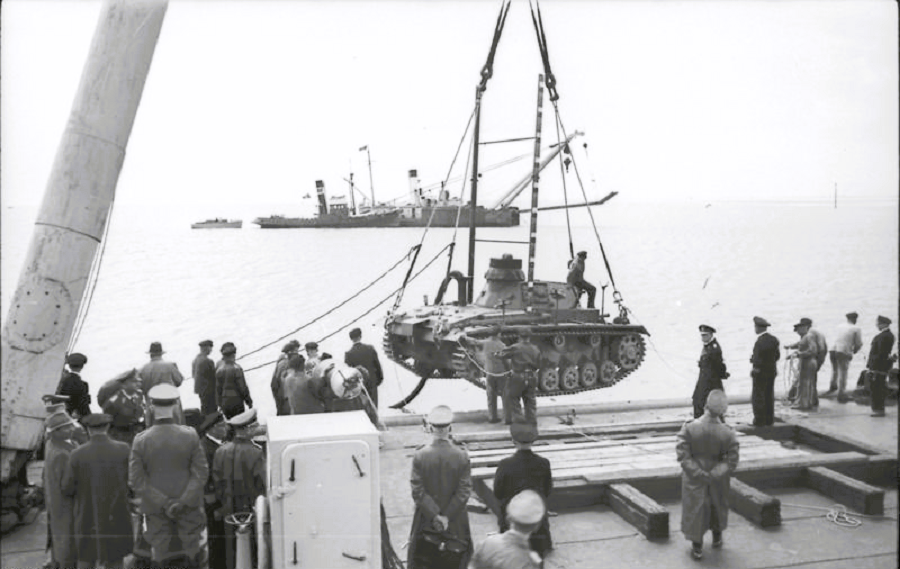
The Royal Navy, the most powerful naval force in the world at the time, posed another major problem. The German Kriegsmarine (navy) was relatively weak compared to the British fleet, and any invasion force would have been vulnerable to British naval attacks. With Britain’s control over the sea lanes, German supply lines would have been severely strained, making prolonged occupation difficult.
The Decision to Abandon the Plan
By mid-September 1940, Hitler recognized that Operation Sealion was infeasible. The Luftwaffe had failed to neutralize the RAF, and the Royal Navy remained a significant threat. Furthermore, Hitler was becoming increasingly preoccupied with his next grand campaign: the invasion of the Soviet Union (Operation Barbarossa), which began in June 1941. Consequently, Operation Sealion was shelved indefinitely, never to be revisited.
The Impact of Operation Sealion’s Failure
The failure of Operation Sealion was a turning point in World War II. Britain’s survival allowed it to remain a base of operations for Allied forces, eventually playing a crucial role in the D-Day landings and the liberation of Europe in 1944. Moreover, Hitler’s shift in focus to the Eastern Front proved to be a strategic blunder, as the prolonged war against the Soviet Union drained German resources and contributed to the eventual downfall of the Third Reich.
Several years ago, I qualified as a Supply Chain Management practitioner. Many people mistakenly believe that supply chain management applies only to manufacturing or the sale of goods, but in reality, it extends far beyond that.
To summarize my analysis of the supply chain aspects related to Operation Sea Lion
1. Lack of Naval Control (Logistics Bottleneck)
- The Kriegsmarine (German Navy) was vastly outmatched by the Royal Navy, making it nearly impossible to safely transport vast quantities of supplies, troops, and equipment across the English Channel.
- The Germans planned to move their forces using barges, but these were slow, vulnerable, and dependent on favorable weather and tides.
2. Insufficient Landing Infrastructure
- Unlike the Allied D-Day landings in 1944, Germany had no access to pre-built landing harbors or proper amphibious assault craft.
- Supplies (fuel, food, ammunition) would have needed to be landed on open beaches, where they could be easily disrupted by British defenses or bad weather.
3. High Demand for Fuel and Transport
- The German invasion force required tons of fuel daily, but their barges were not equipped to handle large-scale refueling at sea.
- The Luftwaffe (German Air Force) needed air superiority to protect supply lines, but after the Battle of Britain, it was clear they couldn’t guarantee it.
4. Food and Ammunition Shortages
- The Wehrmacht (German Army) was estimated to need a daily resupply of 300+ tons of ammunition and several thousand tons of food.
- With an already strained supply chain due to the Battle of France, feeding and supplying an army across the Channel was unrealistic.
5. Rail and Road Networks in Britain
- Even if Germany landed successfully, they lacked a reliable plan to quickly seize and use British rail and road networks.
- British sabotage and counterattacks would have made overland supply movements extremely difficult.
6. Dependence on Weather Conditions
- The Channel’s rough waters, unpredictable weather, and strong tides made logistics even more unreliable.
- Unlike later Allied invasions (which had specialized landing craft and weather forecasting), Germany had no contingency for storms.
7. Overstretching Resources
- Germany was already supplying forces in occupied Europe and preparing for Operation Barbarossa (the invasion of the USSR in 1941).
- Diverting logistics for Sealion would have further strained Germany’s ability to maintain other campaigns.

Operation Green (German: Unternehmen Grün), also referred to as Case Green (Fall Grün) or Plan Green (Plan Grün), was a full-scale invasion plan for Nazi Germany’s potential assault on Ireland. It was devised by an unknown German officer, using the alias ‘Hadel,’ as a supporting operation for Operation Sea Lion (Unternehmen Seelöwe), the planned invasion of the United Kingdom during World War II. Despite its detailed nature, Operation Green is widely believed to have been a strategic feint rather than an actual operation. In response, the British government, in secret coordination with the Irish government, developed Plan W—a contingency plan for British forces to occupy the Irish Free State in case of a German invasion.

Operation Sealion remains one of history’s most famous unrealized military plans. Although it never came to fruition, its planning and subsequent abandonment highlight the complexities of warfare and the importance of strategic foresight. Hitler’s failure to subdue Britain in 1940 not only preserved British resistance but also set the stage for Germany’s eventual defeat. In hindsight, Operation Sealion’s failure was a blessing for the Allied cause, proving that even the most ambitious plans can be thwarted by resilience, strategy, and superior defense.
Sources
https://en.wikipedia.org/wiki/Operation_Sea_Lion#
https://www.usni.org/magazines/proceedings/1950/january/operation-sea-lion
https://www.tandfonline.com/doi/pdf/10.1080/03071847309428710
Donation
Your readership is what makes my site a success, and I am truly passionate about providing you with valuable content. I have been doing this at no cost and will continue to do so. Your voluntary donation of $2 or more, if you are able, would be a significant contribution to the continuation of my work. However, I fully understand if you’re not in a position to do so. Your support, in any form, is greatly appreciated. Thank you. To donate, click on the credit/debit card icon of the card you will use. If you want to donate more than $2, just add a higher number in the box left from the PayPal link. Your generosity is greatly appreciated. Many thanks.
$2.00
 History of Sorts
Leave a comment