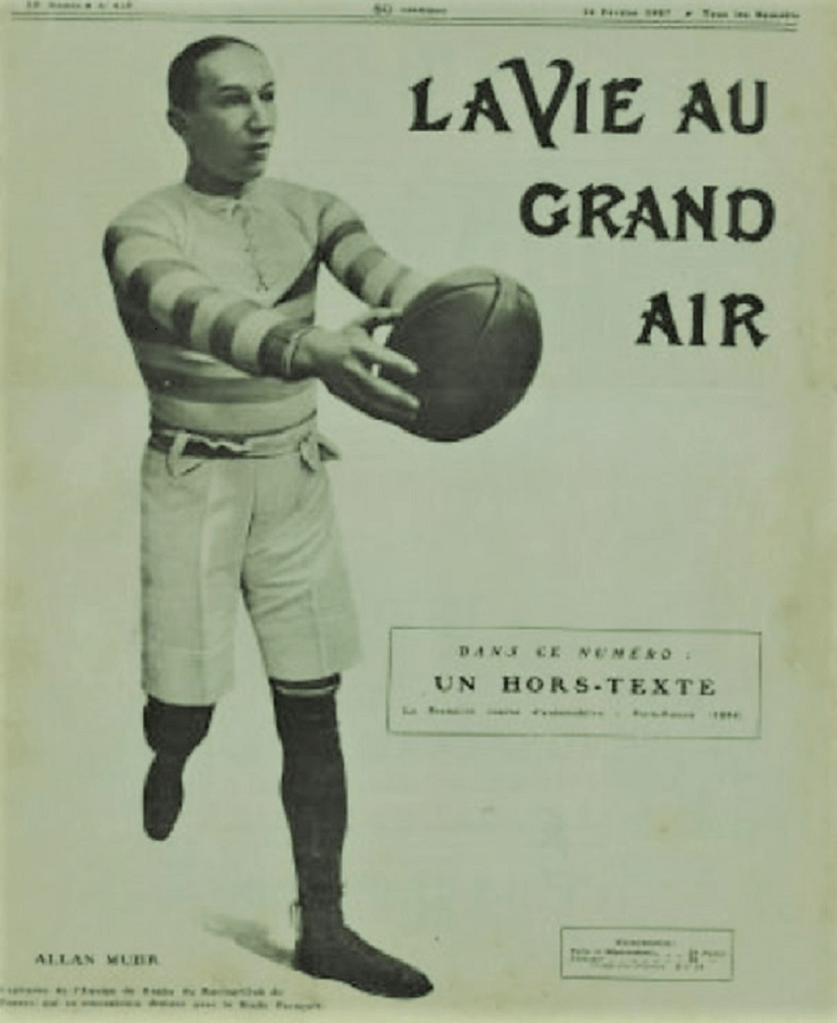
The Six Nations Championship, commonly known as the Six Nations and branded as Guinness Six Nations, is an annual international rugby union competition featuring the teams of England, France, Ireland, Italy, Scotland, and Wales. As the oldest tournament contested by the Home Nations, it holds a distinguished place in the history of the sport. The current champions are Ireland, who triumphed in the 2024 tournament. With the final round of the men’s Six Nations taking place this weekend, it’s a fitting moment to reflect on the life, death and legacy of a rugby legend.
Born into a wealthy Jewish family in Philadelphia in 1882, Allan, having recently come of age, traveled independently to France around the turn of the century. “Allan Muhr planned to dedicate himself entirely to sport in Europe,” explains Frédéric Humbert, a rugby historian and curator of the World Rugby Museum, who has extensively researched Allan Muhr’s life. “He was able to do so because he lived off his family’s wealth and never had to work. As a result, sport became the central focus of his life.”.
Rugby Career
Upon his arrival in Paris, Muhr quickly became involved in rugby, joining the Racing Club de France (RCF), one of the country’s premier sports clubs. His natural talent on the field led to his selection for the French national rugby team. Muhr made his international debut in 1906, participating in France’s first official match against the New Zealand All Blacks at the Parc des Princes. Later that year, he achieved another historic milestone by scoring France’s first-ever try against England, a key moment in French rugby history.
Muhr went on to earn three caps for France, between 1906 and 1907, scoring two tries. His contributions were not limited to playing, however; he also became an accomplished referee. Muhr officiated the French Championship finals in both 1906 and 1907, showcasing his deep understanding of the game. His bilingual abilities, speaking both French and English, and his familiarity with rugby cultures in both countries, were instrumental in France’s eventual admission to the prestigious Home Nations Championship in 1910.

Tennis Involvement
Muhr’s athletic abilities extended beyond rugby. He was also an accomplished tennis player and became deeply involved in the sport’s administration. Muhr competed in the French Championships and played a crucial role in the development of tennis in France. He captained the French Davis Cup team in 1922 and 1923, leading a squad that included the legendary René Lacoste. Muhr was a significant mentor to Lacoste, whose playing style and career were greatly influenced by Muhr’s guidance and support. Lacoste later became one of the sport’s all-time greats and was affectionately nicknamed “the Crocodile.”
World War I Service

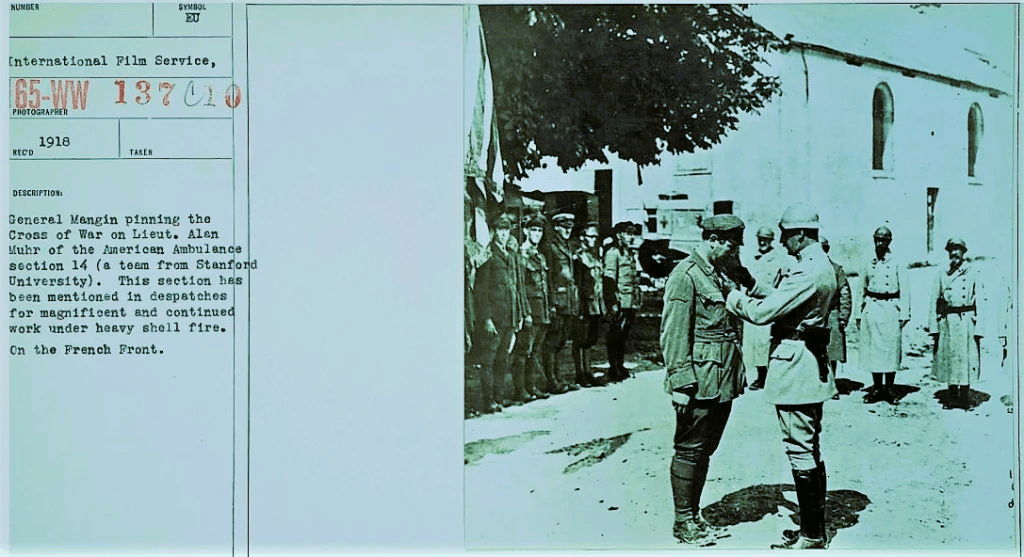
During World War I, Muhr demonstrated his courage and commitment to the war effort by volunteering as an ambulance driver. He risked his life transporting wounded soldiers from the front lines to medical facilities, showing great selflessness. Allan led a voluntary unit of ambulance drivers who transported the wounded soldiers from the front to the American Ambulance Hospital, which had been founded by Americans in Paris when the war broke out. When the USA entered the war in 1917, this organization was integrated into the US Army, and so Allan also became an officer in the American armed forces, where he continued his service, earning a U.S. Army medal for his bravery and dedication to his duties.
Sports Administration and Olympic Contributions
In 1920, Allan retired from his career as an active sportsman to focus on organizing international competitions and developing French teams in both rugby and tennis. He became the vice chairman of Racing Club de France, the first European multi-sport club, and served as the captain of the French Davis Cup tennis team, leading them to international success. Additionally, he managed the rugby department of Racing Club de France, where he was responsible for selecting players for the French national rugby team. When the Olympic Games were hosted in France in 1924, Allan played a pivotal role in organizing the competition and overseeing international negotiations.
Muhr’s organizational skills and vision were key to ensuring the success of the event, cementing his place in the history of the Olympic Games.
World War II and Final Years
When war broke out again in 1939, Muhr resumed his volunteer work with the Red Cross. At 57 years old, he was married to his Belgian wife, Madeleine Braet.
After the United States entered the war in 1941, Muhr went underground to escape the German occupying forces, bringing his son, Philippe, with him. Along with other U.S. citizens and members of the French Resistance, they sought refuge in Sayat, a small village in the Auvergne, where they remained for a year before being captured by the Nazis on November 21, 1943. They were taken to the camp at Compiègne for interrogation. In May 1944, Allan and Philippe were deported to Neuengamme, where Allan was subjected to starvation and died on December 29, 1944. Philippe, however, survived the war.
Legacy
Muhr’s legacy continues to be honored posthumously. In recognition of his extraordinary contributions to sport and his country, he was awarded the Legion of Honor. His memory is preserved through various tributes, including the Challenge Allan Muhr basketball tournament, organized by the Racing Club de France. In 2023, the World Rugby Museum showcased a poignant artifact—a watch that had been confiscated during his internment and later returned to his family. This watch was displayed as part of the “Allez Les Bleus” exhibition, a tribute to his lasting impact on the world of rugby.
Allan Muhr’s life is a testament to passion, resilience, and unwavering dedication. His remarkable contributions to French rugby and tennis, combined with his heroic wartime service, continue to inspire generations. His story serves as a powerful reminder of the profound and lasting impact one individual can have across various fields, even in the face of immense adversity
sources
https://worldrugbymuseum.com/from-the-vaults/players/remembering-allan-muhr
https://en.wikipedia.org/wiki/Allan_Muhr
https://arolsen-archives.org/en/news/a-life-for-sport/
https://www.espn.com/rugby/story/_/id/15339748/remarkable-story-french-rugby-first-hero
Please support us so we can continue our important work.
Donation
Your readership is what makes my site a success, and I am truly passionate about providing you with valuable content. I have been doing this at no cost and will continue to do so. Your voluntary donation of $2 or more, if you are able, would be a significant contribution to the continuation of my work. However, I fully understand if you’re not in a position to do so. Your support, in any form, is greatly appreciated. Thank you. To donate, click on the credit/debit card icon of the card you will use. If you want to donate more than $2, just add a higher number in the box left from the PayPal link. Your generosity is greatly appreciated. Many thanks.
$2.00
 History of Sorts
Leave a comment