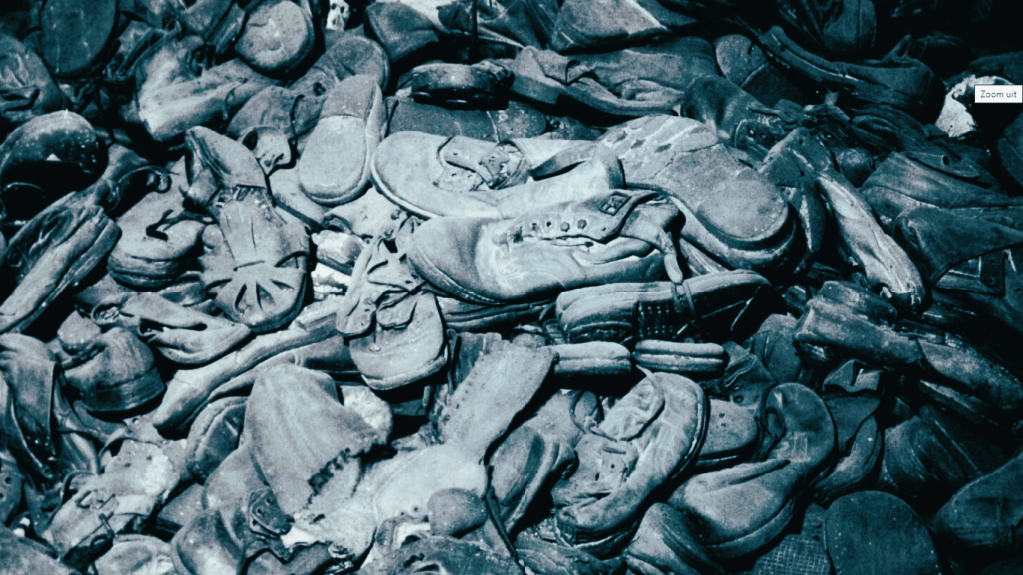
They say a picture is worth a thousand words, and while that may be true, a photograph never tells the whole story. Although photographic evidence of the Holocaust is invaluable, I believe that reading or hearing the firsthand accounts of survivors is just as important—if not more so,
Premysl Dobias was born in June 1913 in the Czech town of Turnov. In September 1938, Germany annexed territory along Czechoslovakia’s northern and western borders. Six months later, German forces occupied the rest of Czechoslovakia, dividing it into two separate territories: Slovakia in the east and the Protectorate of Bohemia and Moravia in the west.
In the winter of 1941, Premysl was arrested for aiding Jews and, in May 1942, was deported to the Terezin transit and labor camp. From there, he was sent to the Mauthausen concentration camp in Austria, where he endured forced labor and medical experimentation. The camp was liberated by American troops in May 1945, after which Premysl worked with them as an interpreter. He later relocated to London in 1947.
Here, Premysl recounts an encounter with Austrian civilians following his deportation and reflects on a particular incident at Mauthausen.

“When we came to the railway station in Linz, before we went, we were taken out, we were cuffed together, two and two. We were taken and lined up on the railway station. I recall vividly that there were mostly women sitting waiting for trains, when one of them came closer and ask one of the armed officers who was guarding us, who we were. And he told her in German, I remember that closely, because I was nearby: ‘Das sind die Feinde unseres Fuhrers’ – these are the enemies of our Fuhrer. The woman then came and spat on us and the others, the other women then star…asked her what happened, she told him them who we were, then about a dozen of them came closer to us and all of them were spitting on us and shouting abuse. The SS told us in German that they needed some prisoners who knew, who were from the farm who knew how to feed pigs, and they would then come every day from the camp direct to that farm to look after the pigs. Obviously everybody wanted to get away from the hard work in the camp and there were – all of them were volunteers. The SS told us he had to have only those who were from a farm and who knew, who spoke German. That eliminated a few Spaniards who were in the group, but we were mostly Czechs, and even some Czechs didn’t know German. So finally the SS guard selected about, oh twenty prisoners, lined them up and I overheard the other one telling him: ‘Du hast zu viele’ – you have too many. So he started to push back a few, he pushed back two Spaniards, then he came to me, he pushed me back, and I was hoping so much to be able to be working on a farm, I was so hungry I hoped that I could actually eat with the pigs. So I came forward and in German, at attention, I told him that I was born on a farm and all I did all my life was feeding pigs – of course it was not true. But he very cruelly kicked me, I still have the mark on my leg, and pushed me back. When he had finally selected about a dozen, I believe dozen to fifteen, he told them: ‘turn right, without step walk to that farm’. And both of them remained behind the group which was marching very happily to the farm. That part of the camp was separated by guards and the guards had machine-guns to guard the outlines of the camp. We were very upset that we were left behind, and looked with envy at those who were marching to that farm. But suddenly we heard machine-gun shooting from two sides and with horror we noticed that all the prisoners who were marching to that farm, crossed the so-called border and were gunned down dead. I could have been one of them. Then the SS turned back, laughingly came back to our Kommando, we again stood at attention and one of them laughingly said ‘who else knows how to feed pigs?’ That is an experience which will haunt me all my life. It’s a tremendous nightmare, nightmare to such an extent, that I could have never believed that a nation, civilized nation, which gave the world musicians, poets, experts in every field of science, how they could have been fooled by a maniac like Hitler is something which I will never understand.”

Magdalena Kusserow and her family were Jehovah’s Witnesses living in Bad Lippespringe, Germany, when Hitler came to power in 1933. In line with their religious beliefs, Jehovah’s Witnesses refused to recognize the authority of the Nazi regime, reject military service, or participate in the war effort. As a result, several thousand were arrested and sent to concentration camps, while an estimated 250 were executed following military tribunals.
Magdalena and her family were among those arrested. After spending six months in a juvenile prison, she was given a choice: sign a declaration renouncing her faith or face further imprisonment. She refused and was returned to prison before being deported to Ravensbrück concentration camp in northern Germany. Magdalena remained there from 1942 until 1945, when she and other prisoners were evacuated as Soviet forces advanced through Germany. They were later discovered and freed by Soviet troops.
Here, Magdalena reflects on how supporting Nazi Germany conflicted with her religious beliefs.
“They told us, they said, my father especially, he teached us, he said ‘Look, Heil Hitler’ means the salvation comes by Hitler, but if we learned by the Bible that the salvation comes from, by Jesus Christ and so my father say you yourself has to choose. I don’t say you must say ‘Heil Hitler’ and you must not say. You have to do like you want it. But he said, he teached us what happened, and he said also by the Bible, the Bible tells us the real Christian will be persecuted. So my father said ‘We have to count’, he said, ‘that one day maybe they will persecute us also and the Bible say some will be killed because of the faith, belief in Christ’ – but I thought it will not be killing, it will not be in our own families, or I never was thinking about it until it came. My brother Wilhelm, it was about one year ago, he got a letter then and he wrote ‘I’m condemned to death, please visit me’ and my mother and I, we went to Munster to the prison – we visit my brother Wilhelm and he was so strong and my mother nearly cried. She said ‘I would like to die for you’ and he said ‘No mother I will make it, I want it’, it was already over – and then he wrote a last letter to us and this makes us more strong. We thought if Wilhelm is so strong in his faith, he will make it, because there’s nothing wrong to believe in the Bible. And before they brought me to concentration camp, in Bielefeld, my other brother Wolfgang, he got then the invitation to go to the milli, to the military, to the war and he visit, it was the last visit. He visit me in Bielefeld and he said ‘Look Magdalena I, I have now the letter to go to the war, but of course I will refuse, I will not go’. And, then this was the last time I saw him. And I reached in concentration camp in February and he was beheaded in March, one month later. But the police, the woman of the wife of this police in Bielefeld, she said ‘Oh crazy, your brother, the Gestapo offered him to, to bring him in the concentration camps and maybe he could save his life, but now for sure they will kill him’ and ok, they killed him later on.”

Jan Imich was just nine years old when the Second World War began. As a Jewish Pole, he was arrested and imprisoned in a series of concentration camps. In one camp, he was forced to work at the crematorium, hauling coal to fuel the furnace.
After the war, Jan was sent to Britain, where his father, a soldier, was stationed. Despite the lasting impact of his experiences, he worked to rebuild his life.
Speaking on Holocaust Memorial Day in 2017, Jan reflected on what sustained him in the years after surviving the camps and shared his hopes and fears for the future.
“As far as I can see from meeting others nowadays, since the exhibition opened, since I met quite a few people, it was a determination to go on, irrespective of what had happened to all of us before. Us, I see the world now; very few lessons have been learned by the, by, by the whole of the, of the world, no matter what religion people are, what nationality. And we now have a rise in anti-Semitism, racism, anti, whatever, everything, anti-everything, and we simply have to make sure that the young people know what happened in those days, and indeed what is happening nowadays, of course. And simply hope against hope, sometimes I feel, that it will stick in their minds and that they will remember. I always tell that the school children, saying that I hope that some of, that most of you will remember what I said and try to bear it in mind in the future.”

Removal of Evidence of Crimes
Załmen Gradowski, a Sonderkommando prisoner, wrote in notes buried near Crematorium III and later discovered after the war:
“Lately, they have begun erasing the traces, ordering that large amounts of ashes be ground fine, taken to the Vistula, and carried away by the current. We have unearthed many graves, but two open graves remain near the second and third crematoria. Several graves are still filled with ash… The remains of hundreds of thousands of Jews, Russians, and Poles are scattered and plowed into the grounds of the crematoria…”
Henryk Mandelbaum, a former Sonderkommando prisoner, testified in March 1947:
“…They set about dismantling the crematoria. First, they ordered us to remove the shingles and rafters, then to dismantle the furnaces… By December 1944, we had bored holes in the walls. They packed these holes with dynamite, sent us all back to the camp, and then blew everything sky-high…”
Abraham Steinhardt, who was assigned to the labor detail responsible for demolishing buildings (Abbruchkommando), stated in a deposition in May 1945:
“By the end of 1944, as Russian forces advanced, the dismantling of the crematorium began. This gave me the chance to see it from the inside… The structure was so solid that we couldn’t tear it down with our bare hands. We were only able to take apart the chimneys and the roof. We prepared the building for demolition by drilling holes in its walls…”
Dov Paisikovic, a former Sonderkommando prisoner, gave the following statement in 1964:
“The SS ordered the dismantling of the crematoria in November 1944. We began by disassembling the furnaces, stacking fire-clay and bricks in neat piles. Initially, we worked on Crematorium I [II] but returned to Crematorium II [III] at night, where it was still operating, burning corpses from the camp. Once the furnaces were removed, we started demolishing the chimneys of both crematoria. Additional prisoners from other labor details were brought in to assist. The metal furnace parts were transported to the railway platform and loaded onto cars—supposedly destined for the Gross-Rosen concentration camp… We continued this work until January 18, 1945.”
sources
https://www.auschwitz.org/en/liberation-of-kl-auschwitz75/witnesses-accounts75/
https://www.iwm.org.uk/history/concentration-camp-survivors-share-their-stories
Please support us so we can continue our important work.
Donation
Your readership is what makes my site a success, and I am truly passionate about providing you with valuable content. I have been doing this at no cost and will continue to do so. Your voluntary donation of $2 or more, if you are able, would be a significant contribution to the continuation of my work. However, I fully understand if you’re not in a position to do so. Your support, in any form, is greatly appreciated. Thank you. To donate, click on the credit/debit card icon of the card you will use. If you want to donate more than $2, just add a higher number in the box left from the PayPal link. Your generosity is greatly appreciated. Many thanks.
$2.00
 History of Sorts
Leave a comment