
Introduction
Bełżec concentration camp was one of the deadliest Nazi extermination camps established during the Holocaust. Located in occupied Poland, Bełżec was part of Operation Reinhard—the Nazi plan to murder Polish Jews systematically. Though lesser-known compared to Auschwitz and Treblinka, Bełżec played a significant role in the genocide, resulting in the deaths of approximately 500,000 Jews within less than a year of operation.
Establishment and Purpose
The construction of Bełżec began in November 1941, and it became operational in March 1942. The camp was designed purely for extermination, with no significant forced labor facilities. Unlike concentration camps that held prisoners for extended periods, Bełżec was built explicitly for the rapid and systematic murder of Jews and other targeted groups. It was strategically located near railway lines to facilitate the mass transportation of victims.
Operational Structure
Bełżec was divided into two primary sections: the reception area and the extermination area. Upon arrival, prisoners were forced to undress and surrender their belongings before being led to the gas chambers. Unlike Auschwitz, which used Zyklon B, Bełżec employed carbon monoxide poisoning through stationary gas chambers. Victims, primarily Jews from Poland, Austria, Germany, and Czechoslovakia, were killed within minutes of exposure.
The camp was operated by a small contingent of German SS officers and Ukrainian guards recruited from Soviet prisoners of war. The limited number of staff, estimated at around 30 SS officers and 120 Ukrainian guards, was sufficient to oversee the mass executions due to the camp’s high-efficiency extermination system.
The Extermination Process
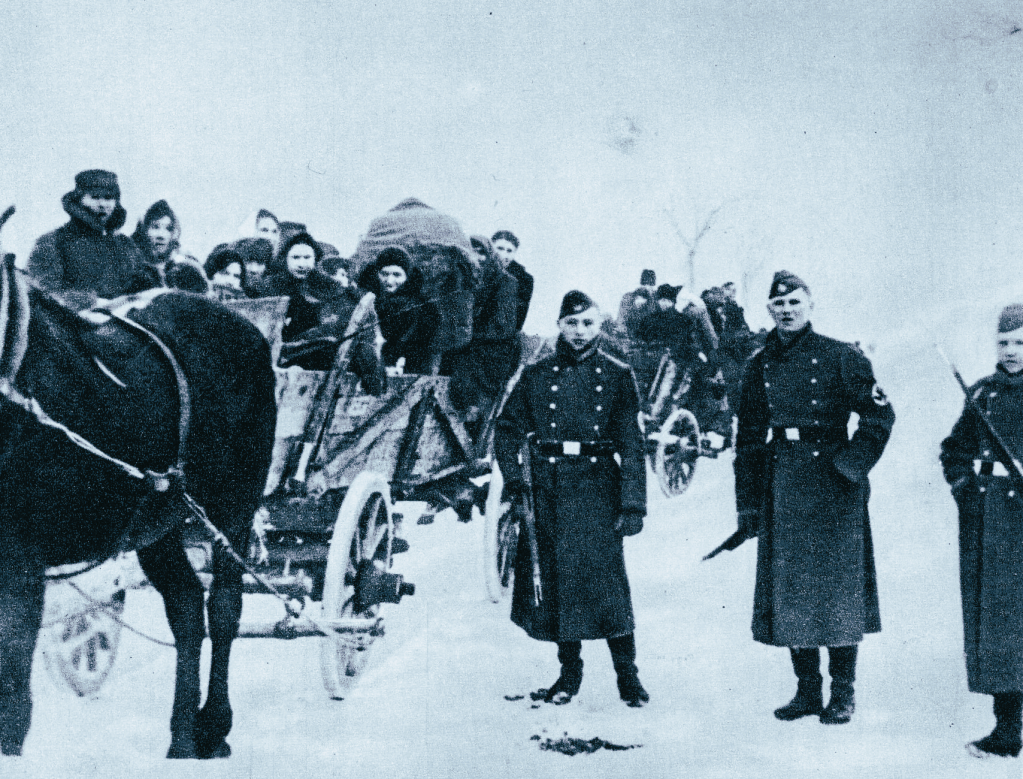
Deportations to Bełżec began on 17 March 1942, with victims transported in overcrowded freight trains. Upon arrival, deceptive measures were used to prevent panic; victims were told they were at a transit camp for resettlement. After being separated by gender, they were quickly sent to the gas chambers under the pretense of taking a shower. Within ten minutes, entire groups of victims were murdered, and their bodies were initially buried in mass graves before being later exhumed and cremated to erase evidence of the crimes. Bełżec was the first place where stationary gas chambers were used to kill the Jewish people.
Resistance and Escape
Unlike other Nazi camps, Bełżec saw minimal resistance due to the swift extermination process. However, some prisoners assigned to work within the camp, such as those responsible for disposing of bodies, attempted to resist or escape. A small number of survivors managed to flee and later provided testimonies about the atrocities committed at Bełżec.
It is estimated that around 50 Jewish prisoners may have escaped from Bełżec, with only seven surviving until the end of the war. An unknown number attempted to flee by jumping from moving Holocaust trains en route to the camp, risking their lives in the process. The railway embankments were often strewn with the bodies of those who perished in their desperate attempts to escape.
Liquidation of the Camp
By the end of 1942, the Nazis had primarily completed their objectives at Bełżec. By December 1942, deportations had ended due to the decimation of the Jewish population in the targeted regions. The camp was subsequently dismantled, with mass graves exhumed, bodies burned, and all structures destroyed to eliminate evidence. By mid-1943, the Nazis planted trees over the site, hoping to erase all traces of the extermination facility.
Post-War Recognition and Legacy
Bełżec remained relatively obscure compared to Auschwitz and Treblinka due to the almost total extermination of its victims, leaving few survivors to bear witness. It was not until decades later that comprehensive research and memorial efforts began. In 2004, a memorial and museum were established at the site to commemorate the victims.

Bełżec concentration camp stands as a grim reminder of the efficiency and brutality of the Nazi genocide. Though it operated for less than a year, it accounted for the deaths of half a million people, demonstrating the industrial-scale killing methods employed by the Third Reich. Today, remembering Bełżec is crucial in ensuring that such atrocities are never forgotten and history does not repeat itself.
Sources
https://en.wikipedia.org/wiki/Belzec_extermination_camp
https://www.belzec.eu/en/history/camp_history/2
https://encyclopedia.ushmm.org/content/en/article/belzec
https://www.jewishgen.org/forgottencamps/camps/belzeceng.html
Please support us so we can continue our important work.
Donation
Your readership is what makes my site a success, and I am truly passionate about providing you with valuable content. I have been doing this at no cost and will continue to do so. Your voluntary donation of $2 or more, if you are able, would be a significant contribution to the continuation of my work. However, I fully understand if you’re not in a position to do so. Your support, in any form, is greatly appreciated. Thank you. To donate, click on the credit/debit card icon of the card you will use. If you want to donate more than $2, just add a higher number in the box left from the PayPal link. Your generosity is greatly appreciated. Many thanks.
$2.00


 History of Sorts
Leave a comment