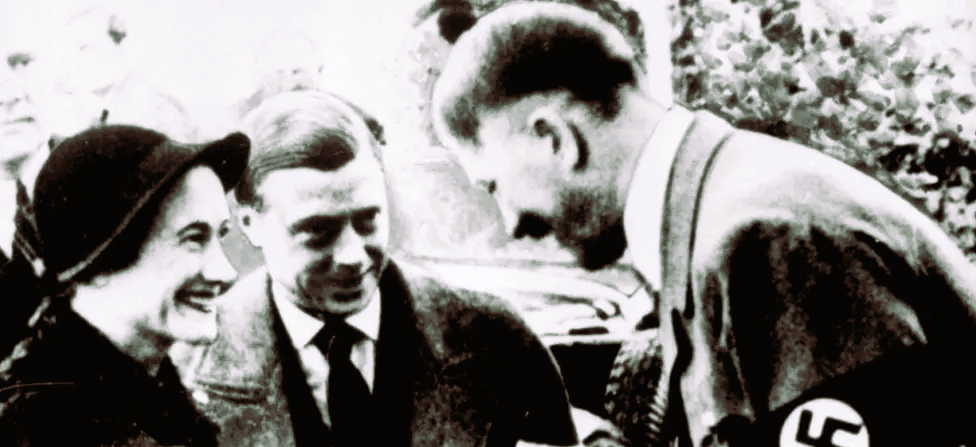
Throughout the 1930s and early 1940s, a number of British aristocrats harbored sympathies for Adolf Hitler and his Nazi regime. While some saw Hitler as a bulwark against communism, others were drawn to his authoritarian rule and nationalist ideology. This essay explores key figures within the British aristocracy who expressed support for Hitler, their motivations, and the consequences of their affiliations.
1. The Duke of Windsor
Perhaps the most well-known British aristocrat with Nazi sympathies was the Duke of Windsor, formerly King Edward VIII. After abdicating the throne in 1936 to marry Wallis Simpson, Edward maintained connections with high-ranking Nazi officials. He and Simpson visited Germany in 1937, where they met Hitler personally. Reports suggest that Hitler viewed Edward as a potential ally who might facilitate British-German rapprochement. Some historians even speculate that Nazi plans, such as Operation Willi, aimed to reinstate Edward as a puppet king should Britain fall to Germany.
2. Lord Rothermere
Harold Harmsworth, 1st Viscount Rothermere, was a newspaper magnate and owner of the Daily Mail. Rothermere was a vocal supporter of Hitler in the early 1930s, praising him as a strong leader who could restore Germany’s power while resisting Bolshevism. His newspaper ran articles sympathetic to the Nazis and even used headlines such as “Hurrah for the Blackshirts!” in support of Oswald Mosley’s British Union of Fascists. However, by the late 1930s, as Nazi aggression intensified, Rothermere distanced himself from Hitler.
3. Lady Diana Mosley
A more recognizable homegrown fascist today is Oswald Mosley, leader of the British Union of Fascists. A sixth Baronet, Mosley’s aristocratic lineage traced back to Ernald de Mosley of Bushbury in the 12th century. His first wedding—a grand affair with Lady Cynthia Curzon in 1920—was attended by the King and Queen, underscoring the deep connections between the young aristocrat and Britain’s elite.

His second wife, Lady Diana Mitford, was the daughter of a Baron and a fervent fascist. Diana and her sister, Unity Valkyrie Mitford, were part of the British delegation at the 1933 Nuremberg Rally. Unity, described as “more Nazi than the Nazis,” stood alongside Hitler on the Hofburg balcony during the Anschluss. She is said to have discussed plans for redecorating a Munich apartment gifted to her by Hitler—while its displaced Jewish owners sat inside, weeping.
4. Unity Mitford

Unity Mitford, Diana’s sister, was one of the most fervent British admirers of Hitler. She moved to Germany in the mid-1930s and ingratiated herself with leading Nazis, eventually forming a close personal relationship with Hitler. She viewed him as a savior of Western civilization and an antidote to what she saw as the dangers of communism and Jewish influence. However, when Britain declared war on Germany in 1939, Unity attempted suicide in Munich, surviving but suffering severe brain damage.
Motivations Behind Support for Hitler
Several factors contributed to the pro-Nazi sentiments among these aristocrats. First, many of them feared communism and saw Hitler as a necessary force to prevent a Bolshevik-style revolution in Britain. Second, the Nazis’ emphasis on hierarchy, nationalism, and authoritarianism resonated with some members of the British upper class. Lastly, diplomatic and economic considerations played a role—some believed a strong Germany would stabilize Europe and prevent another world war.
Queen Elizabeth II’s husband, Prince Philip, had four sisters who were deeply connected to Nazi Germany, with some playing roles as intermediaries between the Nazi Party and the German aristocracy. For instance, Cecilie was a member of the Nazi Party, Sophie named her son after Hitler, and Margarita’s husband was a German army commander. Notably, when Cecilie died in a 1937 air crash, Prince Philip attended her funeral and was photographed alongside Nazi soldiers in uniform.
Consequences and Legacy
The outbreak of World War II exposed the dangers of Nazi sympathy. Figures like the Duke of Windsor, the Mosleys, and Unity Mitford faced reputational damage, with some suffering direct consequences such as internment. In post-war Britain, open support for Hitler became a social and political liability, and these aristocrats were largely marginalized in public life.
Lessons not learned

In 2005, a 20-year-old Prince Harry caused a public uproar when he attended a costume party wearing a Nazi uniform. The incident drew widespread condemnation, and Harry quickly issued an apology. “I am very sorry if I caused any offense or embarrassment to anyone. It was a poor choice of costume and I apologize,” he said in a statement from Clarence House.
At the time, Rabbi Jonathan Romain, a spokesman for the Reform Synagogues of Great Britain, remarked, “The fact that the palace issued an apology shows this was a mistake by the prince. But now that the apology has been given, it should be accepted.”
In the third episode of Harry & Meghan, the docuseries about him and Meghan Markle, Harry opened up about the incident. “It was probably one of the biggest mistakes of my life,” he confessed. “I felt so ashamed afterwards.
Sources
https://www.bbc.com/news/uk-england-35765793
https://www.bbc.com/news/uk-england-35765793
Please support us so we can continue our important work.
Donation
Your readership is what makes my site a success, and I am truly passionate about providing you with valuable content. I have been doing this at no cost and will continue to do so. Your voluntary donation of $2 or more, if you are able, would be a significant contribution to the continuation of my work. However, I fully understand if you’re not in a position to do so. Your support, in any form, is greatly appreciated. Thank you. To donate, click on the credit/debit card icon of the card you will use. If you want to donate more than $2, just add a higher number in the box left from the PayPal link. Your generosity is greatly appreciated. Many thanks.
$2.00

 History of Sorts
Leave a comment