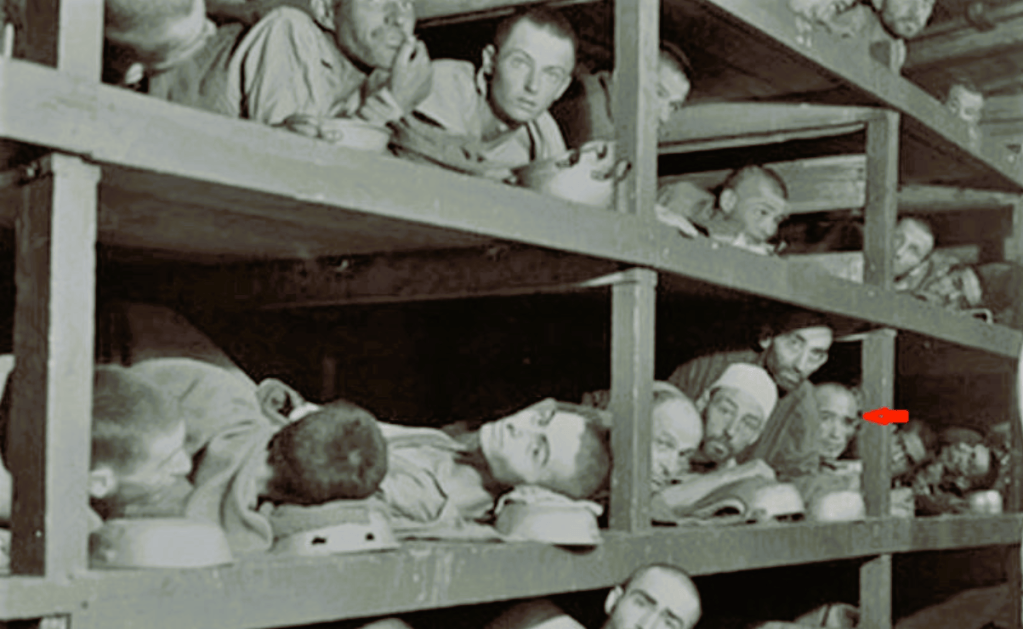
Buchenwald was one of the largest concentration camps established by the Nazis, located near Weimar, Germany. It was operational from 1937 until its liberation on April 11, 1945, by American forces.
When the American soldiers arrived at Buchenwald, they were shocked by the appalling conditions they encountered. The camp was overcrowded, with thousands of emaciated prisoners subjected to forced labor, starvation, disease, and brutal treatment by the SS guards. Many inmates were on the brink of death, and mass graves dotted the landscape.
The liberation of Buchenwald was a moment of both relief and horror. For the survivors, it meant freedom from the daily torment and the hope of rebuilding their lives. However, it also revealed the extent of Nazi atrocities to the world. The images and testimonies from Buchenwald played a crucial role in documenting the Holocaust and holding perpetrators accountable for their crimes.

As American forces closed in on the Nazi concentration camp at Buchenwald, Gestapo headquarters at Weimar telephoned the camp administration to announce that it was sending explosives to blow up any evidence of the camp–including its inmates. What the Gestapo did not know was that the camp administrators had already fled in fear of the Allies. A prisoner answered the phone and informed headquarters that explosives would not be needed, as the camp had already been blown up, which, of course, was not true.
Among the camp’s most gruesome characters was Ilse Koch, wife of the camp commandant, who was infamous for her sadism.
Witnesses claimed “she wore clothes which were deliberately chosen to be inciting for the prisoners”,. They accused her of whipping prisoners for daring to look at her and of having “a desire to own certain objects made of human skin”, such as lampshades, a cover for a family photo album, and gloves.
Various objects made from human skin were found in Buchenwald when it was liberated. Despite the testimony of former prisoners who were forced to make such grisly objects, prosecutors could not conclusively prove her involvement in committing such crimes.
On April 11,1945, around 2:30 pm the tanks of the Fourth Armoured Division rolled through the SS complex without stopping. The SS fled. Armed inmates took control of the camp and overpowered the last remaining SS soldiers. By 4:00 pm they had taken control of the camp. Buchenwald was freed from within and without. About one hour later, scouts from the Fourth and Sixth Armoured Divisions were the first American soldiers to reach the camp. 21,000 inmates were liberated on that day, among them some 900 children and youth.
In the aftermath of liberation, efforts were made to provide medical care, food, and support to the survivors.

Many displaced persons would face a long road to physical and psychological recovery. The liberation of Buchenwald stands as a reminder of the horrors of genocide and the importance of never forgetting the lessons of history.
Among those saved by the Americans was Elie Wiesel, seen in the photo at the top of the blog-seen in the second row, seventh from left-who went on to win the Nobel Peace Prize in 1986. His mother and the youngest of his three sisters were murdered in Auschwitz, while he and his father were moved to Buchenwald where his father died of starvation and dysentery just months before it was liberated by Allied troops. Seventeen-year-old Elie was barely alive when American soldiers opened the camp.
I’ll finish with some of Elie Wiesel’s quotes:
“The opposite of love is not hate, it’s indifference.”
“For the dead and the living, we must bear witness.”
“To forget the dead would be akin to killing them a second time.”
“We must take sides. Neutrality helps the oppressor, never the victim. Silence encourages the tormentor, never the tormented.”
“There may be times when we are powerless to prevent injustice, but there must never be a time when we fail to protest.”
Sources
https://collections.ushmm.org/search/catalog/pa1175448
https://www.history.com/this-day-in-history/the-u-s-army-liberates-buchenwald-concentration-camp
https://www.britannica.com/biography/Ilse-Koch
Please support us so we can continue our important work.
Donation
Your readership is what makes my site a success, and I am truly passionate about providing you with valuable content. I have been doing this at no cost and will continue to do so. Your voluntary donation of $2 or more, if you are able, would be a significant contribution to the continuation of my work. However, I fully understand if you’re not in a position to do so. Your support, in any form, is greatly appreciated. Thank you. To donate, click on the credit/debit card icon of the card you will use. If you want to donate more than $2, just add a higher number in the box left from the PayPal link. Your generosity is greatly appreciated. Many thanks.
$2.00
 History of Sorts
Leave a comment