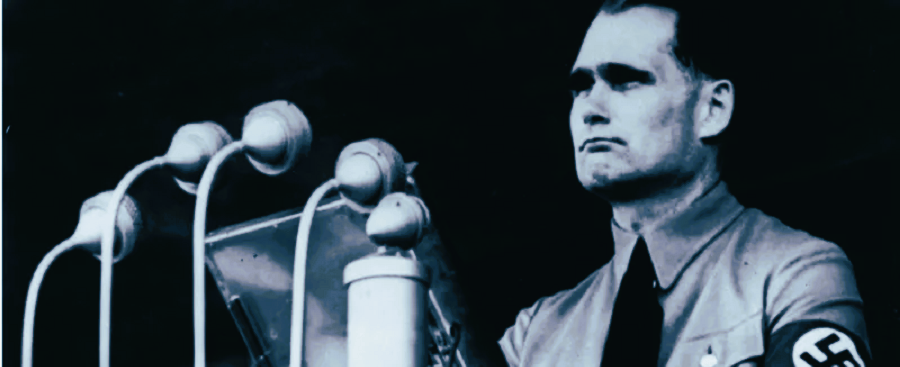
The title of this blog is a quote by Groucho Marx—I chose it because I felt it best captured the absurdity of Rudolf Hess and his misguided attempt to convince the Allies to ally with the Nazis.
Rudolf Hess’s dramatic solo flight to Scotland in May 1941 is one of the most bizarre and enigmatic episodes of World War II. Hess, Adolf Hitler’s Deputy Führer and one of the most senior figures in the Nazi regime, unexpectedly flew a Messerschmitt Bf 110 fighter plane across enemy lines and parachuted into Scotland in an unauthorized mission to broker peace between Nazi Germany and the United Kingdom. The episode, which stunned both the Axis and Allied powers, reflected the complex web of personal ambition, ideological delusion, and desperation that characterized the Nazi leadership during a pivotal phase of the war.
At the time of Hess’s flight, World War II was entering a critical juncture. Nazi Germany had conquered much of Western Europe, but Britain, under the leadership of Prime Minister Winston Churchill, remained defiant. The Blitz had failed to break British morale, and the threat of a German invasion had receded. Behind the scenes, however, Hess became increasingly convinced that a peace agreement with Britain was both possible and necessary. He feared that a prolonged war on multiple fronts would be disastrous for Germany, particularly with Hitler planning an invasion of the Soviet Union—Operation Barbarossa—just weeks away.

Hess believed that elements within the British aristocracy and political elite—particularly the so-called “peace party”—were willing to negotiate with Germany, mainly to halt the advance of Bolshevism. He fixated on the Duke of Hamilton, a Scottish nobleman and Royal Air Force officer, whom Hess mistakenly believed influenced British policy and might help initiate peace talks. On May 10, 1941, acting entirely independently, Hess flew from Augsburg, Germany, to Scotland, ditching his plane and parachuting near Eaglesham, south of Glasgow. He was promptly captured by a local farmer and handed over to British authorities.
The British government, utterly perplexed, initially believed the mission might be a trap or a prelude to invasion. Churchill treated Hess’s arrival with a mixture of suspicion and contempt, refusing to engage with him seriously. The idea of negotiating peace with Hitler—especially after the devastating bombings of London and other cities—was politically untenable and morally repugnant. Hess was imprisoned, first in the Tower of London and later in other secure facilities, as a prisoner of war and an apparent madman.
Meanwhile, Hitler was reportedly furious and humiliated by Hess’s unauthorized mission. The Nazi regime quickly disavowed him, labeling Hess mentally ill and removing all mention of him from official propaganda. Within the Nazi hierarchy, Hess’s act was interpreted not only as a betrayal but also as a dangerous embarrassment that could undermine Hitler’s credibility, especially in the midst of preparations for war with the Soviet Union.
Historians continue to debate Hess’s true motivations and mental state. Some view his mission as the act of a deluded idealist who saw himself as a peacemaker and misunderstood the political realities of the time. Others interpret it as a sign of internal dissent and psychological instability within the upper echelons of the Nazi regime. There is little evidence to support the notion that his mission had any official backing, though conspiracy theories have long swirled around the event.
After the war, Hess was tried at Nuremberg and sentenced to life imprisonment for crimes against peace and other war crimes. He spent the rest of his life in solitary confinement in Spandau Prison, where he died in 1987 under suspicious circumstances, officially ruled a suicide.
In retrospect, Rudolf Hess’s flight to Scotland is a historical curiosity that offers a window into the delusions and internal tensions of the Nazi leadership. It also underscores the unwavering resolve of the British government to resist fascist overtures, regardless of the overtures’ source or presentation. More than anything, it is a stark reminder of how personal ambition, ideological fanaticism, and desperation can collide in moments of world-shaking consequence.
Sources
https://www.bbc.com/news/uk-scotland-56908183
Donation
Your readership is what makes my site a success, and I am truly passionate about providing you with valuable content. I have been doing this at no cost and will continue to do so. Your voluntary donation of $2 or more, if you are able, would be a significant contribution to the continuation of my work. However, I fully understand if you’re not in a position to do so. Your support, in any form, is greatly appreciated. Thank you. To donate, click on the credit/debit card icon of the card you will use. If you want to donate more than $2, just add a higher number in the box left from the PayPal link. Your generosity is greatly appreciated. Many thanks.
$2.00
 History of Sorts
Leave a comment