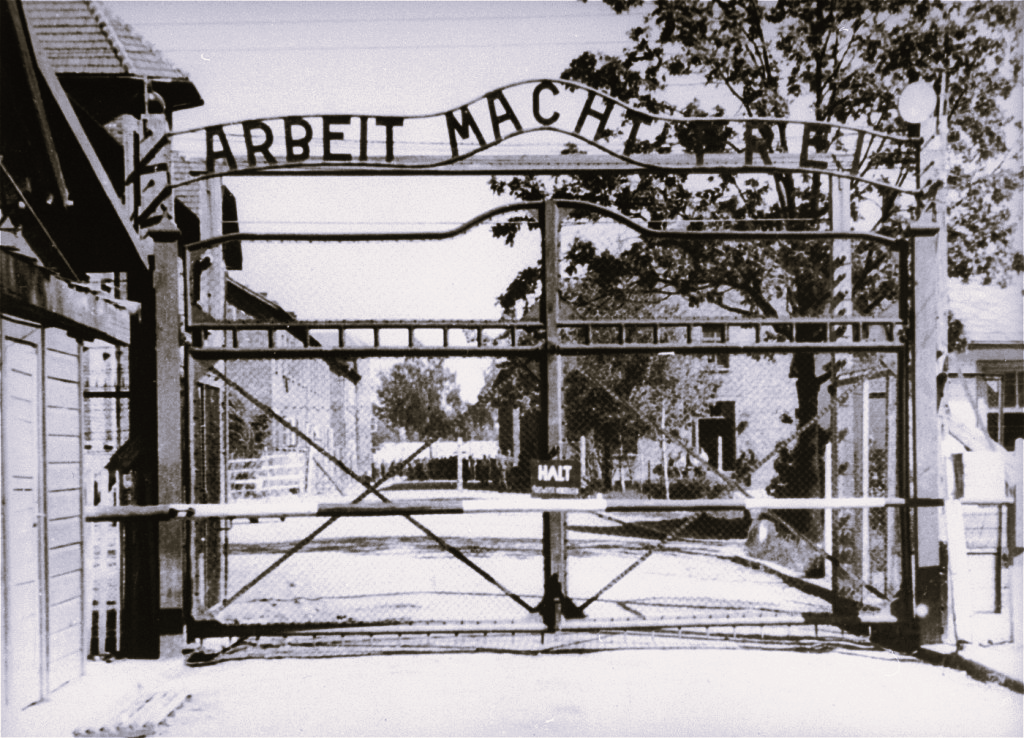
On May 20, 1940, the first group of prisoners arrived at Auschwitz: approximately 30 German inmates classified by the SS as “professional criminals.” They had been selected from the Sachsenhausen concentration camp near Berlin. Less than a month later, on June 14, 728 Polish prisoners were deported by German authorities from a prison in Tarnów, in occupied Poland, to Auschwitz. It marked the beginning of a series of mass transports of Polish inmates to the camp.
The Background of Auschwitz’s Establishment
Auschwitz was established by the Nazi regime in occupied Poland as part of a broader strategy to suppress resistance and consolidate control over the region. The location near the town of Oświęcim was chosen for its strategic advantages—its proximity to railway lines and relative isolation. Initially, Auschwitz was not designed as a death camp; it was intended to be one of the many facilities used to imprison political opponents of the regime.
In early 1940, the Nazis converted a former Polish army barracks into the first camp, Auschwitz I. On June 14, 1940, the first transport of prisoners arrived—728 Polish men from the city of Tarnów. These men were primarily members of the Polish intelligentsia, political activists, members of the resistance, Catholic priests, and others deemed enemies of the Nazi state. Their arrival marked the grim beginning of Auschwitz’s role in the Nazi concentration camp system.
The First Prisoners: Who Were They?
The majority of the first prisoners were Polish political prisoners. Some had been arrested for resistance activities, while others were rounded up in mass arrests designed to intimidate and decapitate potential opposition.

The selection of these individuals reflects the Nazi strategy of targeting the leadership and intellectual class of occupied countries, especially in Poland, where the goal was cultural and political annihilation.
Among the first transport was prisoner number 31, Tadeusz Wiejowski, who would later become the first escapee from Auschwitz. Each prisoner was stripped of their name and given a number, beginning a dehumanizing process that would become standard in Nazi camps.
Life and Conditions in the Early Days
The first prisoners faced brutal conditions. They were subjected to forced labor, meager rations, harsh punishments, and constant humiliation. Many died from exhaustion, disease, or outright execution. The camp’s first commandant, Rudolf Höss, implemented a regime of terror and order that would later be scaled up in service of genocide.
Initially, the primary goal was not mass extermination but repression and exploitation. However, even in this early stage, the seeds of Auschwitz’s later role in the Holocaust were sown. The infrastructure, policies, and administrative practices developed for political prisoners would later facilitate the mass murder of Jews and other targeted groups.
The Evolution Toward Genocide
The first Polish prisoners played a crucial, if tragic, role in shaping Auschwitz. They were the first to experience the camp’s brutality and to build much of its infrastructure. By late 1941 and into 1942, Auschwitz expanded to include Auschwitz II (Birkenau), which was designed specifically for mass extermination, primarily of Jews deported from across Europe.
The early Polish prisoners were eventually joined by Jews, Roma, Soviet POWs, and others. Auschwitz evolved from a concentration camp for political repression into the largest and most lethal death camp in the Nazi system. Over 1.1 million people would be murdered there, the vast majority of them Jews.
Legacy and Memory
The story of the first prisoners is sometimes overshadowed by the sheer scale of the Holocaust that followed, but it remains a vital part of Auschwitz’s history. Their suffering, resistance, and resilience set the tone for what Auschwitz would become. Survivors of these early days, such as Witold Pilecki—who volunteered to be imprisoned at Auschwitz to gather intelligence—left behind powerful testimonies of courage and sacrifice.
In remembering the first prisoners of Auschwitz, we acknowledge not only the origins of the camp system but also the broader objectives of Nazi oppression in occupied territories. Their experience reminds us that Auschwitz did not begin as a death camp, but it became one because a system of dehumanization and violence was allowed to evolve unchecked.
Sources
https://www.auschwitz.org/en/history/categories-of-prisoners/poles-in-auschwitz/
https://encyclopedia.ushmm.org/content/en/article/auschwitz-key-dates
Please support us so we can continue our important work.
Donation
Your readership is what makes my site a success, and I am truly passionate about providing you with valuable content. I have been doing this at no cost and will continue to do so. Your voluntary donation of $2 or more, if you are able, would be a significant contribution to the continuation of my work. However, I fully understand if you’re not in a position to do so. Your support, in any form, is greatly appreciated. Thank you. To donate, click on the credit/debit card icon of the card you will use. If you want to donate more than $2, just add a higher number in the box left from the PayPal link. Your generosity is greatly appreciated. Many thanks.
$2.00

 History of Sorts
Leave a comment