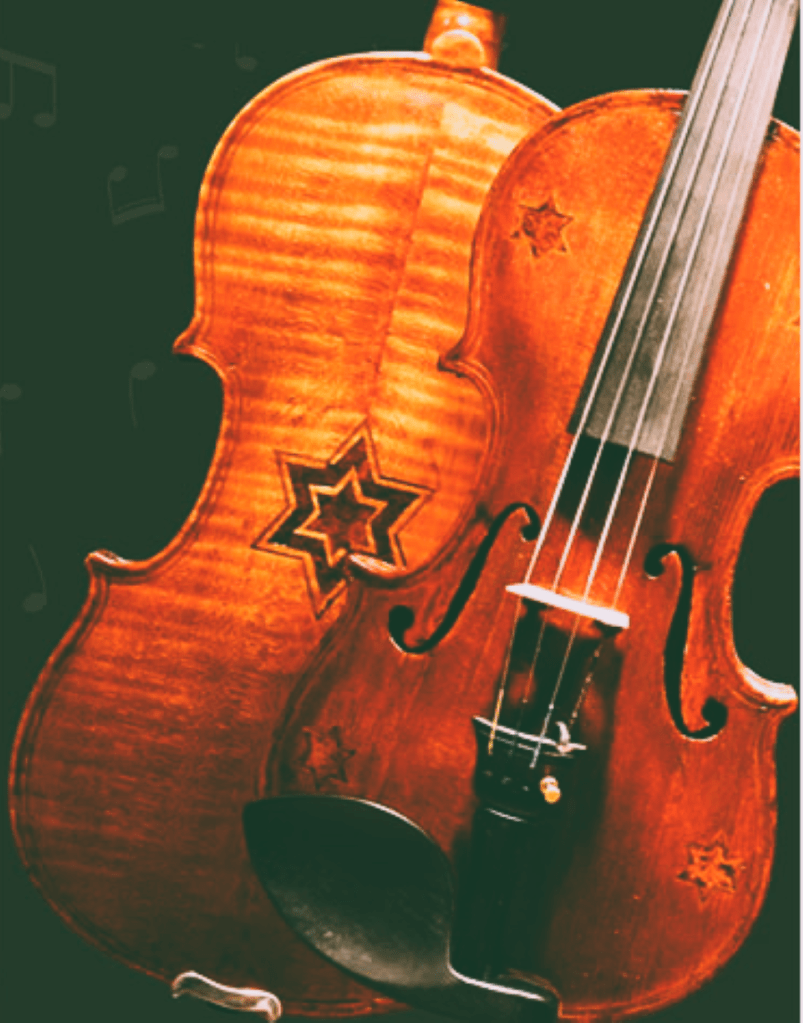
Amid the unimaginable suffering endured by European Jewry under Nazi rule, music emerged as a profound means of resistance, remembrance, and resilience. In the ghettos and concentration camps, music gave expression to a humanity that could not be extinguished. It provided a spiritual escape, a voice for longing and defiance, and a source of collective comfort and hope.
Music in the Ghettos: A Testament to the Human Spirit
Despite extreme deprivation, Jews continued to sing, play, and even dance—sometimes in private gatherings, sometimes in public spaces. Street singers roamed the ghettos of Łódź, Warsaw, and Kraków, echoing the emotional landscape of the imprisoned communities. One such figure, Yankele Hershkowitz (1910–1970), became a well-known street performer in the Łódź ghetto, his songs resonating deeply with its residents.
Though professional performances were often censored and tightly controlled by the Nazi authorities, music remained a rare domain of relative freedom. In Warsaw, Adam Furmanski (1883–1943) organized small orchestras in cafés and soup kitchens. A full symphony orchestra performed in the ghetto until April 1942, when German works were officially banned. In Łódź, Chaim Rumkowski, head of the Jewish Council, supervised extensive musical activities, transforming the community center into a vibrant venue for revues, orchestras, and choral societies. Kraków featured chamber and liturgical music, while the Vilna ghetto supported an exceptional musical life with orchestras, choirs, a conservatory with 100 students, and a popular revue theater.
Songs of the Ghettos: Voices That Endure
Ghetto songs were both old and new—some were traditional melodies with rewritten lyrics, others entirely original compositions. One of the first postwar anthologies, Lider fun di getos un lagern (“Songs of Ghettos and Camps”), was published in 1948 by Vilna poet, teacher, and partisan Shmerke Kaczerginski (1908–1954). This invaluable collection preserved 236 Yiddish lyrics and 100 melodies. Still, many songs were never recorded and have been lost forever.
Among the most enduring songs are four from the Vilna ghetto:
- “Zog nit keynmol” (“Never Say”), known as The Partisan Hymn, lyrics by Hirsh Glik (1922–1944), set to a melody by Russian composer Dmitri Pokrass.
- “Shtiler, shtiler” (“Quiet, Quiet”), with lyrics by Kaczerginski and music by Aleksander Volkoviski-Tamir, who was just 11 years old at the time.
- “Friling” (“Spring”), lyrics by Kaczerginski, music by Abraham Brodno.
- “Shotns” (“Shadows”), lyrics by Leyb Rozental, sung to a popular tango melody.
These songs later found life on the stage in Yehoshua Sobol’s acclaimed play Ghetto, and they continue to be performed at Holocaust remembrance events worldwide, often in Hebrew or English translation.
Music in the Camps: A Soundtrack of Resistance and Sorrow
Music was also present in the concentration camps—sometimes as a tool of survival, sometimes as an instrument of Nazi cruelty. In Terezín (Theresienstadt), a unique community of imprisoned Jewish artists created an astonishing body of music under harrowing conditions. Composer Viktor Ullmann (1898–1944) wrote sonatas, songs, and the opera Der Kaiser von Atlantis (“The Emperor of Atlantis”), which was rehearsed but never performed before he was deported to Auschwitz and killed. Other Terezín composers included Gideon Klein, Ilse Weber, and Hans Krása, whose children’s opera Brundibár became a symbol of defiance.
Elsewhere, the Nazis forced prisoners to form orchestras in camps like Auschwitz, Treblinka, Majdanek, Bełżec, and Sobibór. These ensembles were made to play as prisoners arrived, marched to forced labor, or were sent to their deaths. Auschwitz had as many as six orchestras, including a 50-member male orchestra and a women’s ensemble led by singer Fania Fénelon.
Preservation and Legacy
Efforts to preserve Holocaust-era music began immediately after the war. In addition to Kaczerginski’s work, early collections were compiled by Yehudah Eisman (Bucharest, 1945) and Zami Feder (Bergen-Belsen, 1946). Kaczerginski also recorded survivors in displaced persons camps, gathering approximately 60 songs now housed at Yad Vashem.
New works continued to be composed in memory of those lost. Henekh Kon’s Kdoyshim (“Martyrs”) set poems by murdered Yiddish poets to music. Later, composers like Arnold Schoenberg (A Survivor from Warsaw, 1947), Krzysztof Penderecki (Dies Irae), Dmitri Shostakovich (Symphony No. 13 – Babi Yar), and Charles Davidson (I Never Saw Another Butterfly) added their voices to the artistic remembrance of the Holocaust.
A Legacy that Lives On
The music of the ghettos and camps endures not only in archives and performances but in the hearts of those who remember. Songs like Zog nit keynmol have become unofficial anthems of Holocaust remembrance, reminding us of the power of music to preserve dignity, express resistance, and bear witness.
Even today, composers in Israel, the United States, and around the world continue to create music inspired by the Holocaust—ensuring that these voices of sorrow, courage, and hope are never silenced.
Brundibár in Terezín: Music, Memory, and the Children Who Sang Through Darkness
The closing scene of the children’s opera Brundibár, as conducted by Rudy Freudenfeld, remains one of the most haunting images from the Nazi propaganda film Theresienstadt: A Documentary Film from the Jewish Settlement Area, shot in the Terezín ghetto during August and September 1944. In the audience, children wearing the Yellow Star can be seen watching attentively—many of them would be deported to Auschwitz just weeks later.
Brundibár, composed in 1938 by Hans Krása (who was later murdered in Auschwitz), with a libretto by Adolf Hoffmeister, became more than a musical performance; it was a beacon of resilience and fleeting joy in a world overshadowed by fear and death. The opera, performed dozens of times in Terezín, told the story of children who, by standing together, defeat a tyrant. Its message—“If we stand together, love the truth and adhere to it, we will win”—was a quiet form of defiance, offering hope and solidarity in the face of oppression.
In preparation for the constant threat of deportations, music teachers trained multiple children for each role so that the production could continue despite the loss of cast members. In June 1944, Brundibár was staged for the visiting International Red Cross delegation as part of the Nazis’ elaborate deception about the true nature of Terezín.
For the children involved, these performances were more than theater—they were moments of stolen normalcy. Greta Klingsberg, who played Aninka, later reflected:
“Participation in Brundibár gave us a few moments of utterly normal life on the stage… The opera’s concluding words… gave us hope.”
Ella Weissberger-Stein, who played the cat, remembered how music allowed them to escape the harshness of ghetto life:
“The music made us forget our hunger and hardships.”
At the heart of the final performance stood Hunze Triechlinger, cast in the title role of Brundibár—the villain with a mustache. Hunze did not survive the Holocaust. Yet, his image endures as a tragic symbol of talent and innocence lost.
Some of the young performers, however, did survive. Ella Weissberger-Stein (the cat), Zdeněk Ohrenstein (Ornest) (the dog), Greta Klingsberg (Aninka), and Eva Erben lived to share their memories—keeping the spirit of Brundibár alive for generations to come.
This opera, performed in the face of horror, remains one of the most poignant examples of how art and music sustained hope and dignity—even in humanity’s darkest hour.
sources
https://collections.yadvashem.org/en/movies/11691449
https://collections.yadvashem.org/en/movies/8426699
https://wwv.yadvashem.org/yv/en/exhibitions/music/music-in-the-holocaust.asp
https://www.exploreclassicalmusic.com/violins-of-hope
https://holocaustmusic.ort.org/places/camps/
Please support us so we can continue our important work.
Donation
Your readership is what makes my site a success, and I am truly passionate about providing you with valuable content. I have been doing this at no cost and will continue to do so. Your voluntary donation of $2 or more, if you are able, would be a significant contribution to the continuation of my work. However, I fully understand if you’re not in a position to do so. Your support, in any form, is greatly appreciated. Thank you. To donate, click on the credit/debit card icon of the card you will use. If you want to donate more than $2, just add a higher number in the box left from the PayPal link. Your generosity is greatly appreciated. Many thanks.
$2.00
 History of Sorts
Leave a comment