
The interest men show in female breasts can be explained through several scientific and evolutionary perspectives. Here’s a detailed breakdown:
Evolutionary and Reproductive Signals
Breasts are secondary sexual characteristics—they signal sexual maturity and fertility. Full, symmetrical breasts can unconsciously indicate reproductive health to a potential mate.
From an evolutionary standpoint, men who were attracted to these cues were more likely to select partners capable of bearing children, enhancing reproductive success.
Fat Distribution and Health Indicators
Breasts are largely composed of fat. Fat distribution in women (hips, thighs, and breasts) is influenced by estrogen, which is linked to fertility.
Visually, this can signal that a woman is in a healthy hormonal state and capable of reproduction.
Neurochemical Reward Pathways
Seeing breasts can activate the brain’s dopamine system, which is associated with pleasure and reward. This is similar to other forms of sexual attraction and is a hardwired response.
Sexual Imprinting and Social Learning
Some studies suggest that cultural and social exposure amplifies breast attraction. In societies where breasts are sexualized, men are more likely to focus on them as erogenous zones.
Proximity to Erogenous Zones
Breasts are part of the erogenous landscape. During intimacy, stimulation of the breasts can promote bonding (via oxytocin release) and sexual arousal, further reinforcing attention to them.
In short, it’s a mix of evolutionary biology, neurochemistry, and social learning. The attraction isn’t just “cultural” or “random”—there’s a deep biological basis tied to fertility, health, and sexual reward pathways.

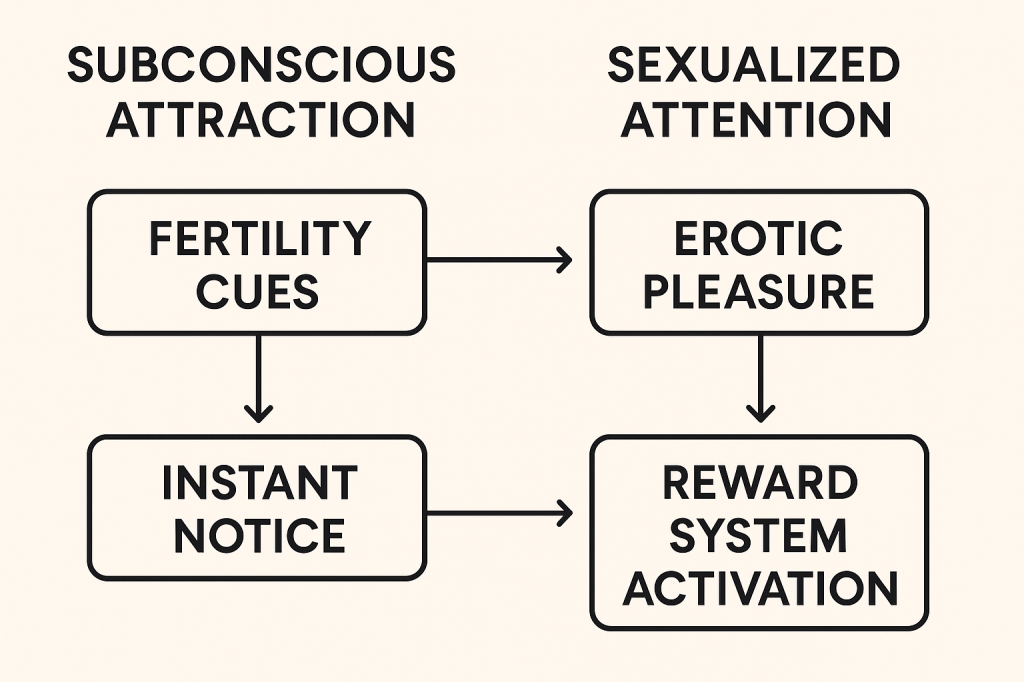
Subconscious attraction and sexualized attention
- Subconscious Attraction
This is biologically hardwired.
The brain unconsciously interprets certain physical features (breasts, waist-to-hip ratio, facial symmetry) as signals of fertility and health.
Example: A man may notice a woman’s breasts without thinking “this signals fertility”—his brain is just responding to evolutionary cues.
Key point: No sexual desire needs to be present; it’s more about assessment of reproductive fitness, like a silent “scan” for health indicators.
- Sexualized Attention
This is conscious and learned, often shaped by culture and personal experience.
The brain links breasts to erotic pleasure, intimacy, and social cues.
Example: Media, societal norms, and early sexual experiences can train the brain to treat breasts as sexually arousing objects.
Key point: This involves dopamine, oxytocin, and reward pathways, making the attention pleasurable and reinforcing.
- How They Interact
Subconscious attraction can trigger sexualized attention: noticing fertility cues unconsciously can make the brain more sensitive to sexual signals.
Sexualized attention can then amplify subconscious attraction: cultural emphasis on breasts strengthens the brain’s reward response, creating a feedback loop.

- Why Men Often Notice Breasts Instantly
The subconscious system is fast and automatic; it flags potential reproductive cues immediately.
Sexualized attention is slower and conscious, layering learned desire on top of innate biological signals.
So essentially: men notice breasts because their brain is wired to detect fertility cues, but culture and personal experience can turn that noticing into sexual focus or fixation.
sources
https://www.livescience.com/23500-why-men-love-breasts.html
https://pmc.ncbi.nlm.nih.gov/articles/PMC3210352/
https://www.scirp.org/journal/paperinformation?paperid=44845
 History of Sorts
Leave a comment