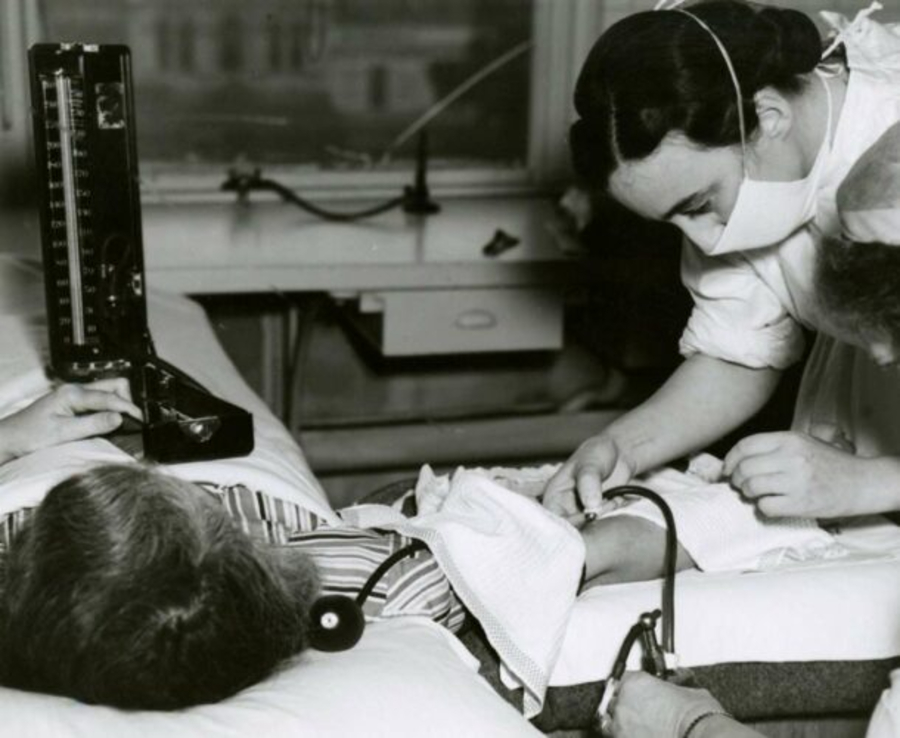
On 27 February 1941, German occupation authorities implemented a regulation in the Netherlands that prohibited Jews from donating blood. Although seemingly administrative or medical in nature, this measure formed part of a broader racial policy imposed under Nazi rule. The exclusion illustrates how ideology penetrated even humanitarian institutions and how discrimination became normalized through bureaucratic procedures during the occupation.
Historical Context: Occupation and Nazification
Following the German invasion in May 1940, the Netherlands came under the authority of Reichskommissariat Niederlande, the civilian occupation regime established by Nazi Germany. The territory was governed by Reich Commissioner Arthur Seyss-Inquart, whose administration sought to align Dutch society with Nazi racial ideology.
Unlike in some occupied regions where repression escalated gradually through military necessity, policies in the Netherlands were systematically reorganized according to the Nazi conception of Volksgemeinschaft — a racially defined national community. Jews were progressively excluded from public life through registration laws, professional bans, segregation, and ultimately deportation.
The exclusion from blood donation emerged during this early phase of institutional segregation, when authorities were restructuring social and civic organizations along racial lines.
Blood Donation and Racial Ideology
Blood held symbolic and pseudo-scientific importance within Nazi thought. Nazi racial theory equated biological blood with national purity and identity. Consequently, the mixing of Jewish and “Aryan” blood was portrayed as dangerous — not medically, but ideologically.
The prohibition on Jewish blood donors therefore did not arise from medical evidence. Modern transfusion science already recognized compatibility through blood groups rather than ethnicity. Instead, the policy reflected racial dogma: Jewish blood was deemed biologically and morally contaminating according to Nazi propaganda.
In practical terms, this meant that Jewish volunteers — many of whom had previously participated in humanitarian medical services — were suddenly excluded regardless of health, willingness, or medical suitability.
Implementation in Dutch Institutions
The measure affected organizations such as the Netherlands Red Cross, which had previously operated on principles of neutrality and humanitarian service. Under occupation pressure, institutions were compelled to comply with German directives.
The exclusion functioned through bureaucratic mechanisms:
Jewish identity had already been recorded through compulsory registration.
Donor lists were screened and revised.
Jewish donors were formally removed or prevented from participating.
Medical cooperation became conditional upon racial classification.
This bureaucratic process was significant because discrimination appeared procedural rather than openly violent. Administrative compliance helped normalize exclusion and reduced opportunities for resistance within professional settings.
Social and Psychological Consequences
Although less visibly brutal than later deportations, the ban carried profound symbolic weight. Blood donation was widely understood as an altruistic civic act — a contribution to collective welfare. Excluding Jews sent a clear message: they were no longer considered members of Dutch society.
The policy reinforced several broader effects:
Dehumanization – Jews were portrayed as biologically incompatible with the national body.
Isolation – everyday interactions between Jewish and non-Jewish citizens were reduced.
Gradual Radicalization – small exclusions conditioned society to accept increasingly severe measures.
Historians often emphasize that such incremental policies prepared administrative systems and public attitudes for later persecution, including deportations beginning in 1942.
Connection to Wider Anti-Jewish Measures
The February 1941 exclusion occurred amid escalating tensions in Dutch cities, especially Amsterdam, where anti-Jewish regulations and violence provoked unrest. Within days, mass protests and strikes would erupt against German policies — demonstrating that segments of Dutch society recognized the discriminatory trajectory unfolding.
The blood donor ban therefore should not be viewed in isolation. It belonged to a coordinated pattern that included:
dismissal of Jews from public employment,
segregation in education and public spaces,
economic dispossession,
and eventual deportation to extermination camps.
Each measure incrementally redefined Jews from citizens into outsiders.
Historical Significance
The exclusion of Jews as blood donors illustrates how genocide begins not only with violence but with administrative exclusion justified through ideology. By transforming humanitarian medicine into an instrument of racial policy, Nazi authorities demonstrated how scientific language and bureaucratic routines could be weaponized.
For historians, this episode reveals three critical dynamics:
Medicalization of racism — pseudo-science legitimized discrimination.
Institutional complicity under occupation — organizations often complied under coercion or adaptation.
Normalization through small steps — seemingly minor policies prepared society for far more radical persecution.
The 27 February 1941 prohibition on Jewish blood donation in the Netherlands was far more than a medical regulation. It represented the intrusion of Nazi racial ideology into one of society’s most humanitarian practices. By excluding Jews from an act symbolizing shared humanity and civic solidarity, the occupation authorities advanced a broader project of exclusion that ultimately facilitated persecution and genocide.
Studying such measures underscores an important historical lesson: discrimination often begins through administrative decisions that appear technical or limited but carry profound moral and social consequences.
sources
https://www.annefrank.org/en/timeline/147/all-jews-need-to-register/
https://kampwesterbork.nl/en/history/second-world-war/anti-jewish-measures
https://www.oorlogsbronnen.nl/thema/Uitsluiting%20van%20Joden%20als%20bloeddonor
Donation
Your readership is what makes my site a success, and I am truly passionate about providing you with valuable content. I have been doing this at no cost and will continue to do so. Your voluntary donation of $2 or more, if you are able, would be a significant contribution to the continuation of my work. However, I fully understand if you’re not in a position to do so. Your support, in any form, is greatly appreciated. Thank you. To donate, click on the credit/debit card icon of the card you will use. If you want to donate more than $2, just add a higher number in the box left from the PayPal link. Your generosity is greatly appreciated. Many thanks.
$2.00
 History of Sorts
Leave a comment